
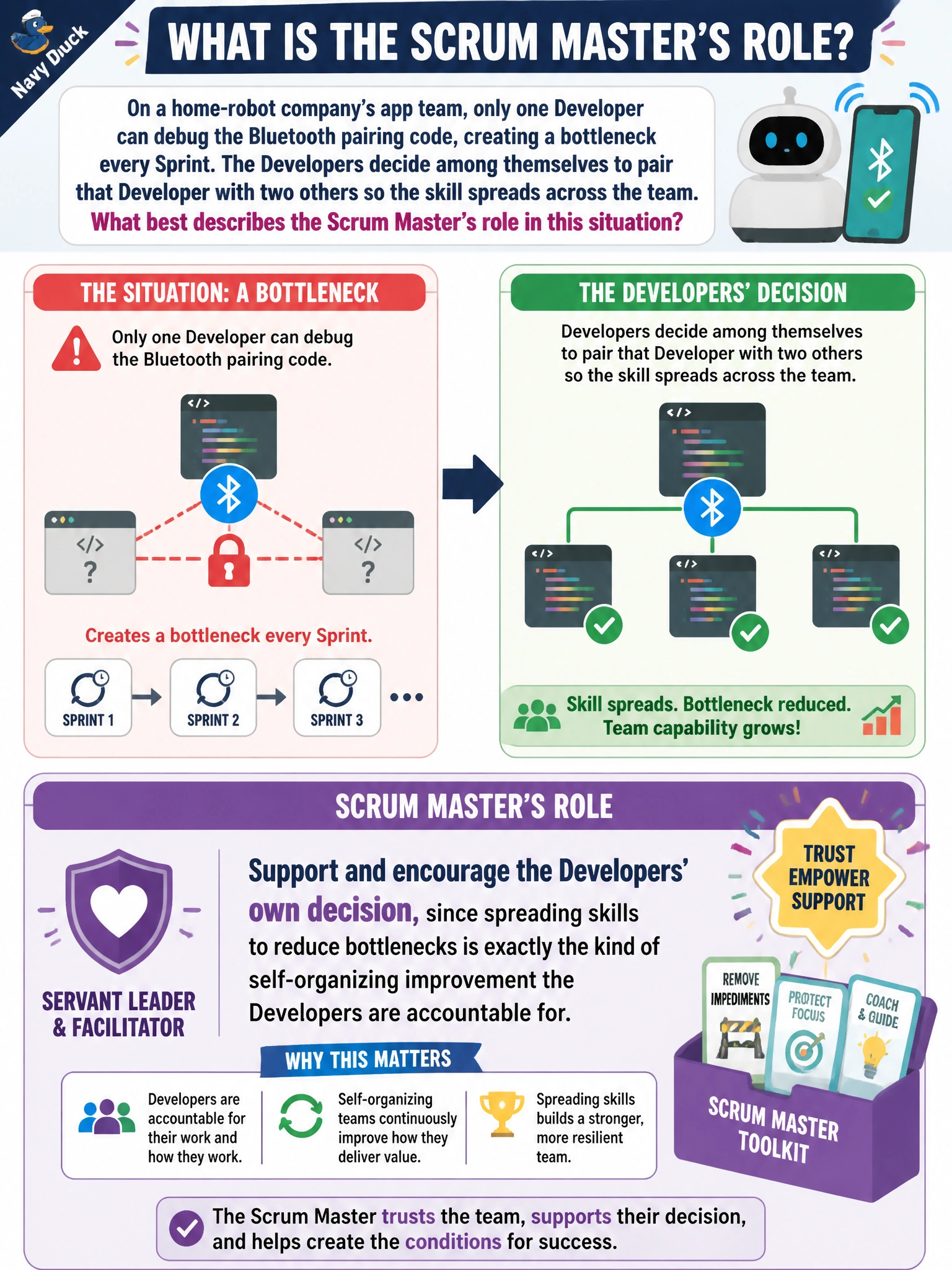
On a home-robot company's app team, only one Developer can debug the Bluetooth pairing code, creating a bottleneck every Sprint. The Developers decide among themselves to pair that Developer with two others so the skill spreads across the team. What best describes the Scrum Master's role in this situation?
Select an answer to reveal the explanation.
Short Explanation
When the team spots its own bottleneck and comes up with its own fix, the best thing the Scrum Master can do is get out of the way and cheer it on. This kind of skill-spreading is self-management doing exactly what it's supposed to do — the team improving itself without waiting for permission.
Full Explanation
Reducing a single-person bottleneck by deliberately spreading a scarce skill is a self-organizing improvement the Developers are both capable of and accountable for, and the Scrum Master's most useful contribution is to support that initiative — removing any obstacles to it and reinforcing that this is exactly the kind of continuous improvement Scrum encourages — rather than taking it over. Scheduling and leading the pairing sessions shifts ownership of an internal team decision to the Scrum Master, which isn't necessary and can quietly undercut the very self-management the team just demonstrated. Choosing which two Developers get paired substitutes the Scrum Master's judgment for the team's own, even though the team already made a sound decision without needing that input. Waiting for a formal Retrospective action item ties useful, timely improvement to a specific ceremony unnecessarily — the Scrum Guide doesn't require every improvement to originate in or wait for the Retrospective, and a bottleneck fix identified mid-Sprint doesn't need to be shelved until then. An operational check: when Developers propose and begin their own improvement, ask whether Scrum Master involvement would add support (removing obstacles, encouragement) or add control (deciding details the team already decided) — aim for the former.