
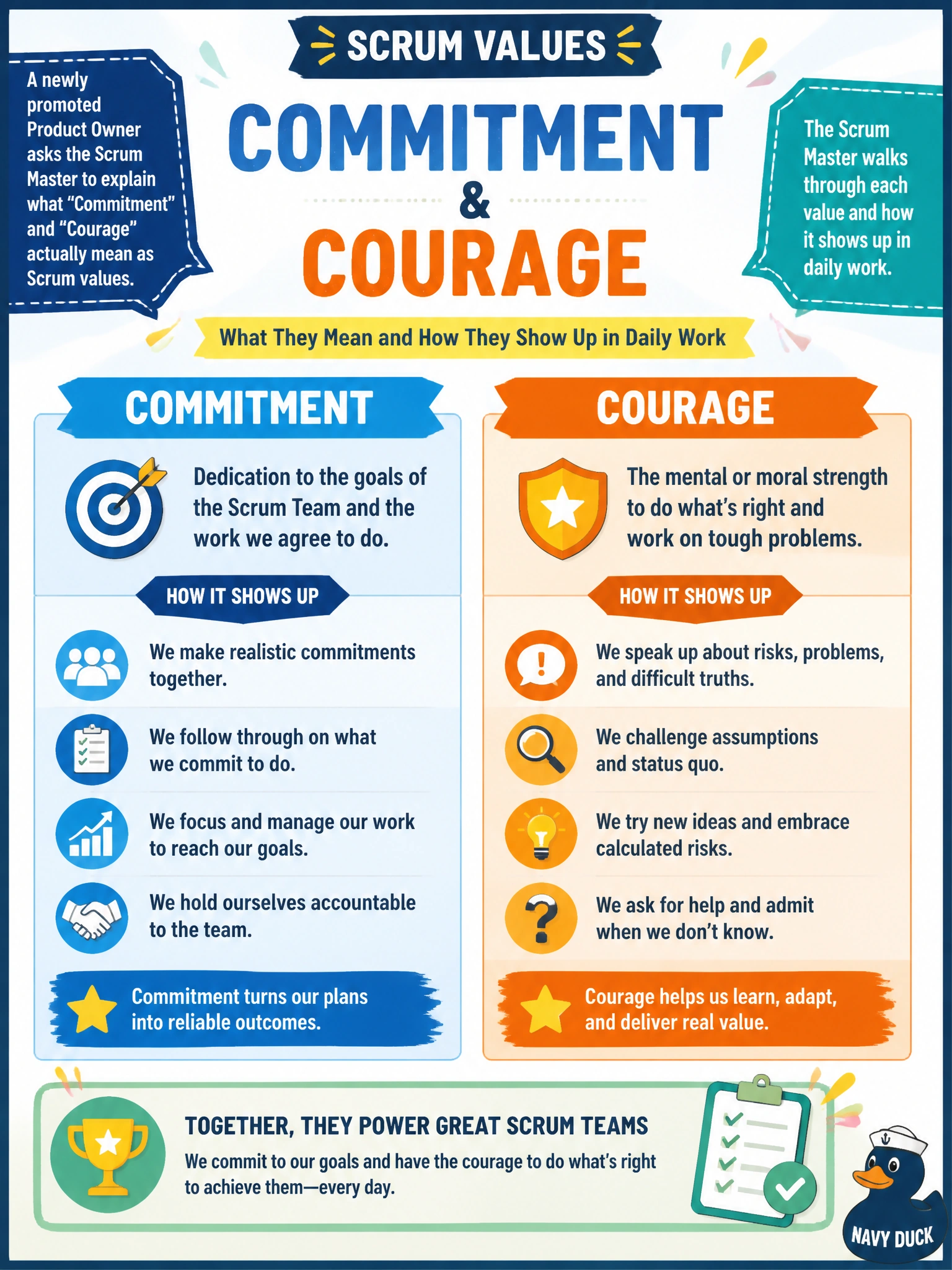
A newly promoted Product Owner at the robot company asks the Scrum Master to explain what "Commitment" and "Courage" actually mean as Scrum values, since they've only heard the terms in passing. The Scrum Master walks through each value and how it shows up in daily work. Which stance is this?
Select an answer to reveal the explanation.
Short Explanation
Someone asked a plain "what does this mean" question, and the answer is a plain explanation — that's teaching. There's no puzzle here for the Product Owner to solve on their own; they just need the concept laid out clearly.
Full Explanation
Teaching fits situations where a person is missing foundational knowledge and needs it explained directly, which is exactly what's happening when a new Product Owner asks what two named Scrum values actually mean. Walking through the definitions and how they show up day to day is a direct transfer of conceptual knowledge, the hallmark of teaching. Coaching would instead involve asking the Product Owner open questions to help them arrive at their own understanding of the values, which doesn't match a request for a straightforward explanation of terms they've never learned. Consulting implies being asked for expert judgment on a specific business decision or problem, not explaining a shared framework concept — there's no decision being made here, just a knowledge gap being closed. Facilitating would apply to structuring a group conversation or event, but this is a one-to-one explanation with no group process involved. An operational check for a Scrum Master: when the question is essentially "what does this term mean," a direct explanation (teaching) usually serves the person faster and more honestly than turning it into a guessing exercise.