
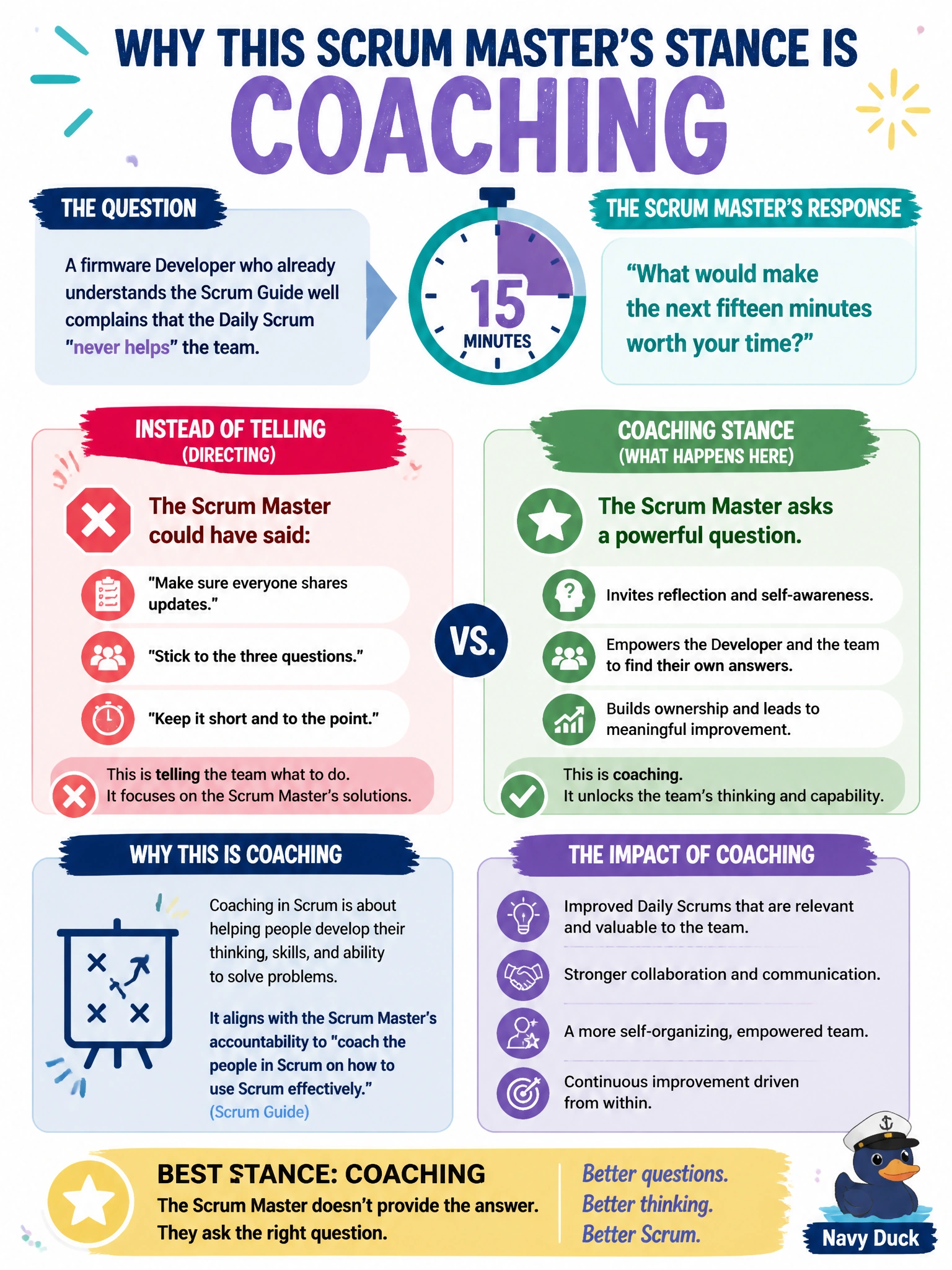
A firmware Developer who already understands the Scrum Guide well complains that the Daily Scrum "never helps" the team. Instead of telling the Developer what to change, the Scrum Master asks, "What would make the next fifteen minutes worth your time?" Which stance best describes this?
Select an answer to reveal the explanation.
Short Explanation
The Developer already has the knowledge — what's missing is a nudge to use it. Asking a sharp, open question instead of handing over an answer is coaching: it trusts the person to find their own fix and just points them at the door.
Full Explanation
Coaching uses open questions to help someone who already has relevant knowledge or experience find their own answer, rather than supplying the answer directly. Here the Developer understands Scrum well enough to know something feels off about the Daily Scrum; the Scrum Master's question is designed to surface the Developer's own insight about what would make it useful, which is the hallmark of coaching. Teaching is the wrong label because there's no missing factual knowledge to transfer — the Developer isn't confused about what the Daily Scrum is, so explaining the concept again wouldn't address the actual complaint. Mentoring is close but distinct: mentoring typically involves the Scrum Master sharing their own relevant experience or expertise from having faced a similar situation before, whereas the scenario shows a question with no experience being shared. Directing is wrong because the Scrum Master doesn't tell the Developer or the team what to change; a directive response would sound like "try this format instead," not an open question. A practical check: if the helper's sentence ends in a question mark and offers no answer, it's more likely coaching; if it ends with a specific recommendation drawn from lived experience, that leans toward mentoring.