
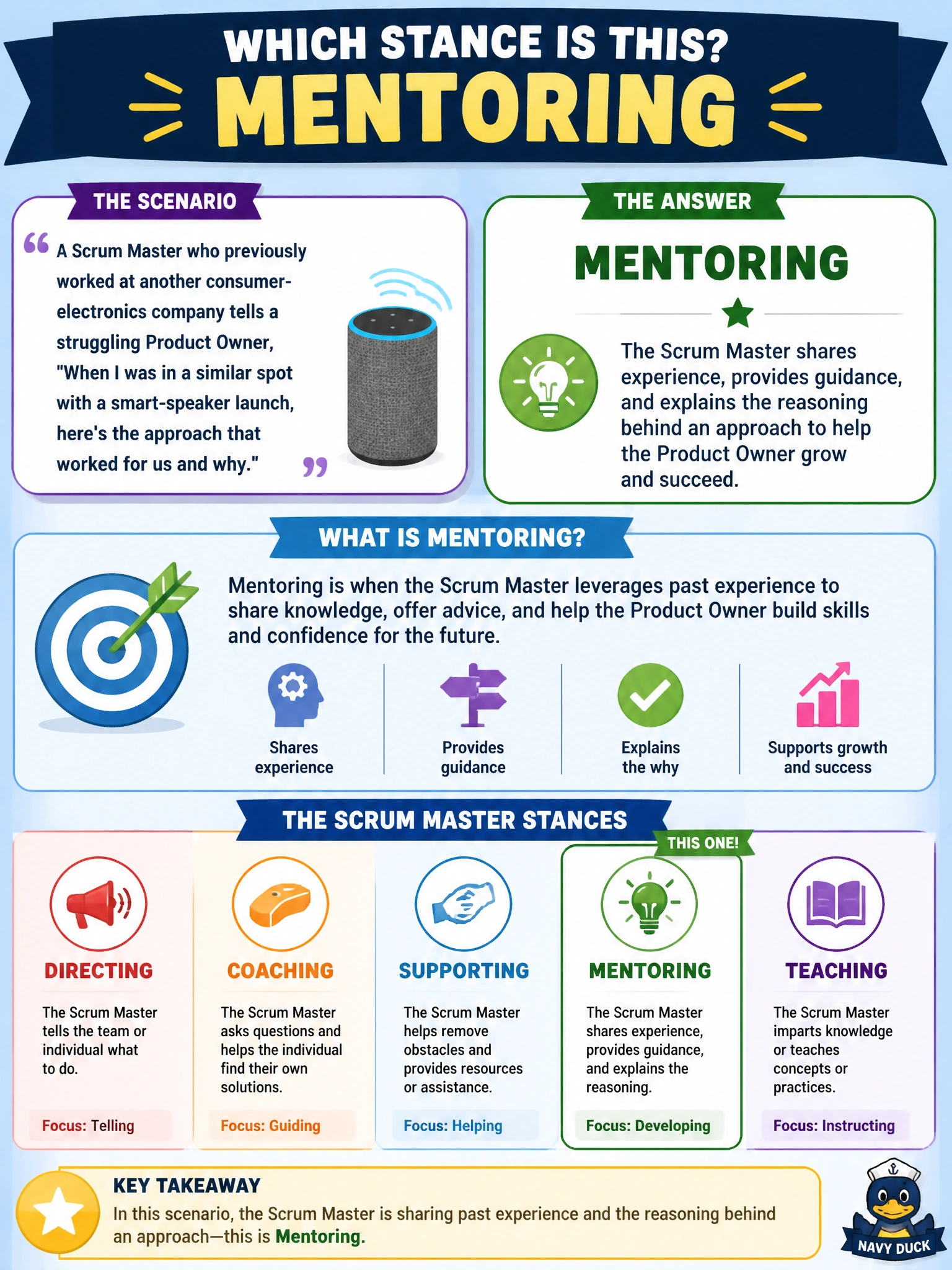
A Scrum Master who previously worked at another consumer-electronics company tells a struggling Product Owner, "When I was in a similar spot with a smart-speaker launch, here's the approach that worked for us and why." Which stance is this?
Select an answer to reveal the explanation.
Short Explanation
Sharing a story from your own past experience to help someone navigate a similar spot they're in now — that's mentoring, plain and simple. It's less about the framework's rules and more about passing along lived experience: what worked before, and what to watch out for this time.
Full Explanation
Mentoring involves sharing relevant personal or professional experience to help someone navigate a situation, drawing on "here's what I've seen work" rather than pure open questioning or framework explanation. The scenario is a clean example: the Scrum Master recounts a specific past situation and the approach that worked, offering it as a reference point for the Product Owner's current challenge. Facilitating is wrong because there's no group event or structured conversation being run here — this is a one-to-one exchange of experience, not shaping a meeting's process. Coaching is a near-miss but doesn't fit because coaching centers on questions that help the other person find their own answer, while this exchange is built entirely around the Scrum Master supplying an answer drawn from lived experience. Teaching is also a near-miss but implies transferring general conceptual knowledge (like explaining what a Product Goal is), not recounting a specific past experience and its outcome. A useful check: ask whether the help being offered could only come from someone who had personally lived through something similar — if so, that's usually mentoring rather than teaching or coaching.