
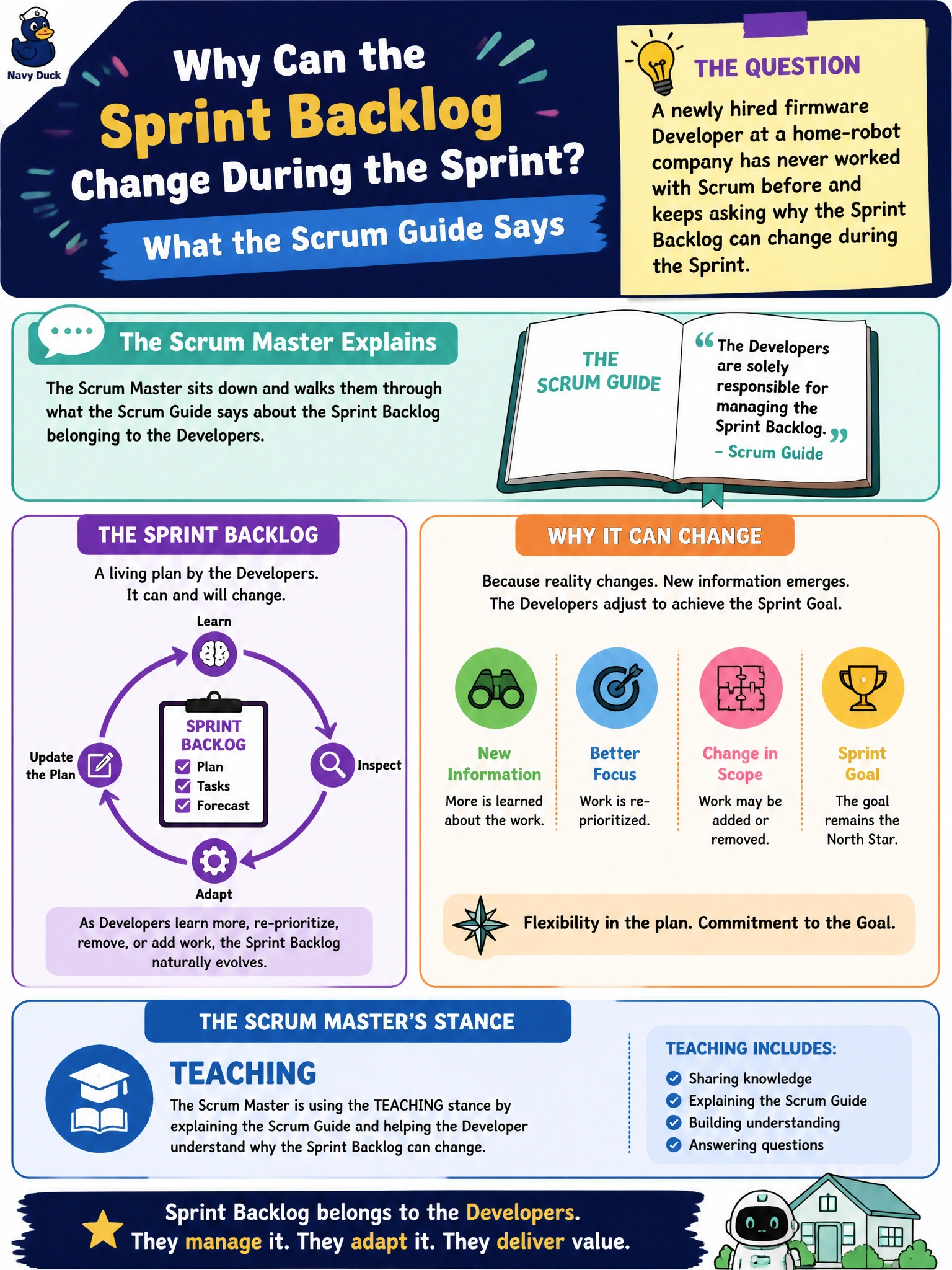
A newly hired firmware Developer at a home-robot company has never worked with Scrum before and keeps asking why the Sprint Backlog can change during the Sprint. The Scrum Master sits down and walks them through what the Scrum Guide says about the Sprint Backlog belonging to the Developers. Which stance is the Scrum Master using?
Select an answer to reveal the explanation.
Short Explanation
When someone doesn't know a concept yet, you don't ask leading questions and hope they discover it — you just tell them, clearly, like explaining a house rule to a new roommate. That direct transfer of knowledge is teaching, and it's exactly the right tool for a brand-new team member who's missing the basics.
Full Explanation
Teaching is the transfer of specific knowledge — in this case, explaining what the Scrum Guide actually says about the Sprint Backlog being owned and updated by the Developers throughout the Sprint. It fits best when someone lacks foundational information they simply haven't been exposed to yet, which is exactly the situation with a brand-new Developer unfamiliar with Scrum. Coaching is the wrong label because coaching typically draws out answers the person or team could reason to themselves through questions, whereas here the Developer has no prior exposure to the concept to draw on — there's nothing to elicit yet. The second distractor swaps the subject matter: teaching Scrum concepts is not the same as teaching firmware coding technique, and the scenario is clearly about the former. Consulting implies being brought in to solve a specific problem or give expert recommendations on a business matter, which doesn't match a Scrum Master explaining a framework concept to a teammate. An operational check: if the person being helped has zero prior exposure to the concept, teaching usually comes first; once they have the basics, coaching questions become more useful for helping them apply it.