
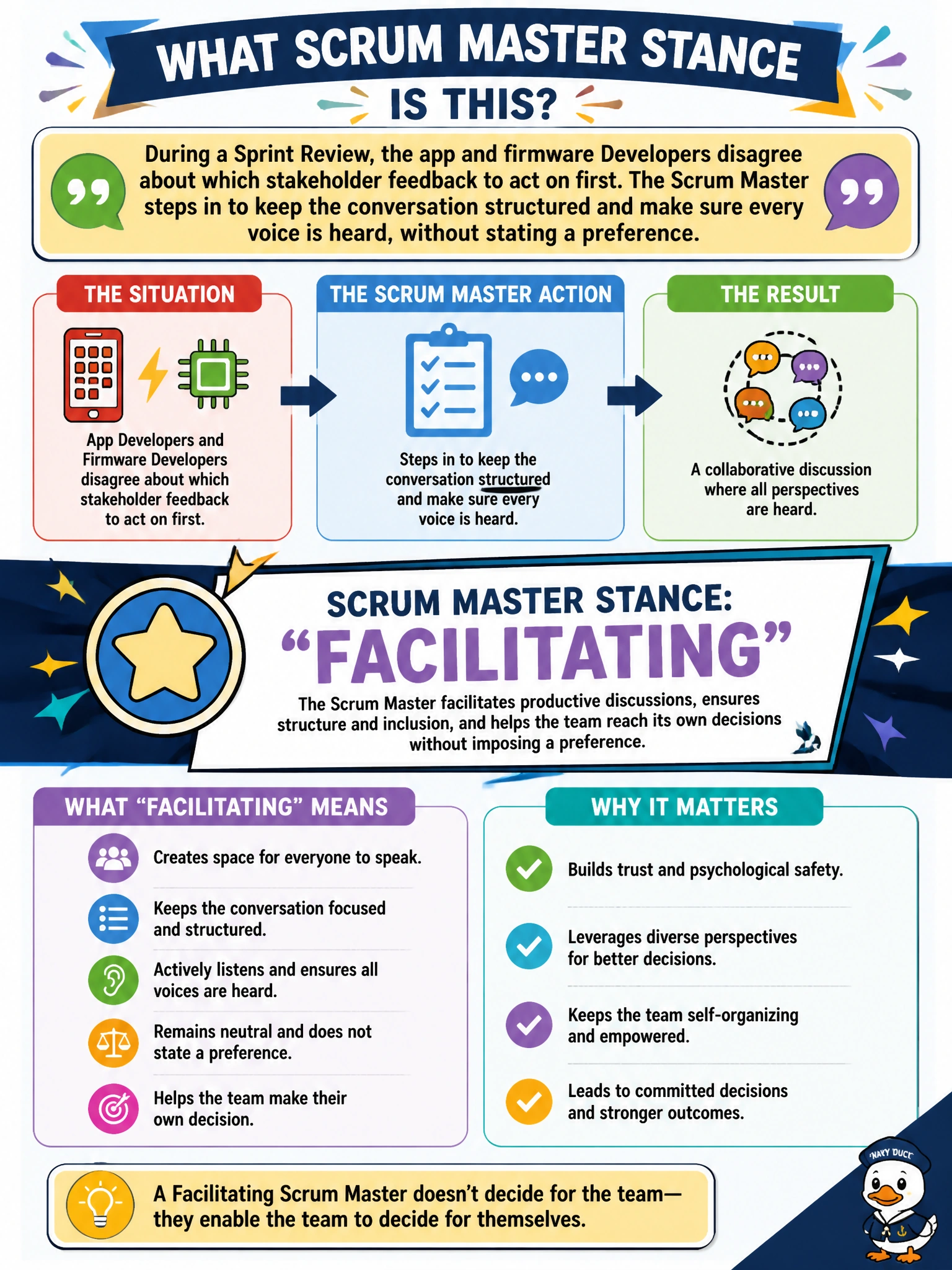
During a Sprint Review, the app and firmware Developers disagree about which stakeholder feedback to act on first. The Scrum Master steps in to keep the conversation structured and make sure every voice is heard, without stating a preference. Which Scrum Master stance is this?
Select an answer to reveal the explanation.
Short Explanation
Picture someone holding the door open at a busy meeting and making sure the conversation doesn't get hijacked by the loudest voice — that's facilitation. It's about shaping the process so the group can reach its own decision, not about picking the answer for them.
Full Explanation
Facilitating means structuring a conversation or event so a group can reach its own outcome — setting a clear format, drawing out quieter voices, keeping time, and staying neutral on the content of the decision itself. A Scrum Master who keeps a Sprint Review conversation orderly without pushing toward a particular stakeholder priority is doing exactly that: shaping how the group decides, not what it decides. "Directing" fails because it implies telling the Developers what to do or which feedback wins, which the scenario explicitly rules out by describing a Scrum Master who states no preference. "Managing" fails because Scrum has no management-of-people function for the Scrum Master; managing implies authority over the Developers' choices that the accountability doesn't grant. "Arbitrating" implies the Scrum Master is settling the disagreement by ruling on it, which is different from keeping a structured conversation moving so the team and stakeholders settle it themselves. A useful check for a Scrum Master reviewing their own behavior: after the event, could a bystander tell what you personally think should happen next? If yes, that's a sign the stance drifted from facilitating toward directing.