
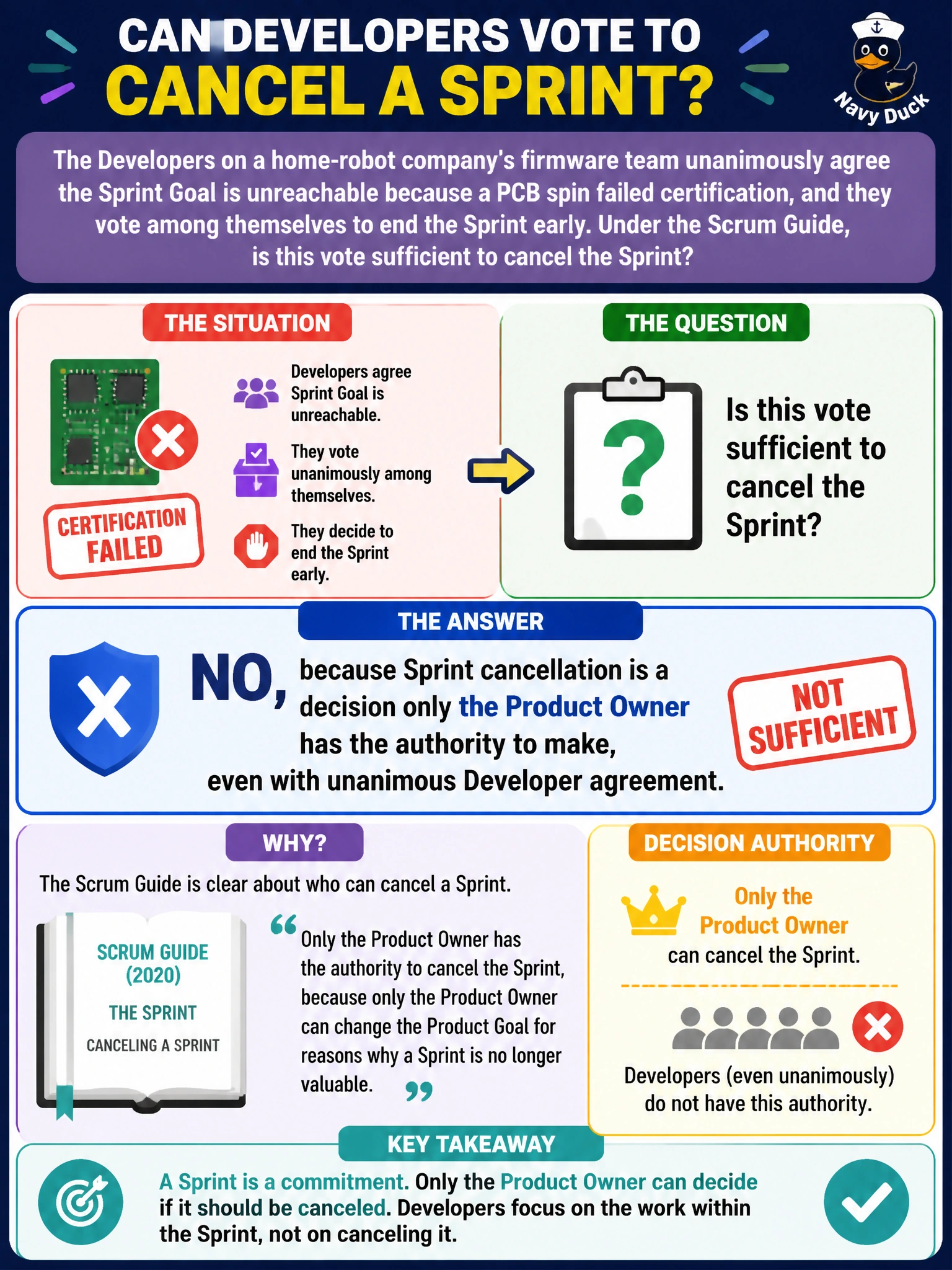
The Developers on a home-robot company's firmware team unanimously agree the Sprint Goal is unreachable because a PCB spin failed certification, and they vote among themselves to end the Sprint early. Under the Scrum Guide, is this vote sufficient to cancel the Sprint?
Select an answer to reveal the explanation.
Short Explanation
Even a room full of people agreeing doesn't change who holds the pen here. Self-management covers how the Developers do their work inside the Sprint, not whether the Sprint itself keeps running — that call stays with the Product Owner alone. A unanimous vote is still a vote nobody but the Product Owner is entitled to cast.
Full Explanation
The Scrum Guide is specific that only the Product Owner has the authority to cancel a Sprint, and it names no exception for unanimous agreement among the Developers. Self-management for the Developers concerns deciding who does what, when, and how within the Sprint Backlog — it does not extend to overriding the framework's assigned authorities, and cancellation is precisely one of those authorities reserved to a single accountability. Claiming unanimous agreement overrides that authority misreads how Scrum's accountabilities work: they aren't a majority-rule system, and a vote among Developers, however unanimous, doesn't transfer a Product Owner's authority to them. A failed PCB certification making the Sprint Goal unreachable is exactly the kind of information the Developers should raise immediately, likely through the Product Owner or via the Daily Scrum, but raising it is different from acting on it themselves. It is also not true that a Sprint can never end early for any reason — cancellation is a defined, if rare, mechanism precisely for situations like this; the flaw in that option isn't that Sprints can't end early, it's the reasoning given. A concrete check: if Developers believe a Sprint should be cancelled, the appropriate move is to surface it to the Product Owner promptly, not to treat their own consensus as the decision.