
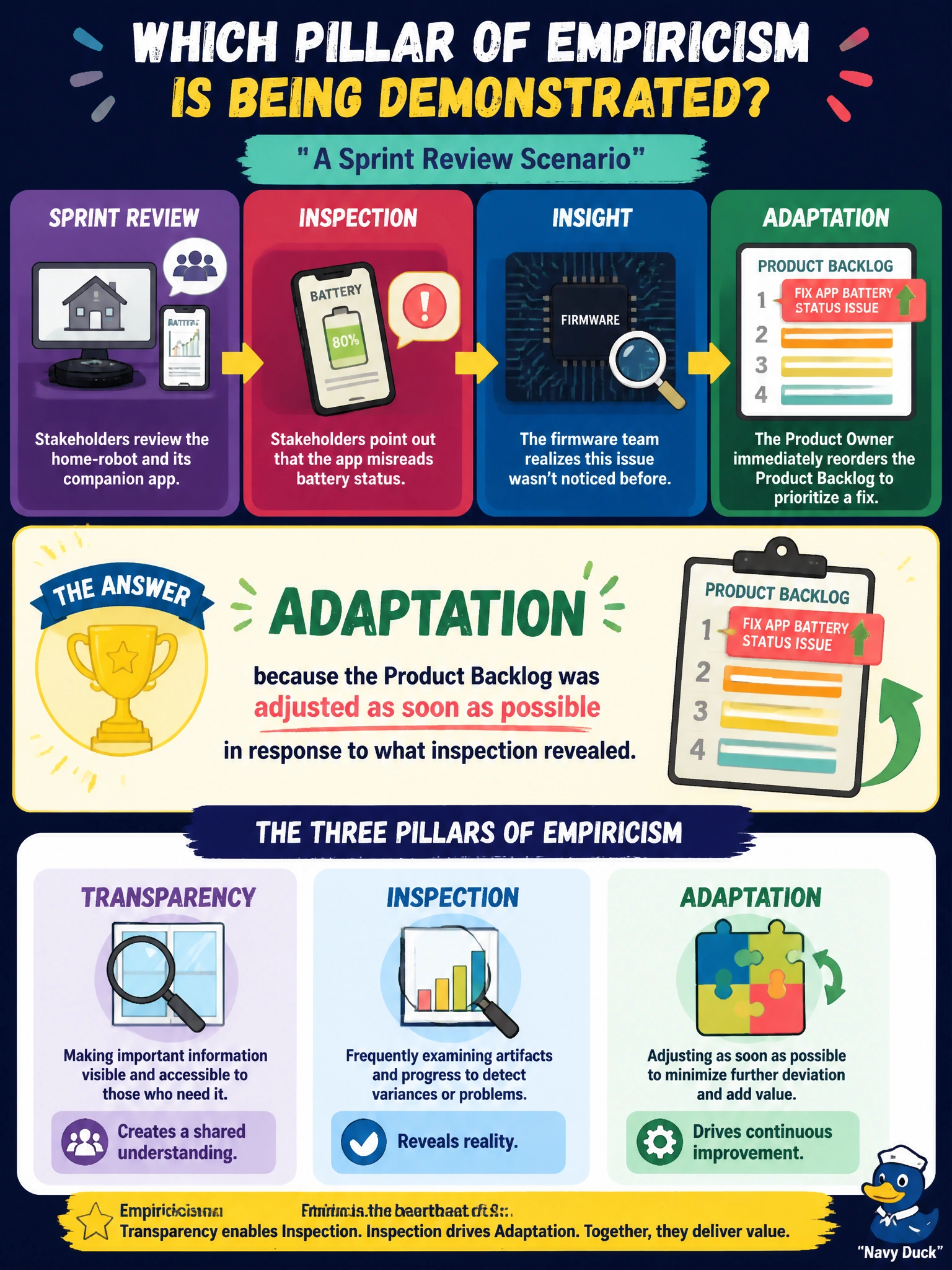
At a Sprint Review, stakeholders point out that the home-robot's companion app misreads battery status in a way the firmware team hadn't noticed. The Product Owner immediately reorders the Product Backlog to prioritize a fix. Which pillar of empiricism does the Product Owner's action demonstrate?
Select an answer to reveal the explanation.
Short Explanation
Noticing a problem is only half the empiricism loop — acting on it is the other half. The Product Owner reordering the backlog right away, based on what just came out of the Sprint Review, is adaptation in its purest form: adjust as soon as possible once you see something's off.
Full Explanation
Adaptation is the pillar that closes the empirical loop: when inspection reveals that an aspect of the process or product deviates outside acceptable limits, an adjustment must be made as soon as possible to minimize further deviation. Here, the stakeholders' observation is the inspection event, and the Product Owner's immediate reordering of the Product Backlog is the adjustment — a textbook adaptation. Naming the moment 'transparency' misidentifies which pillar is in play; transparency was already at work simply by the Increment being visible enough at the Sprint Review for stakeholders to notice the misread battery status, but the visibility itself isn't the Product Owner's reordering action. Crediting 'inspection' to the stakeholders' noticing is closer but still describes the wrong half of the sequence — inspection is the looking, and the question asks about the response that followed it. 'Scaling' isn't one of the three empirical pillars at all; it refers to how multiple Scrum Teams coordinate around one Product Backlog, which is unrelated to what just happened in this scenario. A concrete check: whenever a Sprint Review surfaces new information, look for whether the Product Backlog visibly changes afterward — that change is the adaptation, and its absence would mean the inspection led nowhere.