
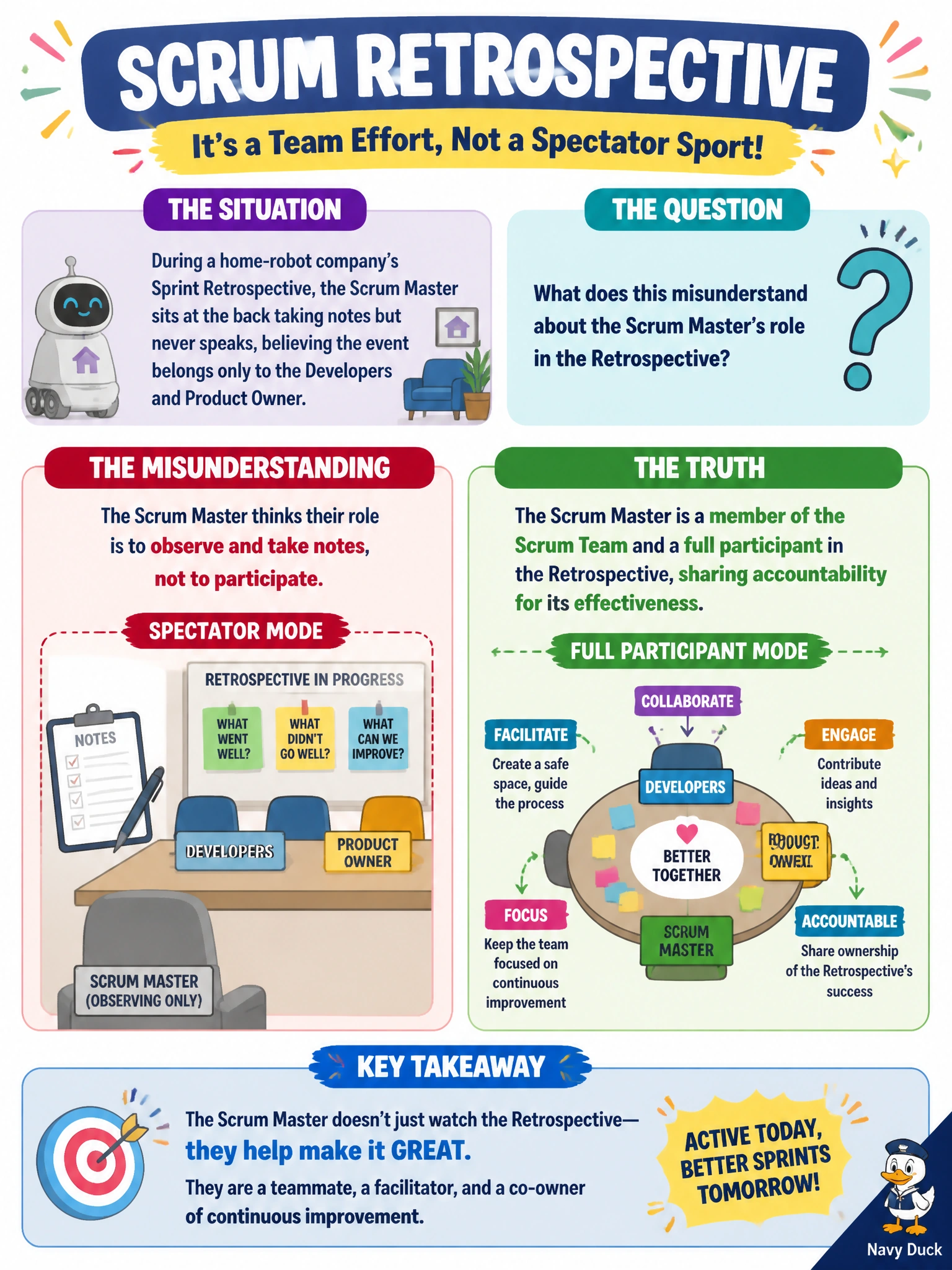
During a home-robot company's Sprint Retrospective, the Scrum Master sits at the back taking notes but never speaks, believing the event belongs only to the Developers and Product Owner. What does this misunderstand about the Scrum Master's role in the Retrospective?
Select an answer to reveal the explanation.
Short Explanation
The Scrum Master isn't a fly on the wall at the Retrospective — they're on the team, in the room, with skin in the game. Their job is to make sure the event is productive and positive, which is hard to do from the back row in silence. Being present and engaged is part of the point, not an intrusion on it.
Full Explanation
The Scrum Guide describes the Scrum Master as a member of the Scrum Team, accountable for establishing Scrum and for the Scrum Team's effectiveness, which extends to ensuring the Sprint Retrospective actually happens and is a productive, positive, and useful event. That accountability is inconsistent with treating the Retrospective as belonging exclusively to the Product Owner and Developers while the Scrum Master merely observes — the Scrum Master is expected to participate as a peer, contribute their own perspective on the Sprint, and help the team find real improvements, not just document what others say. Running it as a top-down status meeting swaps facilitation for command, which contradicts the Scrum Master's servant-leadership stance; the Retrospective is a peer conversation, not a report-up. Skipping it and leaving it entirely to the Developers ignores that this is one of the Scrum Team's own events and the Scrum Master shares in improving it, not just enabling others to. And attendance conditioned on a Product Owner request misreads Scrum's structure — Scrum Team membership, not an invitation, is what puts the Scrum Master in that room every Sprint. A concrete check: after a Retrospective, ask whether the Scrum Master contributed at least one observation or question, not just a set of notes.