
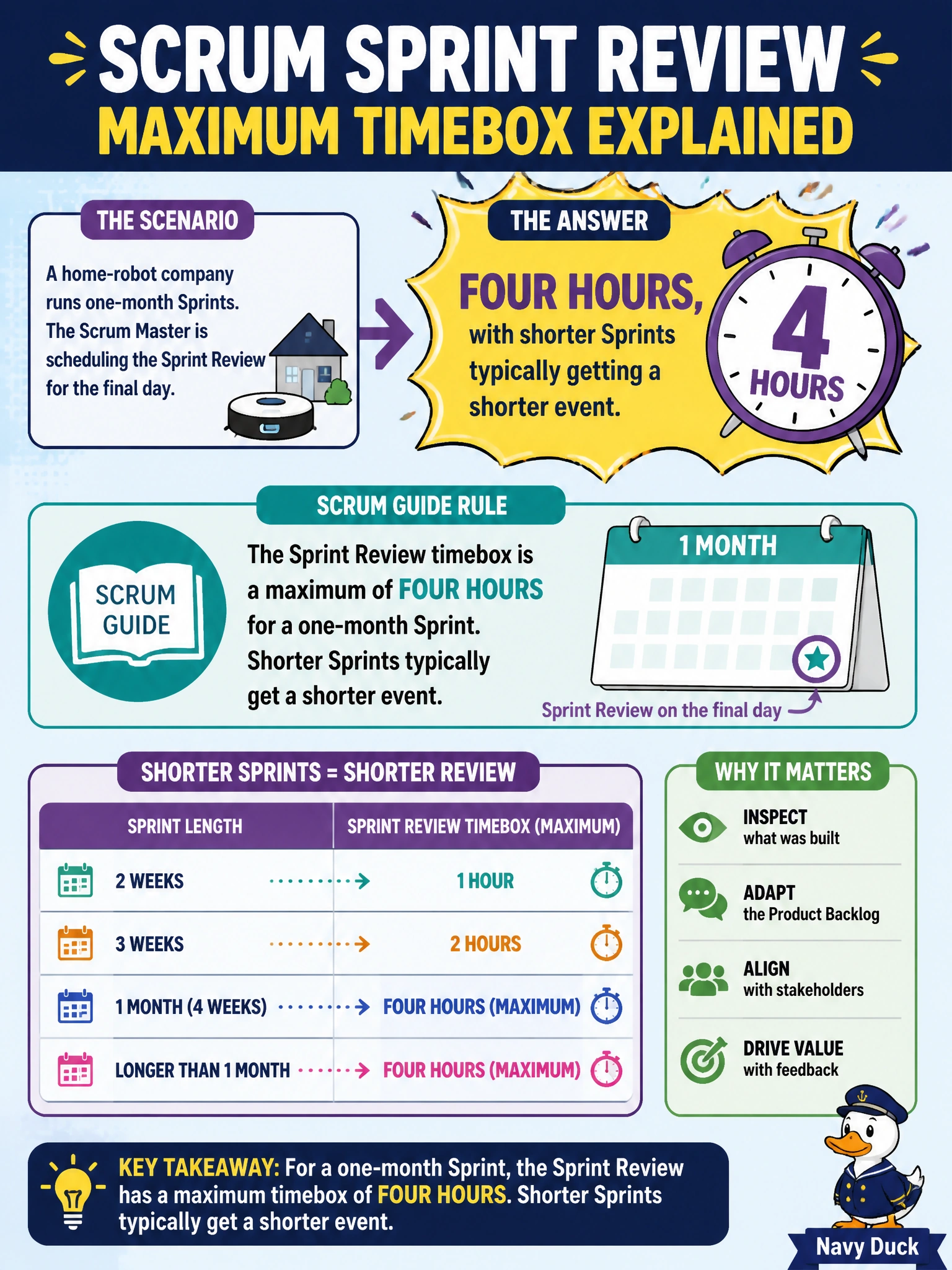
A home-robot company runs one-month Sprints. The Scrum Master is scheduling the Sprint Review for the final day. What is the maximum timebox the Scrum Guide sets for a Sprint Review at this Sprint length?
Select an answer to reveal the explanation.
Short Explanation
Every Scrum event has a ceiling, and the Sprint Review's is tied to how long the Sprint itself is. For a full one-month Sprint, that ceiling is four hours — a working session with real time to inspect and discuss, but still bounded. Shorter Sprints get a proportionally shorter Review, not an open-ended meeting.
Full Explanation
The Scrum Guide sets the Sprint Review's timebox at a maximum of four hours for a one-month Sprint, with shorter Sprints usually warranting a shorter event. This timebox exists so the Review stays a bounded, purposeful working session rather than expanding to fill whatever time stakeholders want to spend in it. One hour understates the actual maximum for a full-length Sprint and would likely be too short for genuine stakeholder collaboration on a month's worth of work. Tying it to 'half the Sprint Retrospective' invents a relationship the Guide doesn't define — the Retrospective has its own separate maximum (three hours for a one-month Sprint), and the two timeboxes aren't defined relative to each other. Treating the Review as unbounded contradicts the very idea of a timebox, which every Scrum event has; an open-ended Review would also crowd out the rest of the day the Sprint Review, Retrospective, and next Sprint Planning share around the Sprint boundary. A concrete check: when scheduling a Sprint Review for a one-month Sprint, block no more than four hours, and scale that down proportionally for two-week or one-week Sprints.