
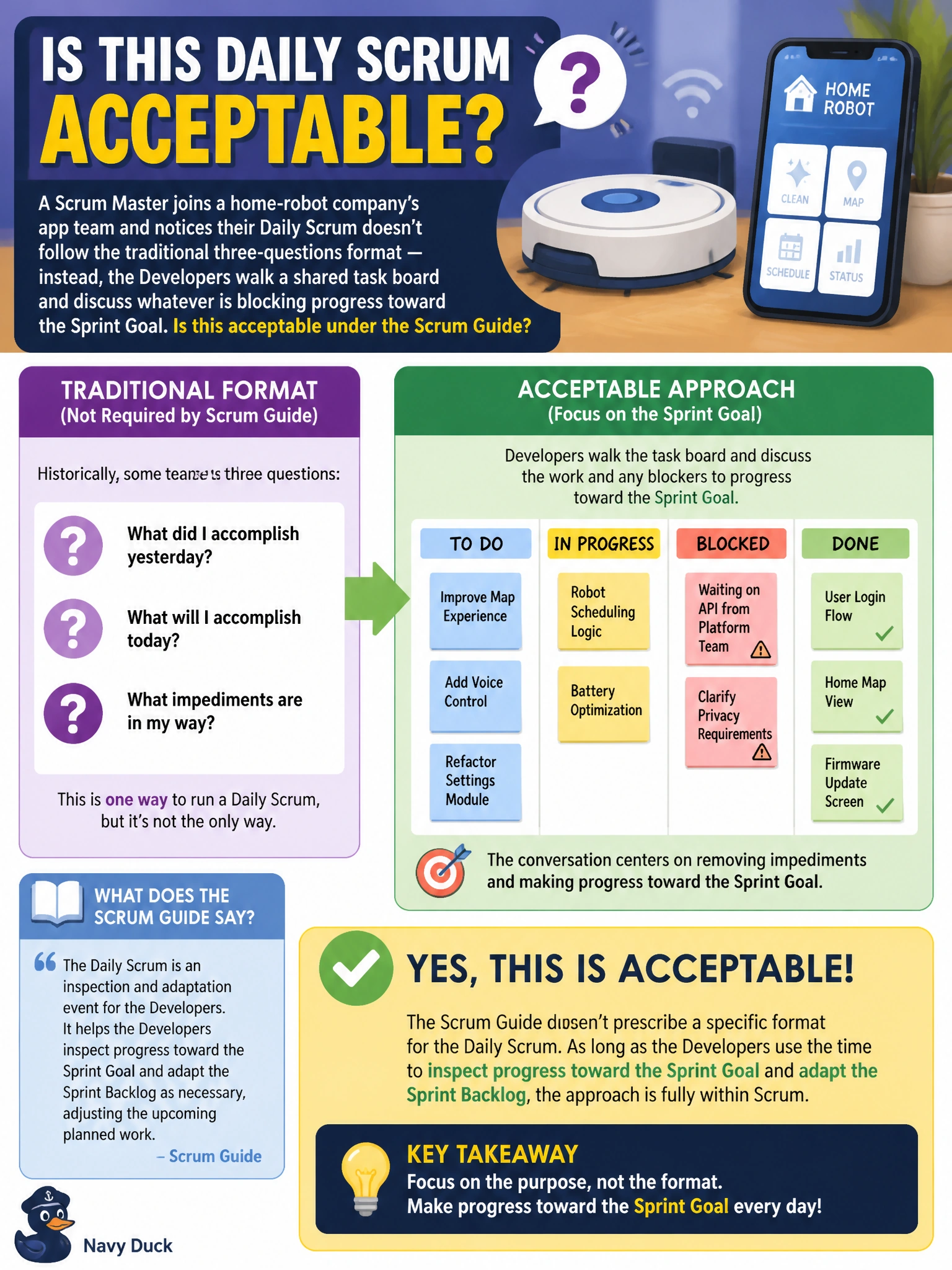
A Scrum Master joins a home-robot company's app team and notices their Daily Scrum doesn't follow the traditional three-questions format — instead, the Developers walk a shared task board and discuss whatever is blocking progress toward the Sprint Goal. Is this acceptable under the Scrum Guide?
Select an answer to reveal the explanation.
Short Explanation
There's no single script the Daily Scrum has to follow — the old three-questions routine is one option among many, not a rule carved into Scrum itself. Walking a task board and talking through blockers toward the Sprint Goal fits the actual requirement just fine. What matters is the focus, not the format.
Full Explanation
The Scrum Guide is explicit that the Daily Scrum can be conducted in different ways as long as it focuses on progress toward the Sprint Goal and produces an actionable plan for the next day of work; the three-questions structure is offered only as one example a team might use, never as a mandate. A team walking a shared task board and discussing blockers is squarely within that flexibility, since the conversation is still anchored on Sprint Goal progress. Claiming the three-questions format is required treats a commonly taught example as a rule the Guide doesn't actually impose - this is a well-known misconception worth actively unlearning. Requiring a stand-up posture facing a board invents a physical-format requirement that has nothing to do with the Guide's actual criteria. Requiring Scrum Master pre-approval of the format introduces an approval gate the Guide doesn't describe; the Developers own how they conduct their own event. Caveat: whatever format a team chooses, the event still has to stay within its 15-minute timebox and keep the focus on the Sprint Goal, not turn into open-ended problem-solving. Operational check: ask whether a new Developer joining the team could learn the current Daily Scrum format in a sentence or two - if the format is that simple and it still surfaces blockers, it's working.