
A home-robot company's firmware team holds its Daily Scrum at a different time each day depending on who's free, and sometimes skips it if the room is booked. What guidance does the Scrum Guide give about when and where the Daily Scrum should happen?
Select an answer to reveal the explanation.
Short Explanation
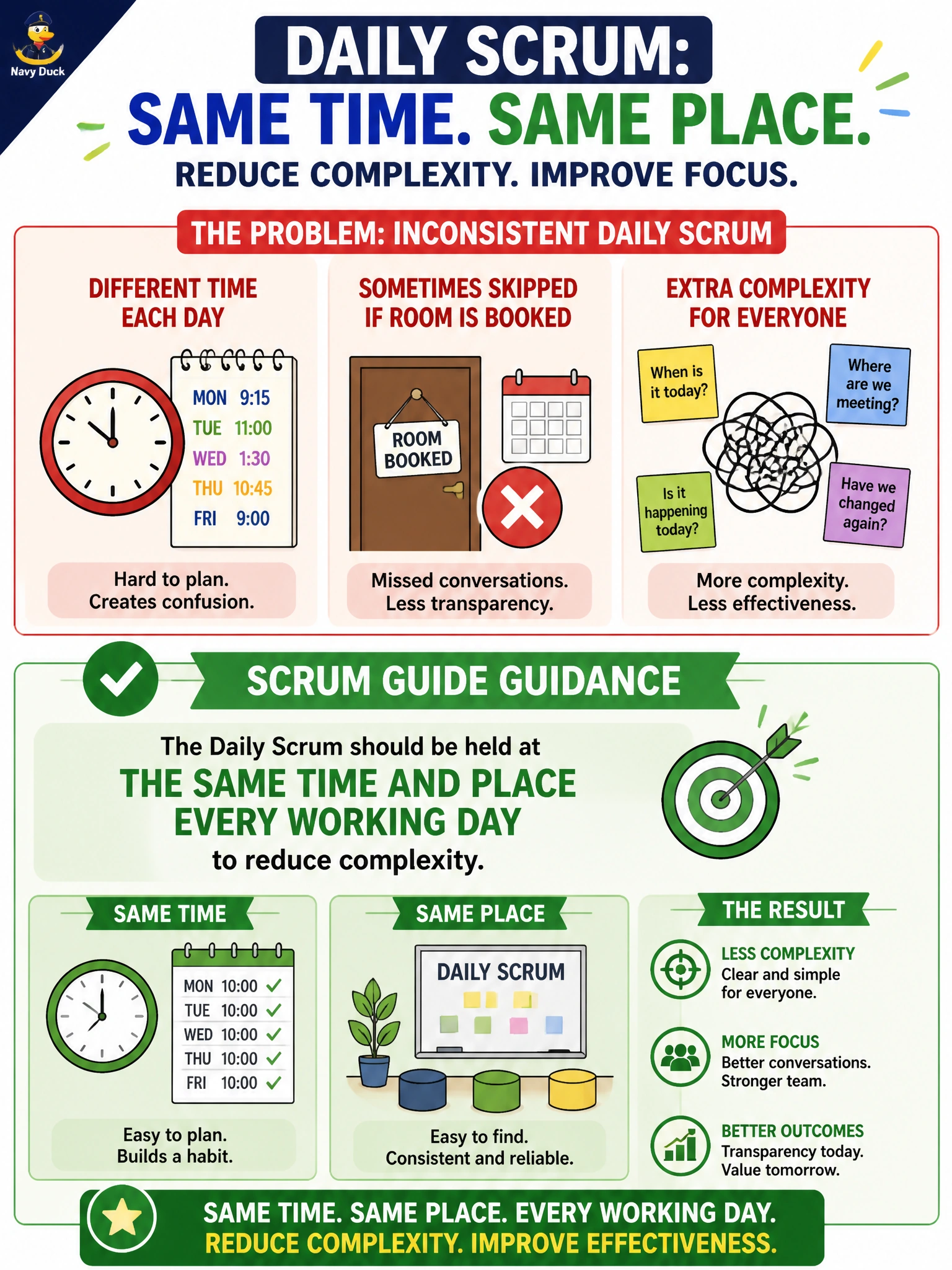
Same time, same place, every working day — that consistency is a deliberate design choice, not a scheduling afterthought. Keeping the Daily Scrum predictable cuts down on the mental overhead of figuring out when and where it happens each day. A team that reshuffles it constantly is adding friction the event was built to remove.
Full Explanation
The Scrum Guide recommends holding the Daily Scrum at the same time and place every working day of the Sprint specifically to reduce complexity - a predictable slot means the Developers don't have to negotiate logistics daily on top of the actual work of inspecting progress. Skipping it when a room is booked, or moving it around based on daily availability, works against that purpose and can quietly erode the habit of checking in on the Sprint Goal at all. Scheduling around whichever Developers happen to be free that day treats attendance as the deciding factor rather than consistency, and invites the event to drift or disappear on busy days. Holding it only when there's news to report misreads its purpose - the Daily Scrum is a standing inspection point regardless of whether anything dramatic happened, and skipping quiet days removes the regular cadence that catches small problems early. Rotating time slots to share inconvenience optimizes for a fairness concern the Guide doesn't raise, at the cost of the predictability the Guide actually recommends. Caveat: "same time and place" is a recommendation to reduce complexity, not a strict rule with its own enforcement mechanism, but abandoning it has a real cost to the team's rhythm. Operational check: if a firmware team's Daily Scrum time has moved more than once or twice in a Sprint, that's worth raising as an impediment to the event's consistency.