
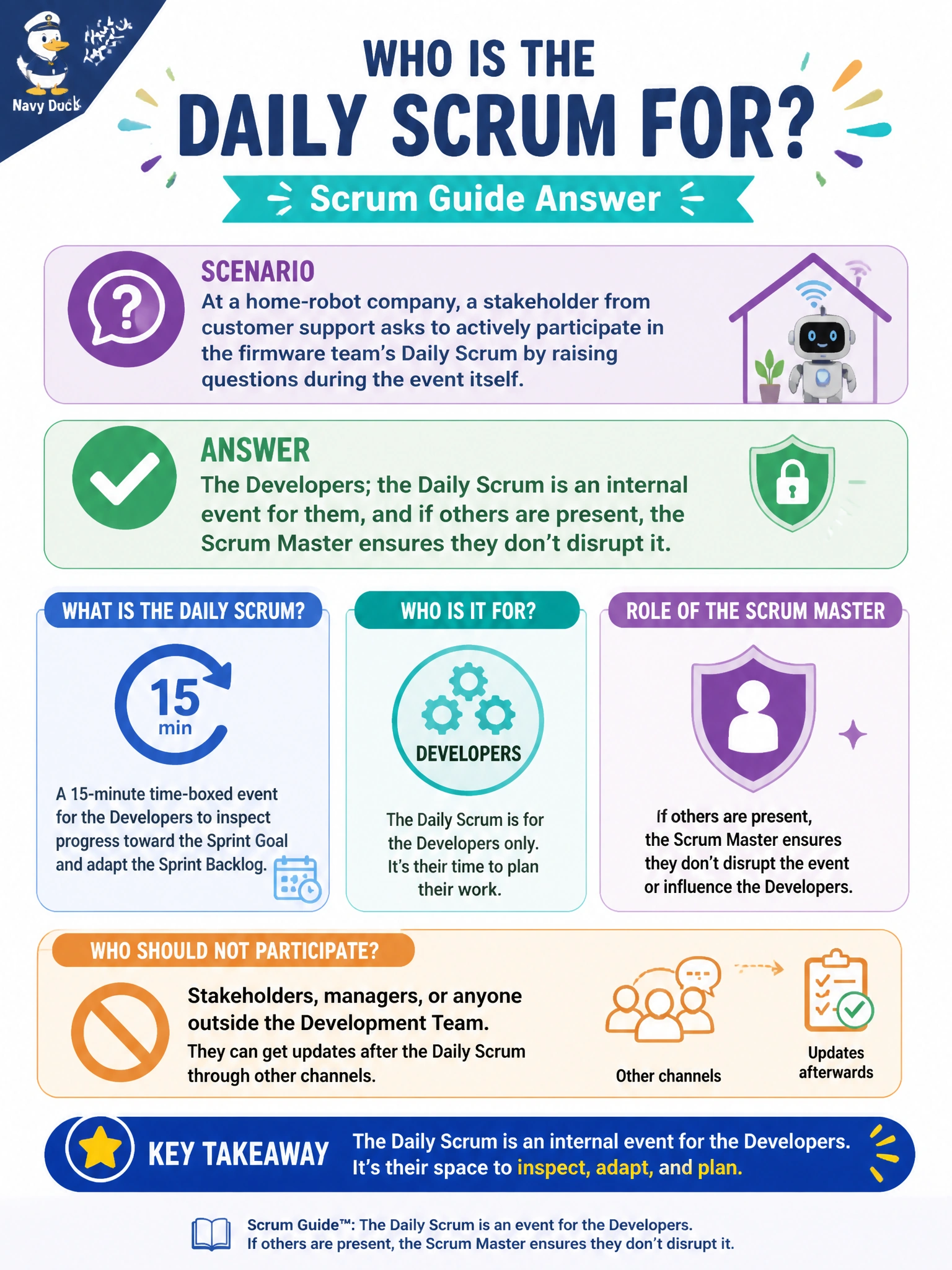
At a home-robot company, a stakeholder from customer support asks to actively participate in the firmware team's Daily Scrum by raising questions during the event itself. According to the Scrum Guide, who is the Daily Scrum for?
Select an answer to reveal the explanation.
Short Explanation
The Daily Scrum belongs to the Developers — it's their own quick check-in on their own plan, not a briefing for an audience. Other people, including stakeholders, can be present and listen in, but the event isn't run for their benefit or open to them steering the conversation. Keeping it that tight is what lets the Developers actually use it instead of performing it.
Full Explanation
The Scrum Guide describes the Daily Scrum as an internal event for the Developers; if other people, such as the Scrum Master or the Product Owner, are actively participating in the Sprint Backlog work, they attend as Developers rather than as observers, and anyone else present must not be allowed to disrupt the event. That framing rules out treating it as an open forum for any stakeholder to raise questions mid-event. Opening it to all stakeholders for transparency confuses this event with the Sprint Review, which is explicitly the event designed for stakeholder engagement and feedback. Centering it on the Product Owner tracking overall progress misplaces the audience; the Product Owner may attend, but the event exists for the Developers to inspect their own plan, not to brief the Product Owner. Framing it as the Scrum Master's status report upward inverts the event's ownership entirely and introduces a reporting function the Guide never assigns to it. Caveat: allowing observers isn't the same as banning them - the Guide permits others to be present as long as they don't disrupt the Developers' work. Operational check: if a stakeholder starts asking questions or requesting explanations mid-Daily-Scrum, the Scrum Master should redirect that conversation to after the event rather than let it consume the timebox.