
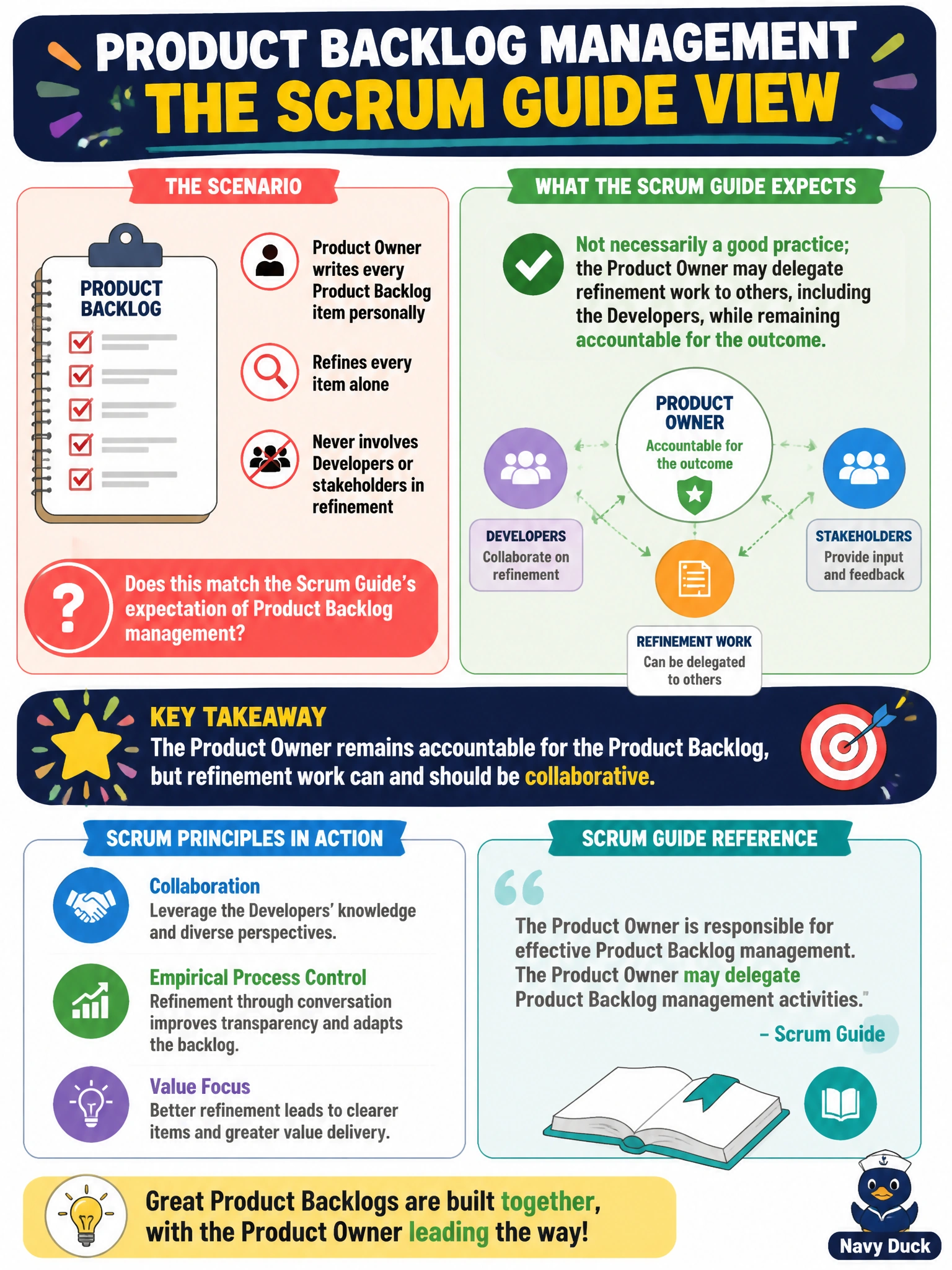
A robotics company's Product Owner personally writes every Product Backlog item, refines every item alone, and never involves the Developers or stakeholders in refinement. A new hire asks whether this matches the Scrum Guide's expectation of Product Backlog management. What is the most accurate response?
Select an answer to reveal the explanation.
Short Explanation
Being accountable for something and doing every bit of it solo aren't the same. The Product Owner can absolutely bring the Developers and stakeholders into shaping and refining backlog items — the accountability for the outcome stays put either way, it just doesn't have to be a one-person show.
Full Explanation
The 2020 Scrum Guide states that the Product Owner is accountable for effective Product Backlog management, which includes developing and communicating the Product Goal and ordering items, but it explicitly allows that Product Backlog refinement work may be delegated to others, including the Developers, while the Product Owner remains accountable for the outcome. Claiming only the Product Owner may write or refine items overstates the Guide's actual constraint, which is about accountability, not about who is permitted to touch the content. The claim that refinement must happen as a separate, dedicated event is also inaccurate — the Guide describes refinement as an ongoing activity that adds detail and order to Product Backlog items, not a formally timeboxed event like the other five. Insisting Developers should never be involved misunderstands why their involvement is often valuable: they bring technical insight that improves item clarity and sizing, and involving them doesn't threaten the Product Owner's accountability for the outcome. In practice, a Product Owner who never involves anyone else in refinement isn't violating the Guide, but it is often a missed opportunity — the healthy pattern is a Product Owner who delegates refinement work while still owning the resulting Product Backlog's quality and ordering.