
A Sprint is underway when the retailer abruptly changes the launch requirements in a way that makes the current Sprint Goal obsolete. The Product Owner believes continuing the Sprint is pointless. Who has the authority to cancel the Sprint?
Select an answer to reveal the explanation.
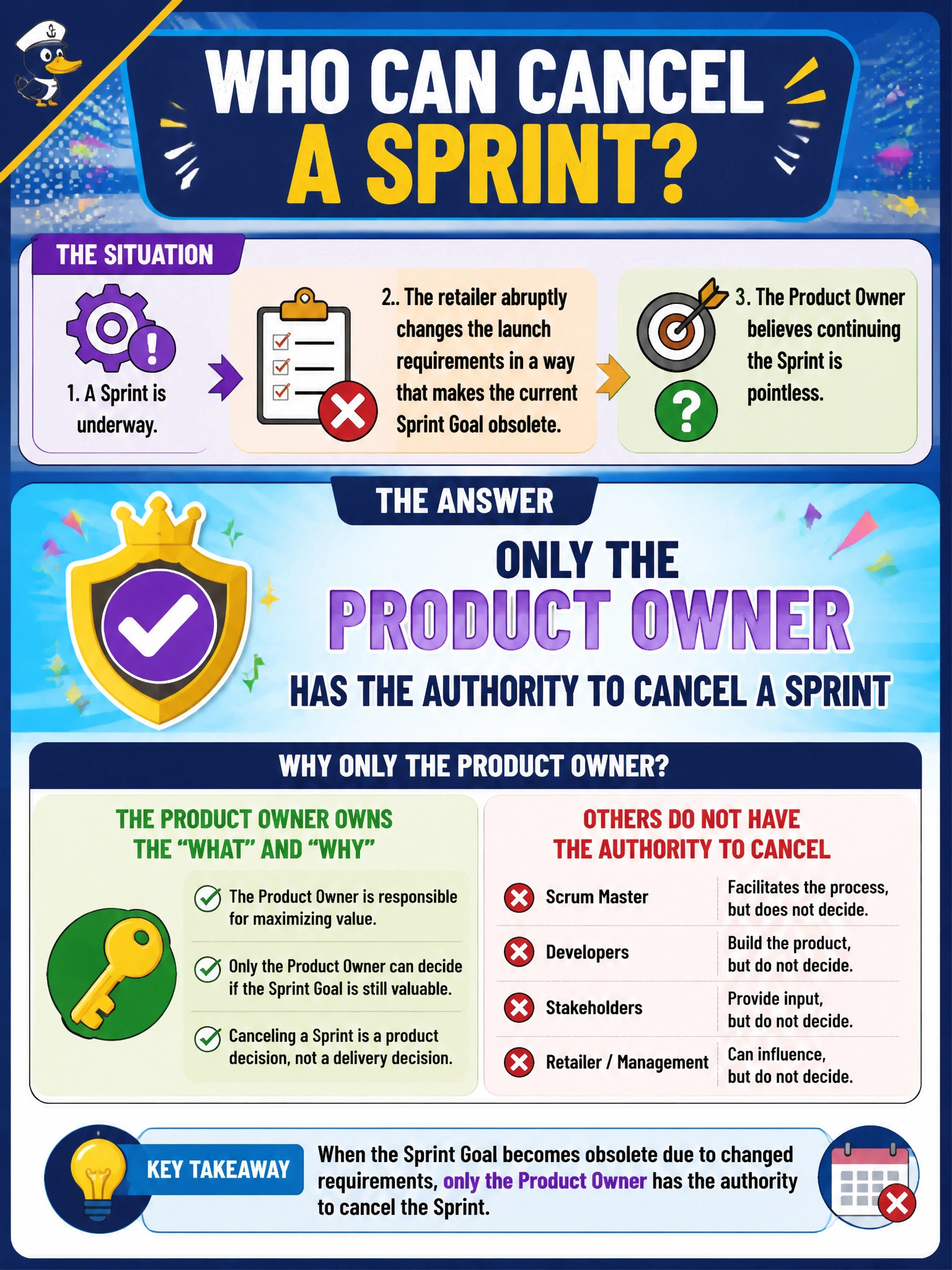
Short Explanation
When a Sprint truly stops making sense, someone has to be able to call it — and the Guide is specific about who that is. It's the Product Owner alone, because they're the one accountable for whether the Sprint Goal still points at anything valuable.
Full Explanation
The 2020 Scrum Guide states that a Sprint can be cancelled if the Sprint Goal becomes obsolete, and that only the Product Owner has the authority to cancel a Sprint. This ties directly to the Product Owner's accountability for maximizing value: they are best positioned to judge when continuing toward a now-pointless Sprint Goal wastes effort that could be redirected. Giving the Scrum Master this authority misassigns a value judgment to a coaching and process accountability that doesn't include deciding whether the Sprint's purpose is still worth pursuing. Giving it to the Developers is also incorrect — while they execute and can and should flag that the goal seems obsolete, the actual cancellation authority is not theirs. Treating it as a general self-managing team decision dilutes a specific, named authority the Guide assigns to one accountability; self-management governs how the Developers organize their work, not who holds a naming-specific power like Sprint cancellation. In practice, cancellation is rare precisely because it's disruptive — a cheaper first move is usually renegotiating the Sprint Backlog with the Developers to preserve some value, and cancellation is reserved for when the goal itself is truly gone.