
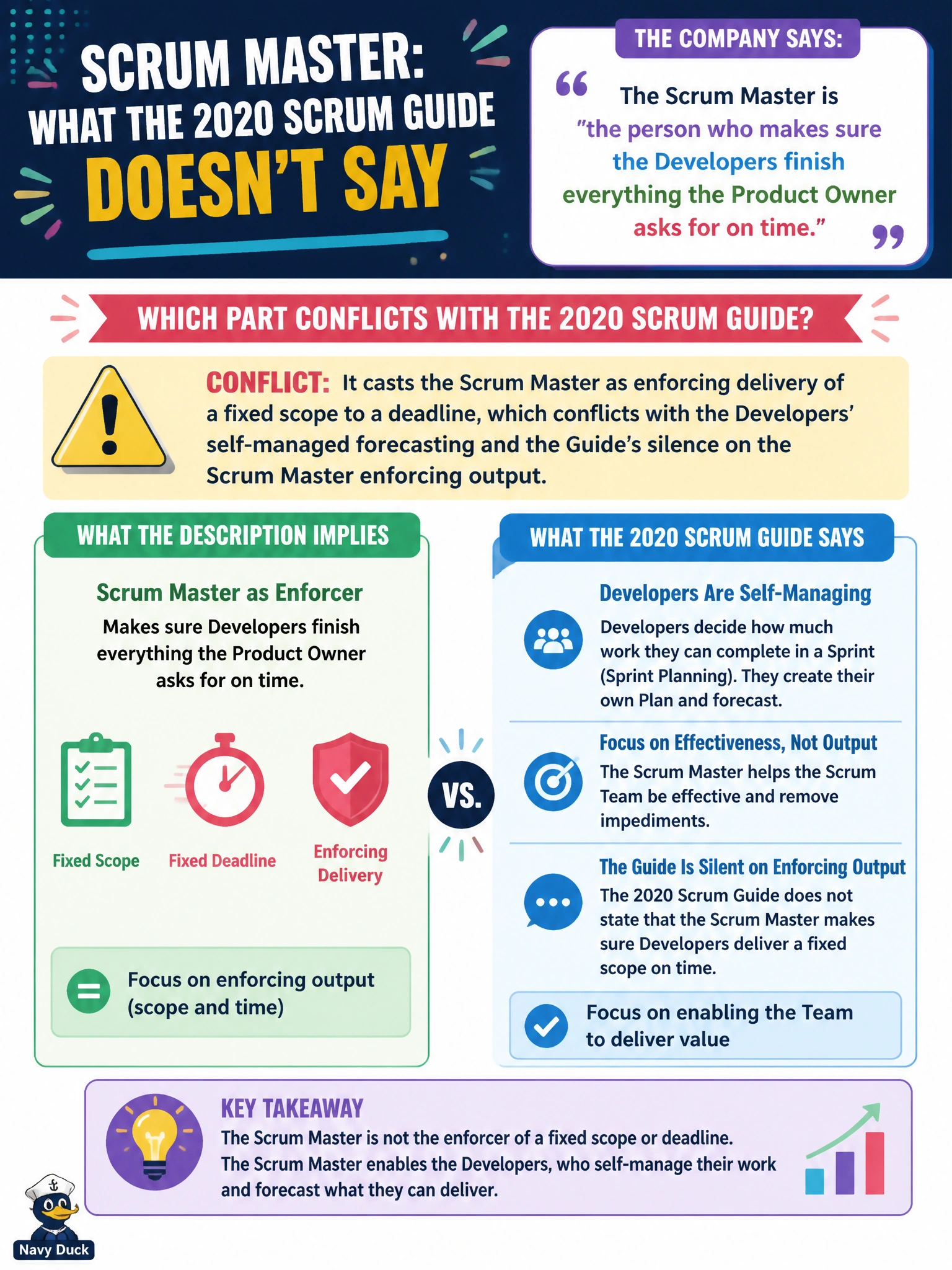
A company describes its Scrum Master as 'the person who makes sure the Developers finish everything the Product Owner asks for on time.' Which part of this description conflicts with the 2020 Scrum Guide?
Select an answer to reveal the explanation.
Short Explanation
This description quietly turns the Scrum Master into an enforcer chasing a fixed to-do list against a clock — and that's not the job. Scope and forecasts flex as the team learns; the Scrum Master's role is coaching that empirical process along, not policing whether every ask got delivered on schedule.
Full Explanation
The description bundles together two things the Guide keeps separate: fixed-scope delivery against a deadline, and the Scrum Master accountability. The Developers forecast what they believe they can complete based on their own capacity and information, and that forecast is expected to be refined as the Sprint unfolds — Scrum's empirical approach assumes plans adapt, not that a fixed list gets forced through regardless of what's learned. Nowhere does the Guide describe the Scrum Master as an enforcer ensuring 'everything' gets finished on time; that framing turns coaching and impediment-removal into deadline policing, which isn't the accountability. Reassigning the same enforcement description to the Product Owner doesn't fix the problem either — the Product Owner also doesn't force fixed-scope delivery to a deadline; their job is maximizing value and Product Backlog management, and they collaborate with, rather than command, the Developers on what's achievable. Limiting the flawed description to 'only small teams' is a distraction — the issue isn't team size, it's mischaracterizing the accountability itself, which the Guide never scales differently. A useful check: the presence of an actual Sprint Goal being met, versus a rigid item count being forced, is what a healthy Sprint outcome looks like — not a Scrum Master keeping score against a Product Owner's wish list.