
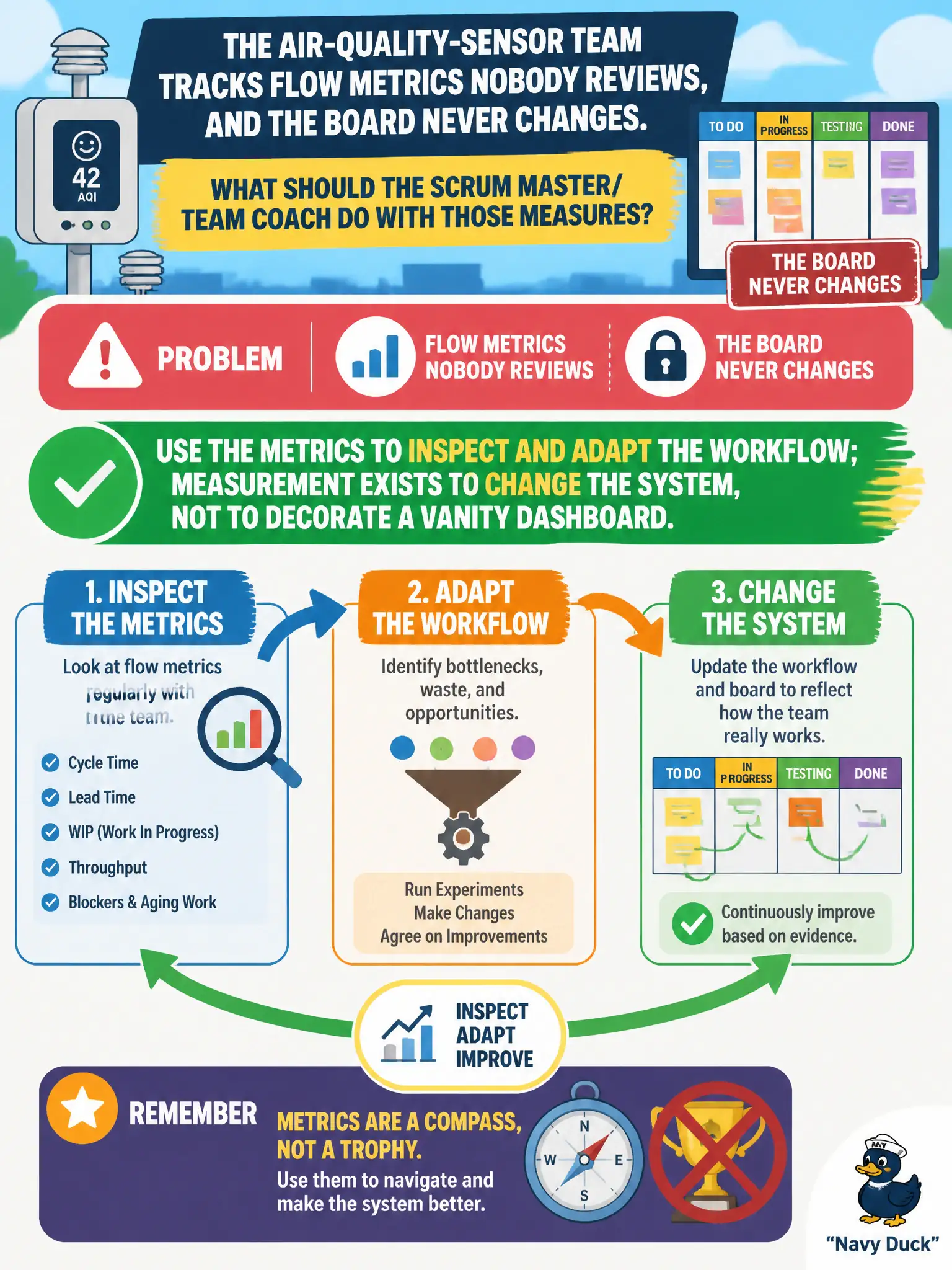
The air-quality-sensor team tracks flow metrics nobody reviews, and the board never changes. What should the Scrum Master/Team Coach do with those measures?
Select an answer to reveal the explanation.
Short Explanation
A rain gauge nobody reads will not keep the reservoir from overflowing. Air-quality flow charts are the same: if the board never changes, the numbers are wallpaper. Use them to pick a coaching move, or they are not accelerating anything.
Full Explanation
Flow metrics exist to drive inspect-and-adapt on the workflow. When the air-quality-sensor team tracks measures nobody reviews and the board never changes, measurement has become vanity wallpaper. The Scrum Master/Team Coach should use the metrics to pick concrete coaching moves—WIP policy, handoff reduction, batch size, or bottleneck focus—so the civic sensing pipeline actually improves rather than decorating a dashboard.
Adding more charts in hopes someone looks fails by concept: volume of unused visuals does not create learning. Archiving the dashboard and stopping measurement until a director asks fails by concept because it abandons empiricism until external pressure returns. Reporting unused metrics at PI Planning as proof of maturity fails by concept: displaying unread charts is theater, not maturity.
Exam caveat: SAFe flow metrics accelerate improvement only when teams inspect them and change the system; collecting measures without action is not a flow practice. Prefer a few acted-upon metrics over a large unread suite for public-service delivery teams.
Operational check: pick one air-quality flow metric that is currently ignored, facilitate a short board-based discussion on what it implies, implement one workflow change, and verify at the next review that both the metric and the board policy moved.