
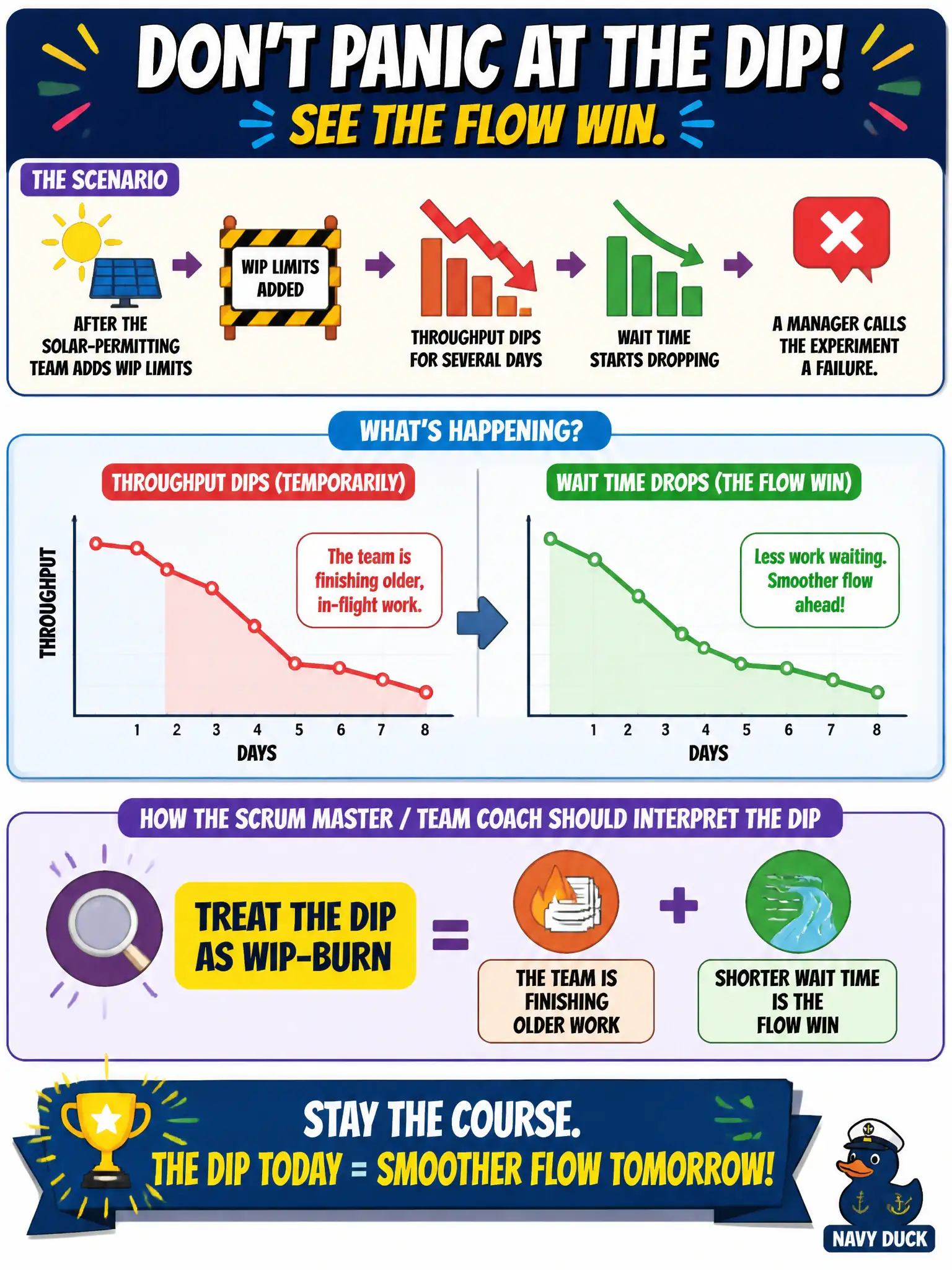
After the solar-permitting team adds WIP limits, throughput dips for several days while wait time starts dropping. A manager calls the experiment a failure. How should the Scrum Master/Team Coach interpret the dip?
Select an answer to reveal the explanation.
Short Explanation
When a jammed permit counter stops taking new tickets, the stamp count dips while the old line finally moves. That dip is the pile burning down, not a broken team. Watch wait time fall; that is the win.
Full Explanation
After WIP limits are introduced, throughput often dips briefly while the team finishes older work—the WIP-burn pattern. On the solar-permitting team, shorter wait time during that dip is the flow win: the jammed permit counter stops taking new tickets so the existing line can move. The Scrum Master/Team Coach should interpret the temporary dip as expected burn-down of excess WIP, not as experiment failure, and keep leadership focused on falling wait time and improving predictability for applicants.
Removing WIP limits immediately so starts return to the old rate fails by concept: it abandons the experiment at the moment inventory is finally clearing. Starting extra stories to keep the throughput dashboard flat fails by concept because it re-inflates WIP and cancels the wait-time gain. Replacing wait-time measures with utilization so the dip disappears fails by concept: it hides the signal and returns the conversation to busyness.
Exam caveat: SAFe and Kanban teaching warn that early WIP-limit periods can show lower start/finish counts while aging and wait improve; judge the experiment on flow time, queue size, and predictability—not on a few days of headline throughput alone.
Operational check: keep WIP limits in place for a defined observation window, chart wait time and WIP age beside throughput for solar-permitting work, explain the WIP-burn narrative to the manager with those charts, and only adjust limits based on sustained flow signals—not dashboard anxiety.