
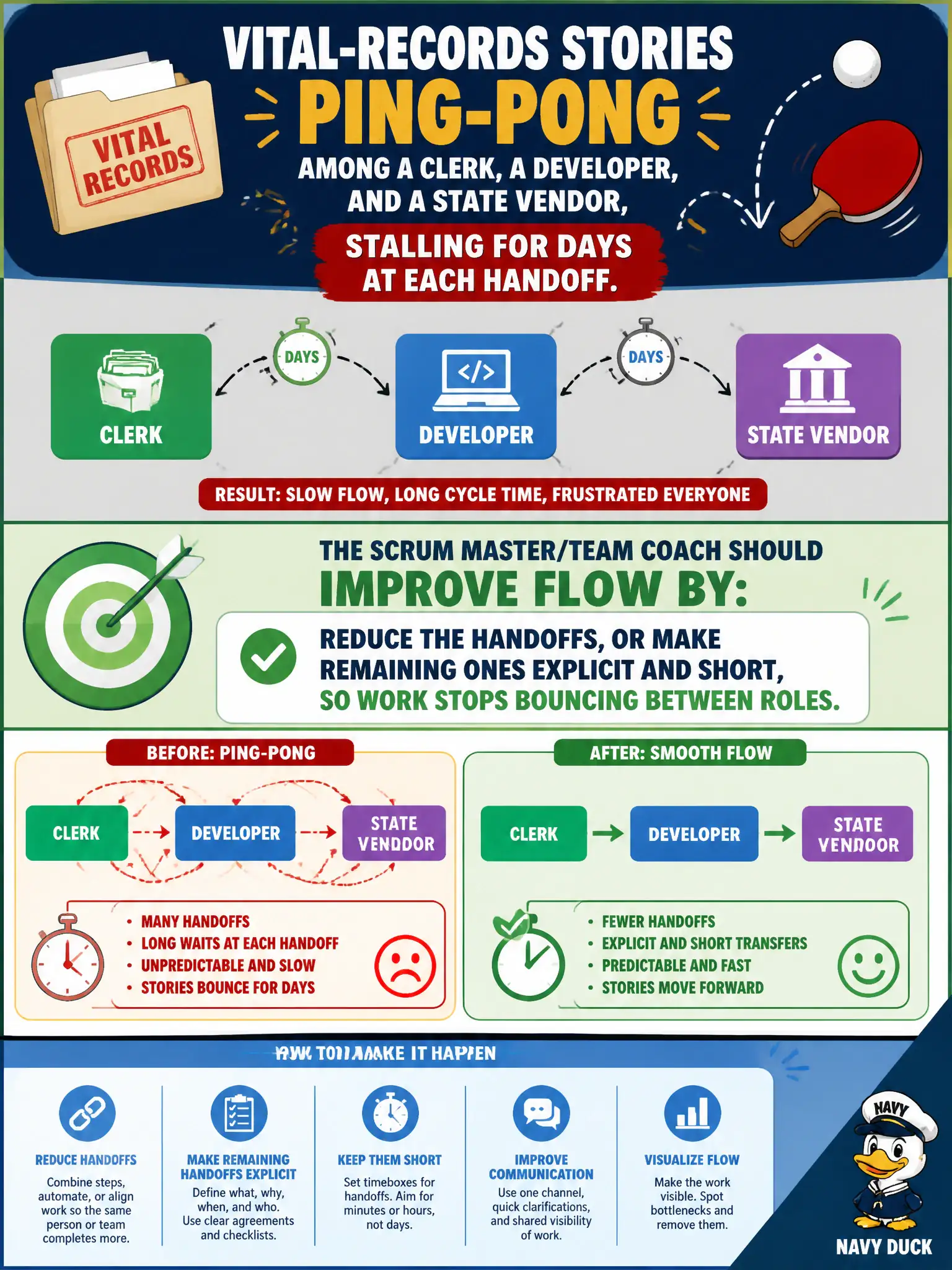
Vital-records stories ping-pong among a clerk, a developer, and a state vendor, stalling for days at each handoff. How should the Scrum Master/Team Coach improve flow?
Select an answer to reveal the explanation.
Short Explanation
A birth certificate that visits three desks is not three times done; it is three times waiting. Cut the hops, or make the leftover hop a short, named policy. Logging the bounce just buys a nicer map of the delay.
Full Explanation
Handoffs create waiting and knowledge loss. Vital-records stories that ping-pong among clerk, developer, and state vendor stall for days at each bounce; flow improves when the Scrum Master/Team Coach reduces handoffs or makes remaining ones explicit, short, and policy-driven so birth-certificate and related civic work stops aging in transit between roles.
Adding a coordinator who only logs every bounce fails by concept: documentation of delay is not delay reduction. Requiring a written status report at each handoff before the next role may start fails by concept because it adds friction to every hop and lengthens wait. Splitting each story into three role-owned tickets fails by concept: it invents throughput from handoffs and fragments the resident outcome across local optimizations.
Exam caveat: SAFe and Lean flow coaching treat handoffs as a primary source of delay; making them visible is useful only if followed by fewer or faster handoffs. Some vendor or statutory hops cannot vanish, but they should be timeboxed, prepared, and minimized—not multiplied into ticket theater.
Operational check: map the current hop sequence for a typical vital-records story, eliminate or combine at least one role transition, define a short explicit checklist for any remaining vendor hop, and measure flow time and aging in handoff wait states before versus after the change.