
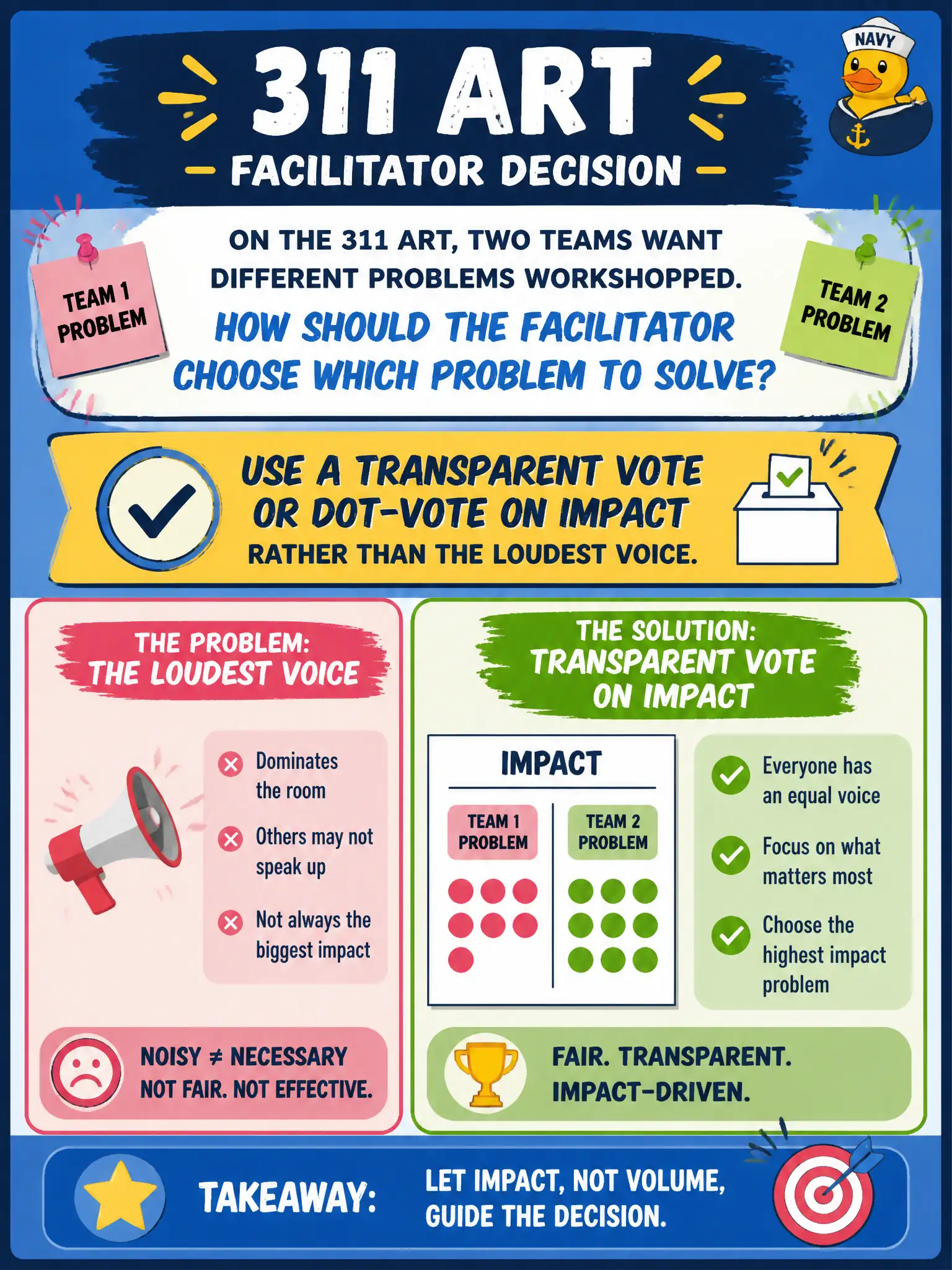
On the 311 ART, two teams want different problems workshopped. How should the facilitator choose which problem to solve?
Select an answer to reveal the explanation.
Short Explanation
Two 311 teams, two pet problems, one clock. Do not reward whoever talks first or whoever has the director's ear. Dot-vote on impact so the group chooses in the open.
Full Explanation
When two 311 teams want different problems workshopped, use a transparent vote or dot-vote on impact rather than the loudest voice. Facilitation makes the choice criteria visible so the ART commits without closed-door politics. Trying to workshop both fully in one timebox usually finishes neither. Civic service improvement needs a clear focus.
Choosing the problem of the team that speaks first rewards speed, not impact. Letting the director break the tie in a closed sidebar breaks transparency. Workshopping both fully in the same timebox dilutes outcomes.
Exam caveat: transparent group selection beats volume or private authority. Operational check: run a timed impact vote between the two 311 problems and proceed with the winner.
Municipal ARTs feel problem-solving workshop quality as clearer permits, fairer housing intake, steadier water billing, and fewer blame cycles in public service. Facilitate evidence-based causes, restated problems, owned experiments, and follow-through into iteration events so residents experience the improvement. Re-check the improvement backlog at the next team sync. Re-check the improvement backlog at the next team sync. Re-check the improvement backlog at the next team sync.