
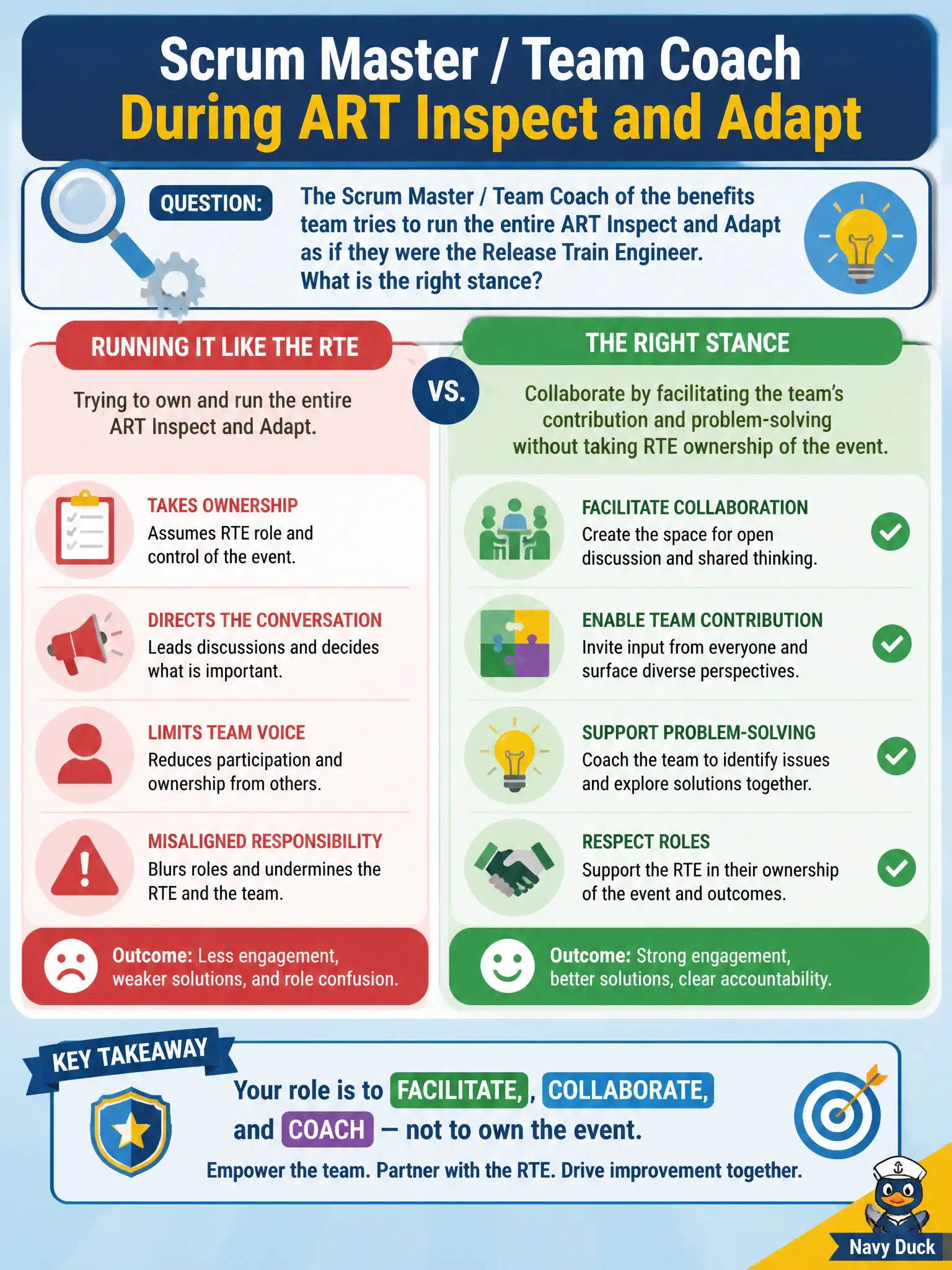
The Scrum Master / Team Coach of the benefits team tries to run the entire ART Inspect and Adapt as if they were the Release Train Engineer. What is the right stance?
Select an answer to reveal the explanation.
Short Explanation
Borrowing the RTE's badge does not make the benefits coach the train engineer. Advanced Scrum Masters facilitate their team's part in Inspect and Adapt. Collaborate; do not hijack the ART event.
Full Explanation
At ART Inspect and Adapt, the SM/TC collaborates by facilitating the team’s contribution and problem-solving without taking RTE ownership of the event. A benefits-team coach who runs the entire ART I&A as if they were the RTE blurs roles and can sideline train facilitation. Stay in the team-coach stance: prepare the team, co-facilitate local problem-solving, support the RTE. Civic ARTs need clear role boundaries under pressure.
Taking over as acting RTE for I&A and PI Planning exceeds the team-coach role. Canceling the ART event for a team-only retro removes train-level inspection. Dictating the ART’s improvement items from the benefits board imposes one team’s view on the train.
Exam caveat: collaborate with the RTE; do not absorb the RTE role. Operational check: agree facilitation boundaries with the RTE before benefits ART I&A starts.
Municipal ARTs feel problem-solving workshop quality as clearer permits, fairer housing intake, steadier water billing, and fewer blame cycles in public service. Facilitate evidence-based causes, restated problems, owned experiments, and follow-through into iteration events so residents experience the improvement. Re-check the improvement backlog at the next team sync.