
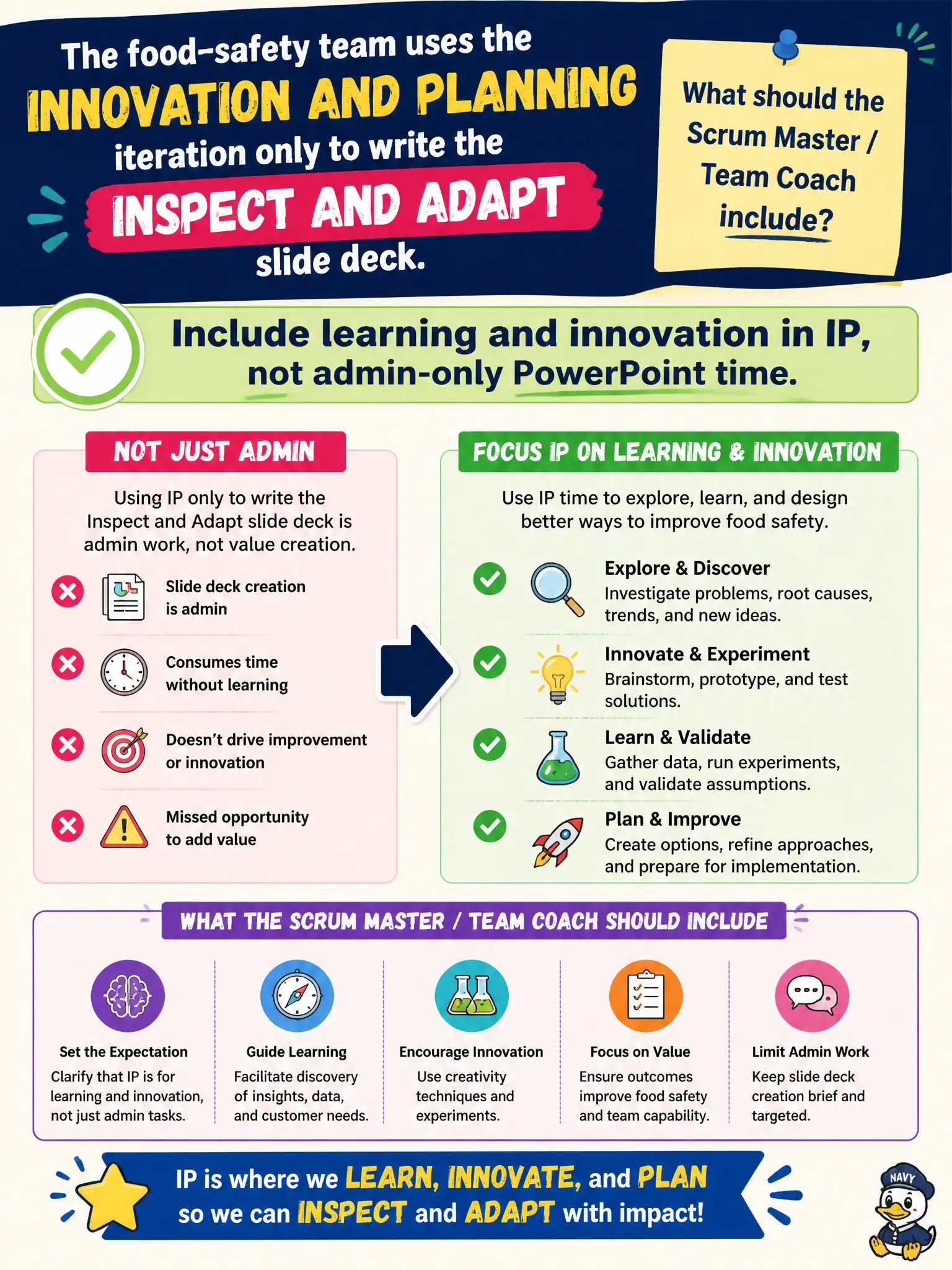
The food-safety team uses the Innovation and Planning iteration only to write the Inspect and Adapt slide deck. What should the Scrum Master / Team Coach include?
Select an answer to reveal the explanation.
Short Explanation
Spending all of IP on I&A slides is a restaurant that preps the menu card and never tries a new recipe. I&A prep is one IP job, not the whole kitchen. Leave room for learning and innovation.
Full Explanation
IP should include learning and innovation, not admin-only PowerPoint time. A food-safety team that uses IP solely to write the Inspect and Adapt deck misses education and experimentation that improve inspection workflows. The Scrum Master / Team Coach includes learning and innovation alongside I&A prep so the iteration serves multiple IP purposes. Pretty slides without learning are incomplete.
Keeping IP as slide-deck production optimizes appearance over capability. Outsourcing the deck to the RTE and sending the team back to delivery stories steals IP for overflow. Skipping I&A slides to finish production defects again treats IP as a junk drawer.
Exam caveat: I&A prep is one IP activity among several, not the only allowed use. Operational check: balance food-safety IP among learning, innovation, and I&A prep—not deck-only days.
In municipal ARTs, residents experience these coaching choices as faster or slower public services—licensing lines, housing decisions, water bills, snow routes, and emergency response—so keep events and buffers tied to inspect-and-adapt outcomes. Record the decision, the owner, and the next inspection date so the team can verify civic impact. Confirm the next demo or metrics review will show whether the change helped residents.