
A court-case team wants to "keep the factory running" through the Innovation and Planning iteration with the same WIP. What should the Scrum Master / Team Coach use IP for?
Select an answer to reveal the explanation.
Short Explanation
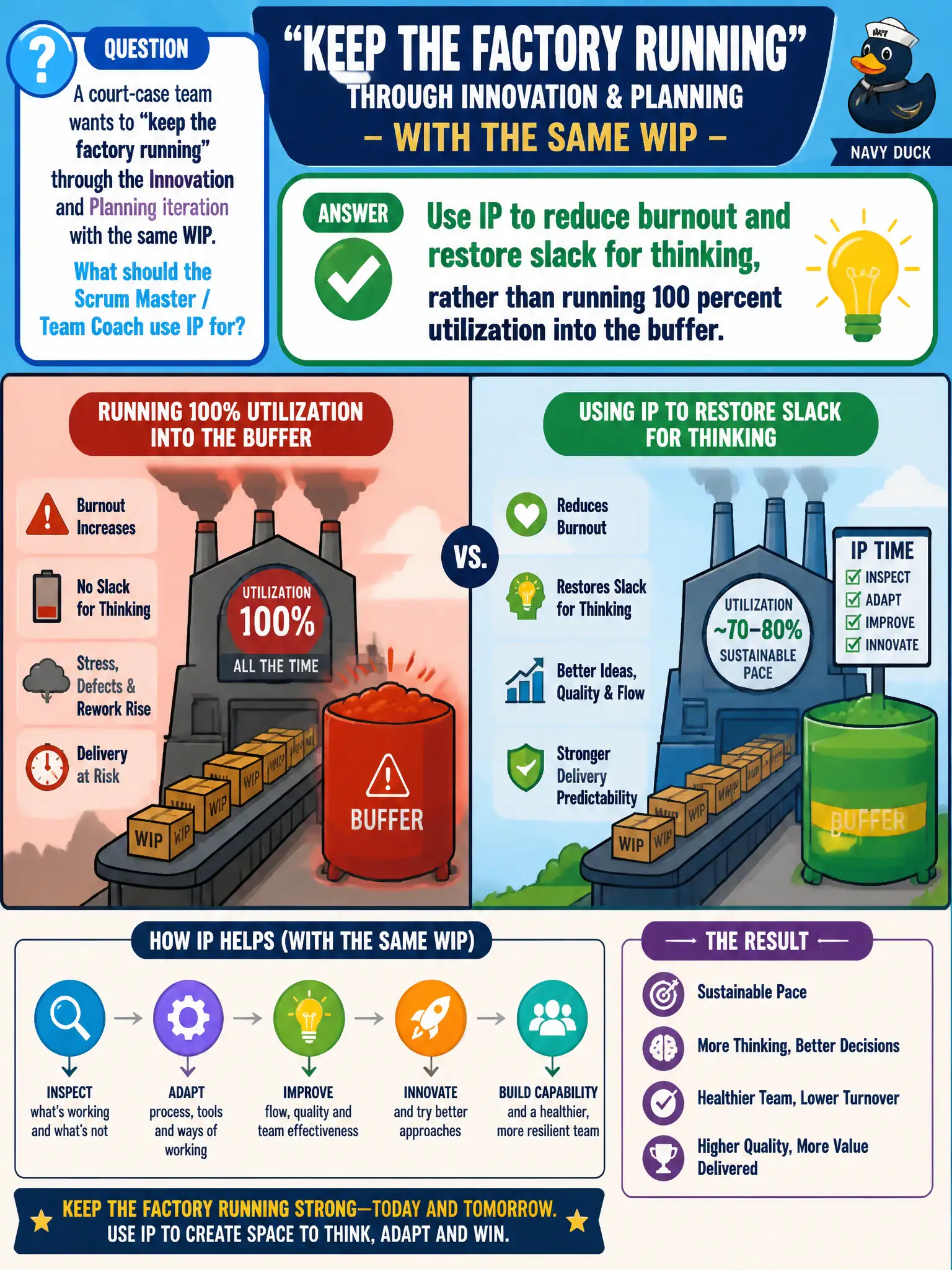
Running the court-case factory at 100 percent into IP is a copier that never gets toner or a cleaning. Slack is how people think and recover. IP is that slack, not another full WIP week.
Full Explanation
IP restores slack for thinking and reduces burnout; it is not meant to run 100 percent utilization like delivery iterations. A court-case team that “keeps the factory running” through IP with the same WIP burns the buffer’s purpose. The Scrum Master / Team Coach uses IP to lower intensity so people can innovate, learn, and prepare—improving sustainable pace for caseflow quality. Throughput obsession in IP recreates the problem the buffer solves.
Holding WIP at 100 percent utilization so throughput never drops denies slack. Adding a second shift so IP does not reduce throughput intensifies burnout. Measuring IP success only by stories closed applies the wrong scoreboard.
Exam caveat: IP success includes learning and readiness, not identical story throughput. Operational check: set court IP WIP deliberately lower and track learning outcomes alongside any support work.
In municipal ARTs, residents experience these coaching choices as faster or slower public services—licensing lines, housing decisions, water bills, snow routes, and emergency response—so keep events and buffers tied to inspect-and-adapt outcomes. Record the decision, the owner, and the next inspection date so the team can verify civic impact.