
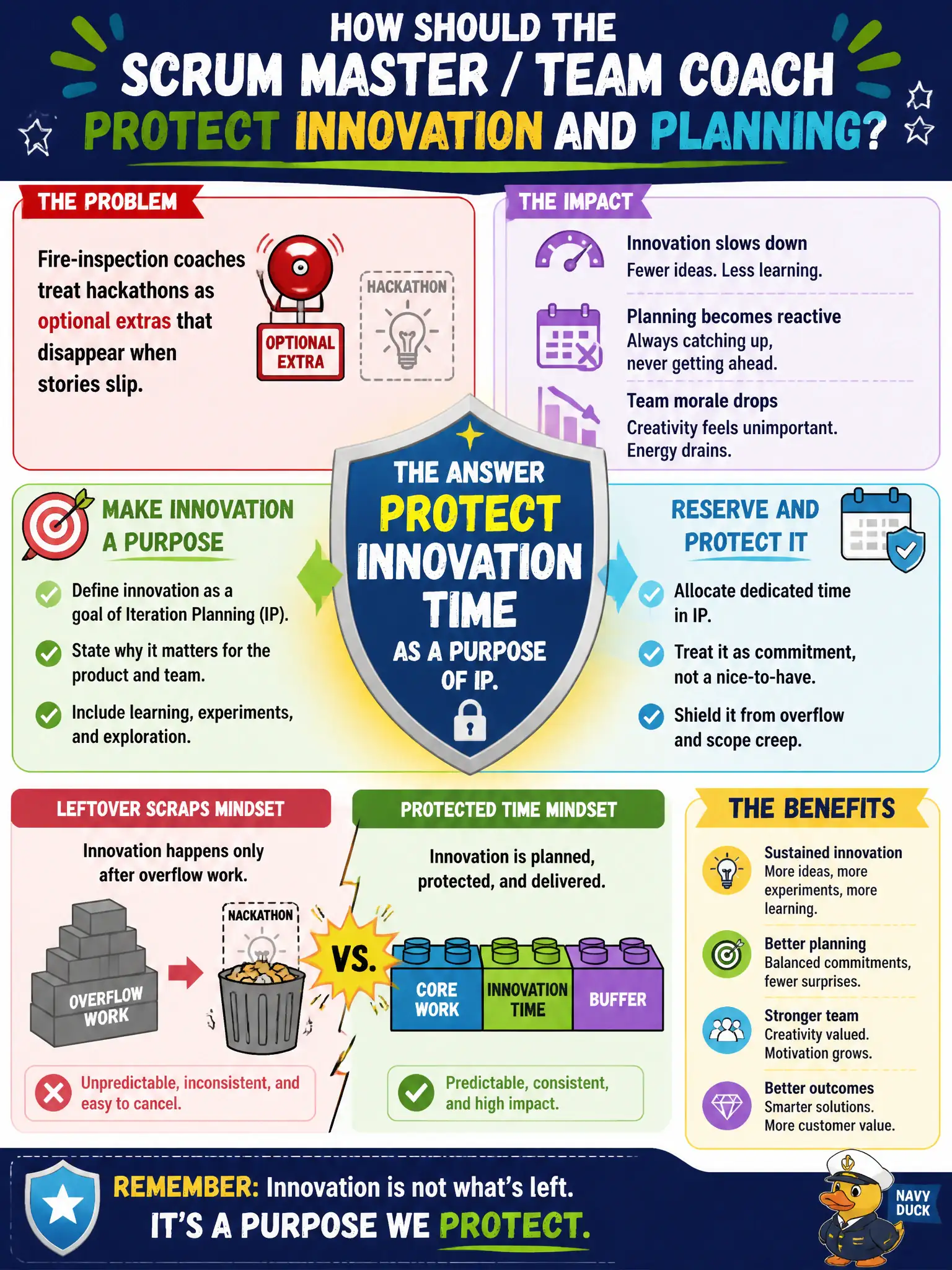
Fire-inspection coaches treat hackathons as optional extras that disappear when stories slip. How should the Scrum Master / Team Coach protect Innovation and Planning?
Select an answer to reveal the explanation.
Short Explanation
A fire-inspection hackathon that only happens if nothing slipped is a spare hose sold at the first alarm. Innovation is a purpose of IP, not leftover scraps. Protect the time or the ART never learns a new tool.
Full Explanation
Innovation time is a purpose of IP, not leftover scraps after overflow. Fire-inspection coaches who cancel hackathons whenever stories slip teach the ART that learning is optional and delivery pressure always wins. The Scrum Master / Team Coach protects innovation inside IP so inspectors can try safer, faster approaches. Public safety improves when learning is scheduled, not squeezed into evenings.
Canceling the hackathon whenever any PI Objective is at risk makes innovation the first casualty. Moving innovation to evenings so IP finishes slipped stories burns people. Requiring Feature justification before any learning is allowed bureaucratizes curiosity out of IP.
Exam caveat: protect innovation as intentional IP capacity, not leftover time. Operational check: keep a named innovation slot in fire-inspection IP and defend it when overflow threatens.
In municipal ARTs, residents experience these coaching choices as faster or slower public services—licensing lines, housing decisions, water bills, snow routes, and emergency response—so keep events and buffers tied to inspect-and-adapt outcomes. Record the decision, the owner, and the next inspection date so the team can verify civic impact.