
During PI Planning, the fleet-telematics team loads the Innovation and Planning iteration with overflow stories. What should the Scrum Master / Team Coach coach?
Select an answer to reveal the explanation.
Short Explanation
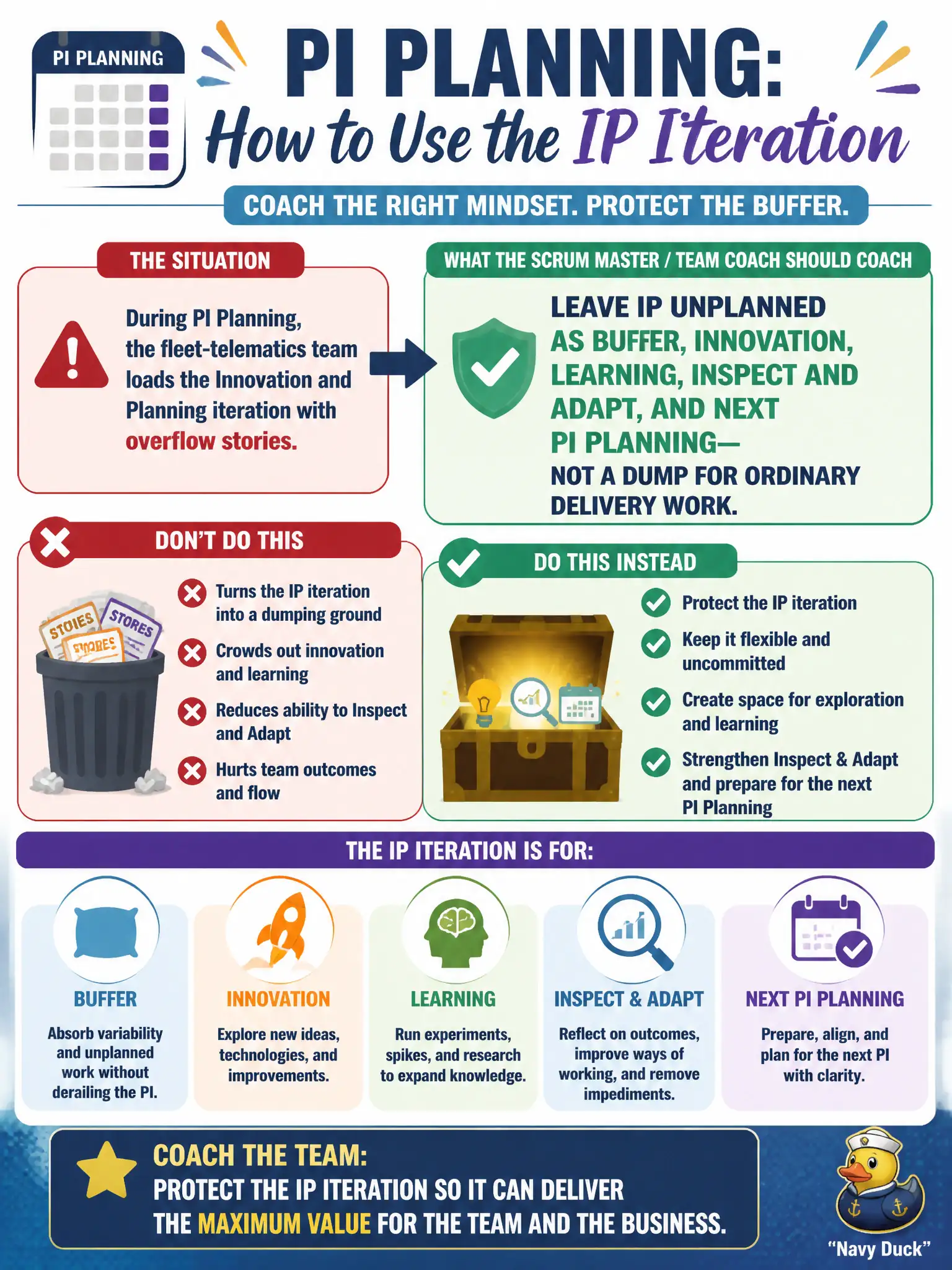
Stuffing leftover fleet stories into IP is packing the spare tire with bricks. IP is empty on purpose: buffer, innovation, learning, I&A, and planning prep. Ordinary delivery work does not get a reservation there during PI Planning.
Full Explanation
The Innovation and Planning iteration is unplanned buffer for innovation, learning, Inspect and Adapt, and next PI Planning—not a dump for ordinary delivery overflow. When a fleet-telematics team loads IP with leftover stories during PI Planning, predictability collapses and learning disappears. The Scrum Master / Team Coach coaches leaving IP capacity free so the ART can recover, improve, and plan. Civic fleet systems need that slack after intense delivery.
Filling IP first so delivery iterations stay empty of stretch work inverts the design. Converting overflow into Features so IP becomes a mini-PI recreates continuous delivery pressure. Asking the RTE to schedule extra delivery iterations instead of IP removes the intentional buffer.
Exam caveat: IP purposes are explicit in SAFe; using IP as sprint 6 fails the exam. Operational check: in fleet PI Planning, show IP with innovation/learning/I&A/prep—not a full story load.
In municipal ARTs, residents experience these coaching choices as faster or slower public services—licensing lines, housing decisions, water bills, snow routes, and emergency response—so keep events and buffers tied to inspect-and-adapt outcomes. Record the decision, the owner, and the next inspection date so the team can verify civic impact.