
Leadership wants to cancel the Innovation and Planning iteration on the water-billing ART "to catch up." What should the Scrum Master / Team Coach explain?
Select an answer to reveal the explanation.
Short Explanation
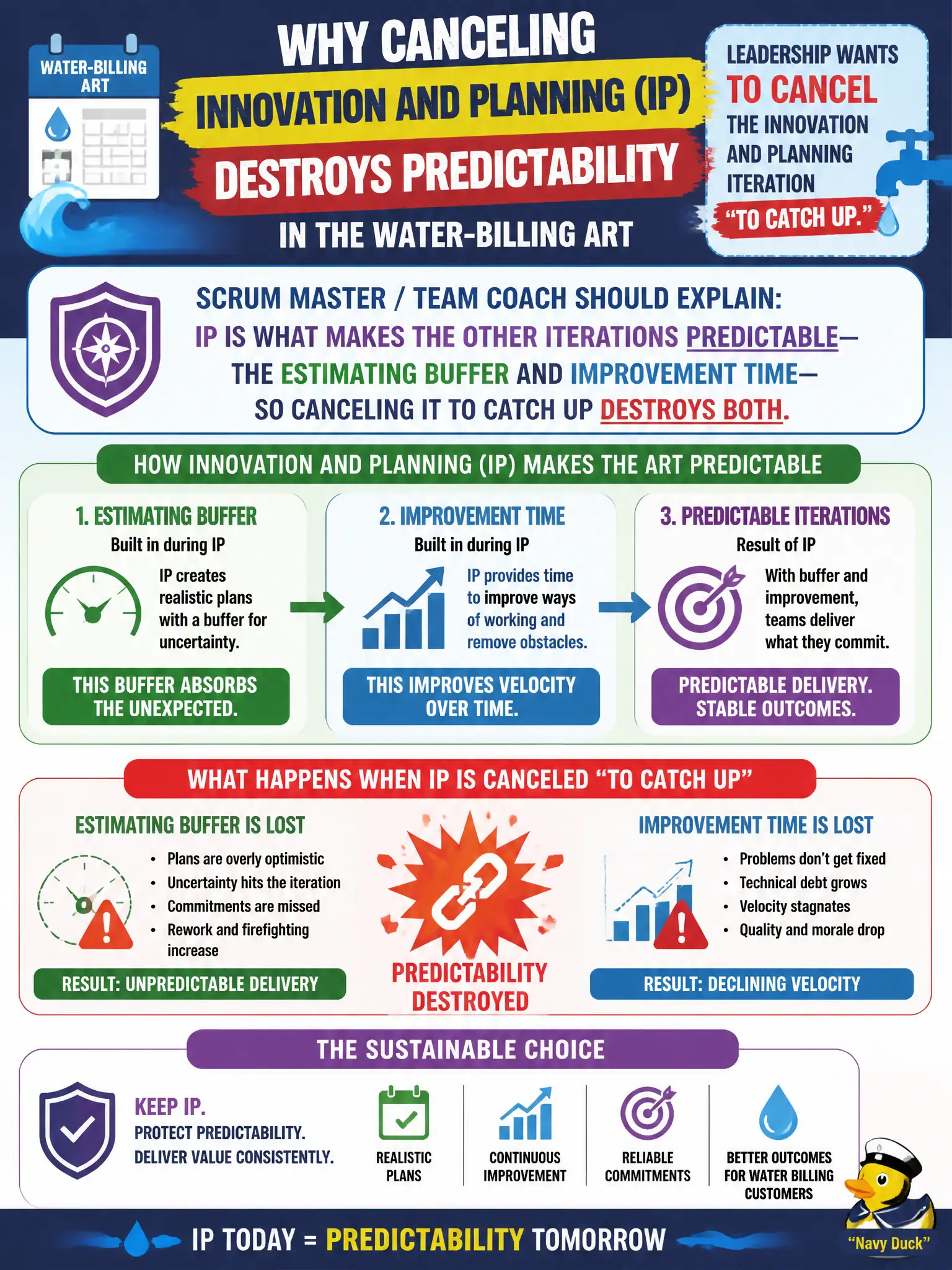
Canceling IP to "catch up" on water bills is selling the spare tire to buy more miles today. That buffer is why the other iterations can be honest. Without it, estimates lie and improvement time disappears.
Full Explanation
IP is what makes other iterations predictable—the estimating buffer and improvement time. Canceling IP on a water-billing ART “to catch up” destroys both predictability and improvement, usually creating more catch-up later. The Scrum Master / Team Coach explains that burning the buffer to finish billing stories removes the system’s shock absorber. Residents then experience thrash as outages and rushed defects.
Claiming canceling IP is fine when velocity was below plan treats the symptom by deleting the cure. Moving Inspect and Adapt into a lunch hour while coding through IP hollows improvement. Replacing IP with overtime weekends burns people and still skips innovation and planning prep.
Exam caveat: catching up by deleting IP is a common trap answer; protect the buffer. Operational check: if water-billing leadership proposes canceling IP, show how prior PIs used buffer for risks and I&A—and refuse the deletion.
In municipal ARTs, residents experience these coaching choices as faster or slower public services—licensing lines, housing decisions, water bills, snow routes, and emergency response—so keep events and buffers tied to inspect-and-adapt outcomes. Record the decision, the owner, and the next inspection date so the team can verify civic impact.