
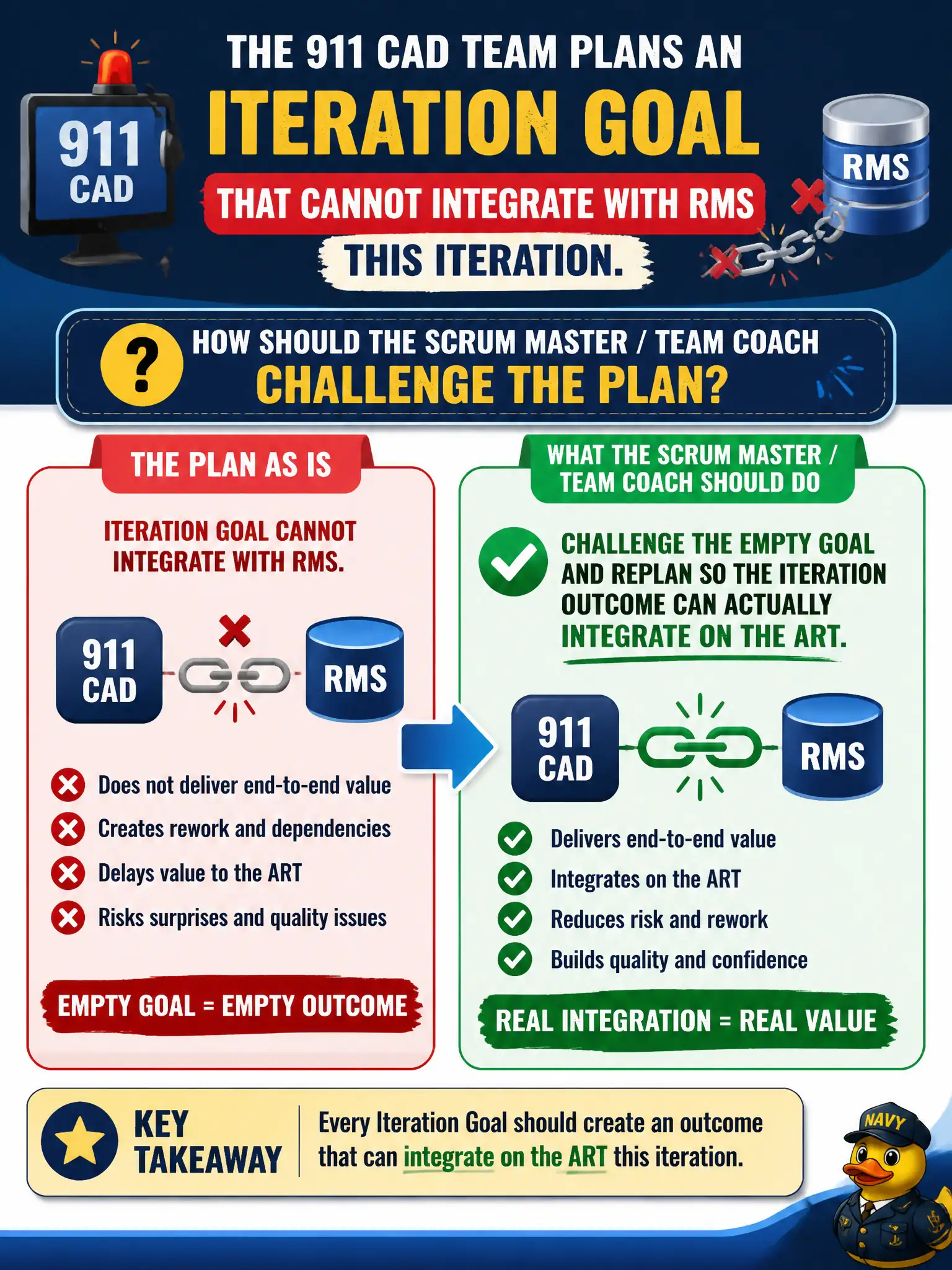
The 911 CAD team plans an Iteration Goal that cannot integrate with RMS this iteration. How should the Scrum Master / Team Coach challenge the plan?
Select an answer to reveal the explanation.
Short Explanation
A 911 goal that never talks to RMS is a dispatch screen with no radio. Team events are supposed to produce an integrable increment, not a local busywork badge. Call the goal empty and replan until CAD and RMS can actually meet.
Full Explanation
An Iteration Goal that cannot integrate with dependent systems is an empty goal. On a 911 CAD team, planning work that cannot integrate with RMS this iteration fails ART purpose—public-safety increments must combine. The Scrum Master / Team Coach challenges the plan and replans toward an outcome that can actually integrate, even if the slice is smaller. Local velocity theater does not help dispatchers or responders.
Keeping the local goal because velocity is independent of RMS ignores ART integration. Asking the Product Owner to hide the RMS dependency until after the demo breaks transparency. Converting CAD work into IP overflow so integration can wait dumps delivery risk into the buffer.
Exam caveat: iteration outcomes should be integrable on the train, not isolated local output. Operational check: before locking a CAD Iteration Goal, verify the RMS integration path for that slice exists this iteration.
In municipal ARTs, residents experience conflict outcomes as delayed permits, missed benefits, unsafe shelter conditions, or opaque public data—so the Scrum Master / Team Coach keeps facilitation tied to service flow, safety, and transparent inspection rather than positional wins. Document the chosen frame or strategy, the evidence used, and the next check date so the team can see whether the intervention improved civic delivery.