
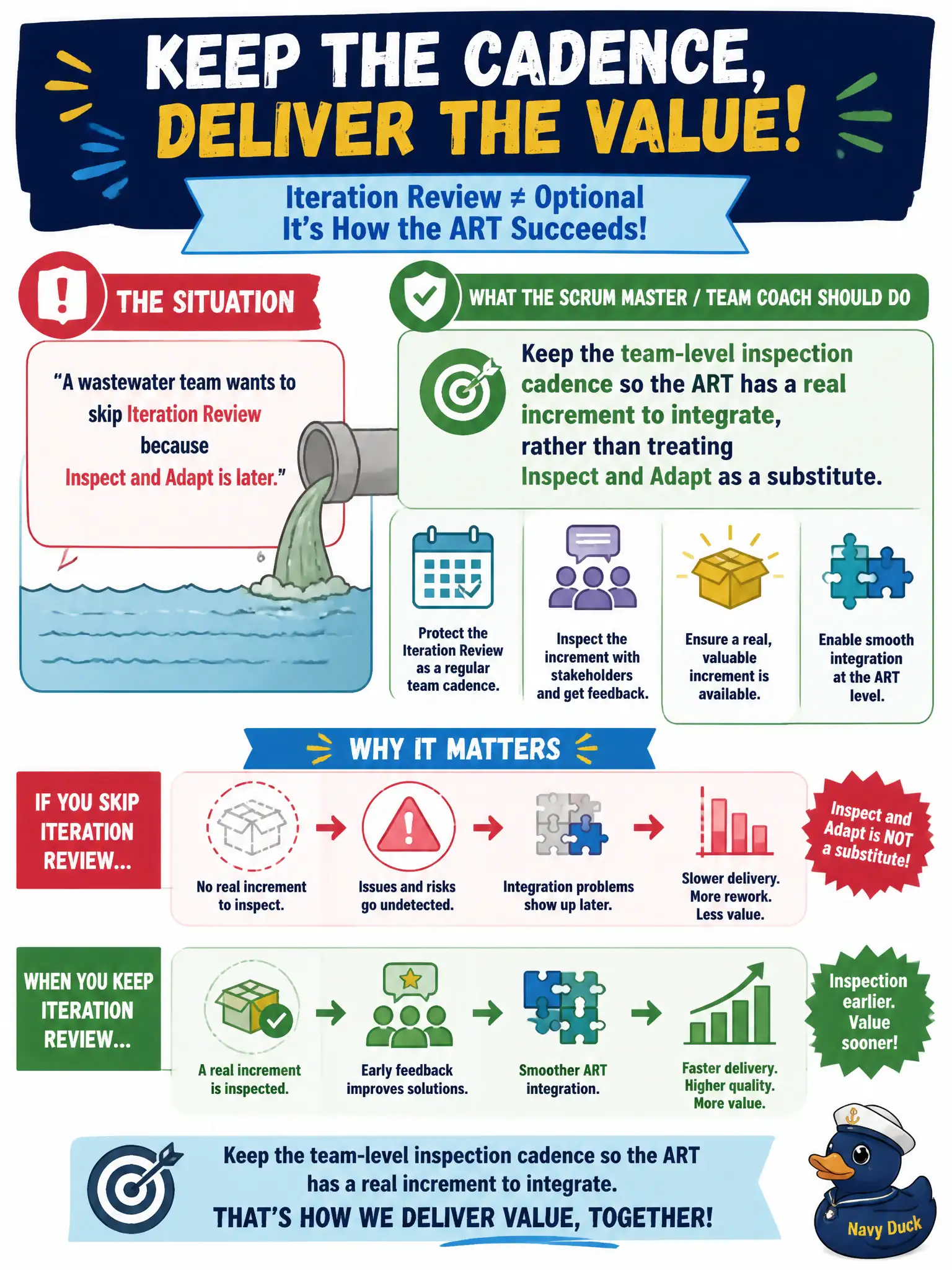
A wastewater team wants to skip Iteration Review "because Inspect and Adapt is later." What should the Scrum Master / Team Coach do?
Select an answer to reveal the explanation.
Short Explanation
Waiting for the PI Inspect and Adapt to see the pipes is like inspecting the plant only at year-end. Team Review is how the wastewater increment gets honest every iteration. ART I&A cannot inspect what the team never showed.
Full Explanation
Iteration Review is the team-level inspection cadence that feeds a real increment into the ART. A wastewater team that wants to skip it “because Inspect and Adapt is later” confuses PI-level I&A with ongoing iteration inspection. The Scrum Master / Team Coach keeps the review so integration and feedback happen continuously, not only at PI end. Treating I&A as a substitute starves the System Demo of working reality.
Skipping the review to finish stories for I&A delays inspection and often creates a scramble of unvalidated work. Holding one review per PI timed only to I&A System Demo removes iteration empiricism. Having the RTE grade the increment at Coach Sync replaces team-stakeholder inspection with coach bureaucracy.
Exam caveat: I&A does not replace Iteration Review; both operate at different cadences. Operational check: if wastewater teams skip reviews, ask what integrated increment will exist for the ART demo—and restore the iteration inspection.
In municipal ARTs, residents experience conflict outcomes as delayed permits, missed benefits, unsafe shelter conditions, or opaque public data—so the Scrum Master / Team Coach keeps facilitation tied to service flow, safety, and transparent inspection rather than positional wins. Document the chosen frame or strategy, the evidence used, and the next check date so the team can see whether the intervention improved civic delivery.