
The 911-dispatch team delivers every iteration, but people are on-call every night and burning out. How should the Scrum Master / Team Coach assess the team's performance?
Select an answer to reveal the explanation.
Short Explanation
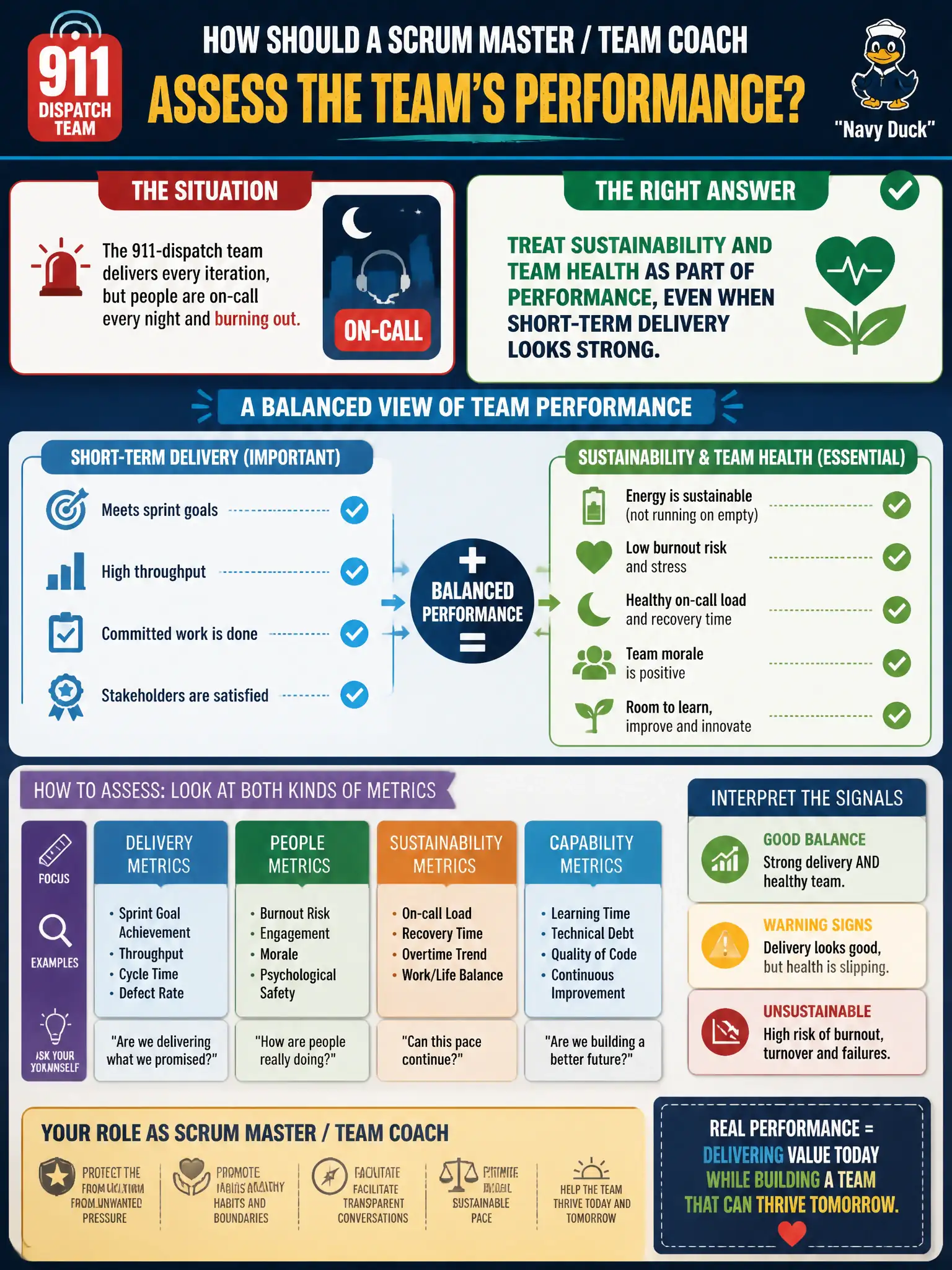
Fast 911 work that wrecks the night shift is a sprint into a wall. Throughput without sleep is not high performance; it is borrowed time. Health and sustainability belong on the same scoreboard as the dispatch increment.
Full Explanation
A 911-dispatch team that delivers every iteration while people are on-call every night and burning out is not fully high performing; the Scrum Master / Team Coach must treat sustainability and team health as part of performance even when short-term delivery looks strong. Heroic throughput that destroys people is a municipal risk, not a badge. Calling the team high performing while ignoring on-call health cost celebrates output that is not sustainable. Asking the RTE to add more on-call staff so heroics can continue at scale may temporarily patch capacity but can institutionalize unsustainable design if the root workload and alert design stay broken. Replacing health questions with individual utilization hides burnout behind a utilization dashboard. Exam caveat: SASM includes team health and sustainability in performance assessment; throughput-only praise and utilization-only dashboards are incomplete. Operational check: add health and on-call load measures beside delivery metrics, facilitate a look at alert noise and WIP that drive night pages, experiment with sustainable on-call design, and verify delivery remains acceptable without nightly burnout. Escalate structural understaffing as an impediment rather than normalizing heroics.