
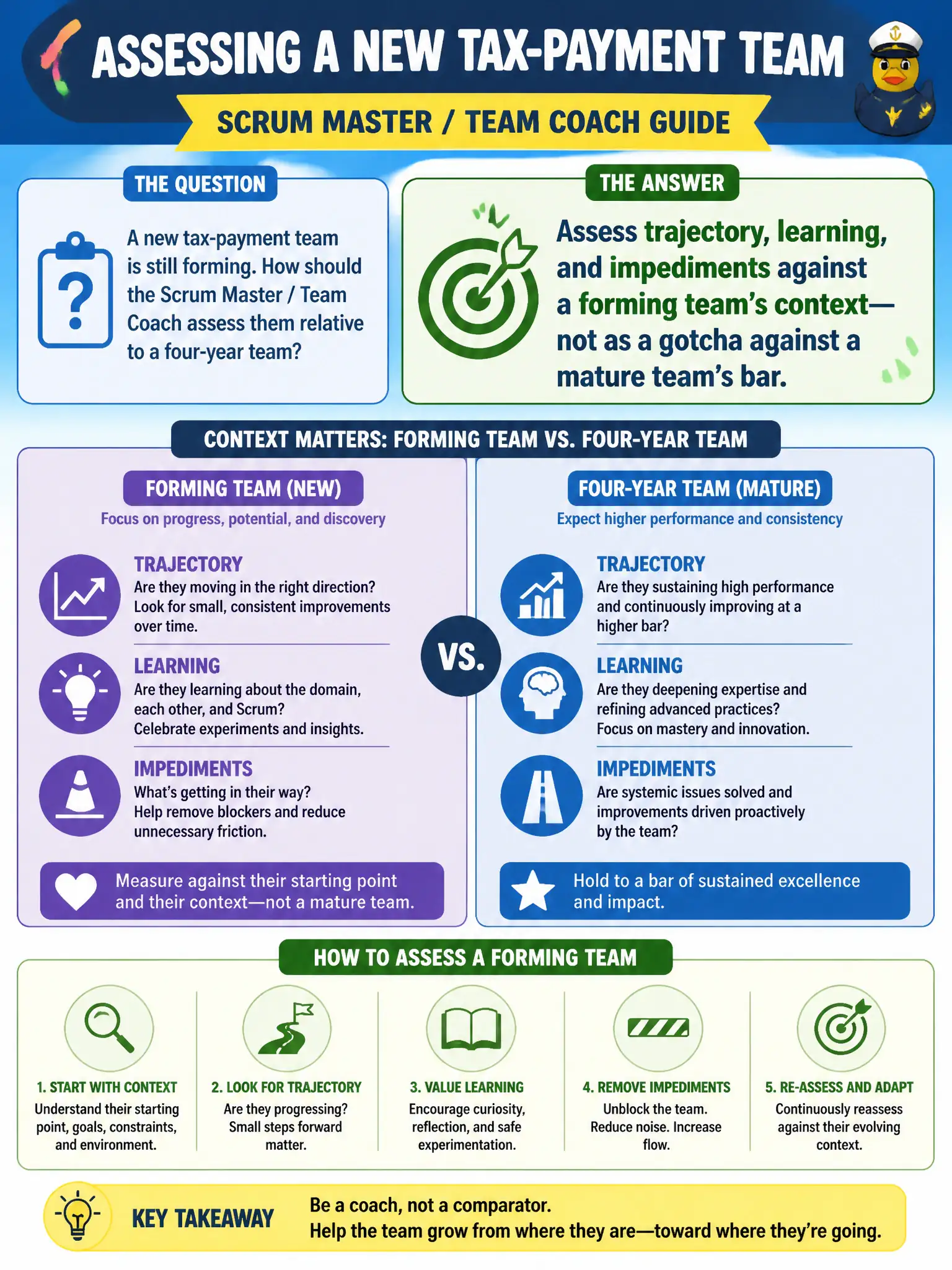
A new tax-payment team is still forming. How should the Scrum Master / Team Coach assess them relative to a four-year team?
Select an answer to reveal the explanation.
Short Explanation
Grading a brand-new tax-payment crew like a four-year veteran is timing a learner on a marathon course. Look at trajectory, blockers, and what they are learning. Assessment should coach the next mile, not ambush the starting line.
Full Explanation
A new tax-payment team still forming should be assessed on trajectory, learning, and impediments in a forming team's context—not with a gotcha against a four-year team's outcome bar. Early teams need coaching on growth, not public failing grades that demoralize without teaching. Using the same outcome bar this month and publishing a failing grade as motivation confuses stretch with unfair comparison. Skipping assessment entirely until the fourth anniversary abandons inspect-and-adapt when it is most needed. Stack-ranking the new team against the mature team in a council packet turns politics into assessment and ignores formation stage. Exam caveat: SASM assesses teams with context for maturity and learning; identical bars and council stack-ranks against mature teams are misuse. Operational check: define a short set of trajectory indicators (learning goals met, impediments cleared, early outcome proxies), review them with the new tax-payment team frequently, compare progress to their own prior baseline rather than the four-year team's absolute bar, and brief leadership on formation context. Escalate systemic impediments rather than blaming the new team for maturity it has not yet earned.