
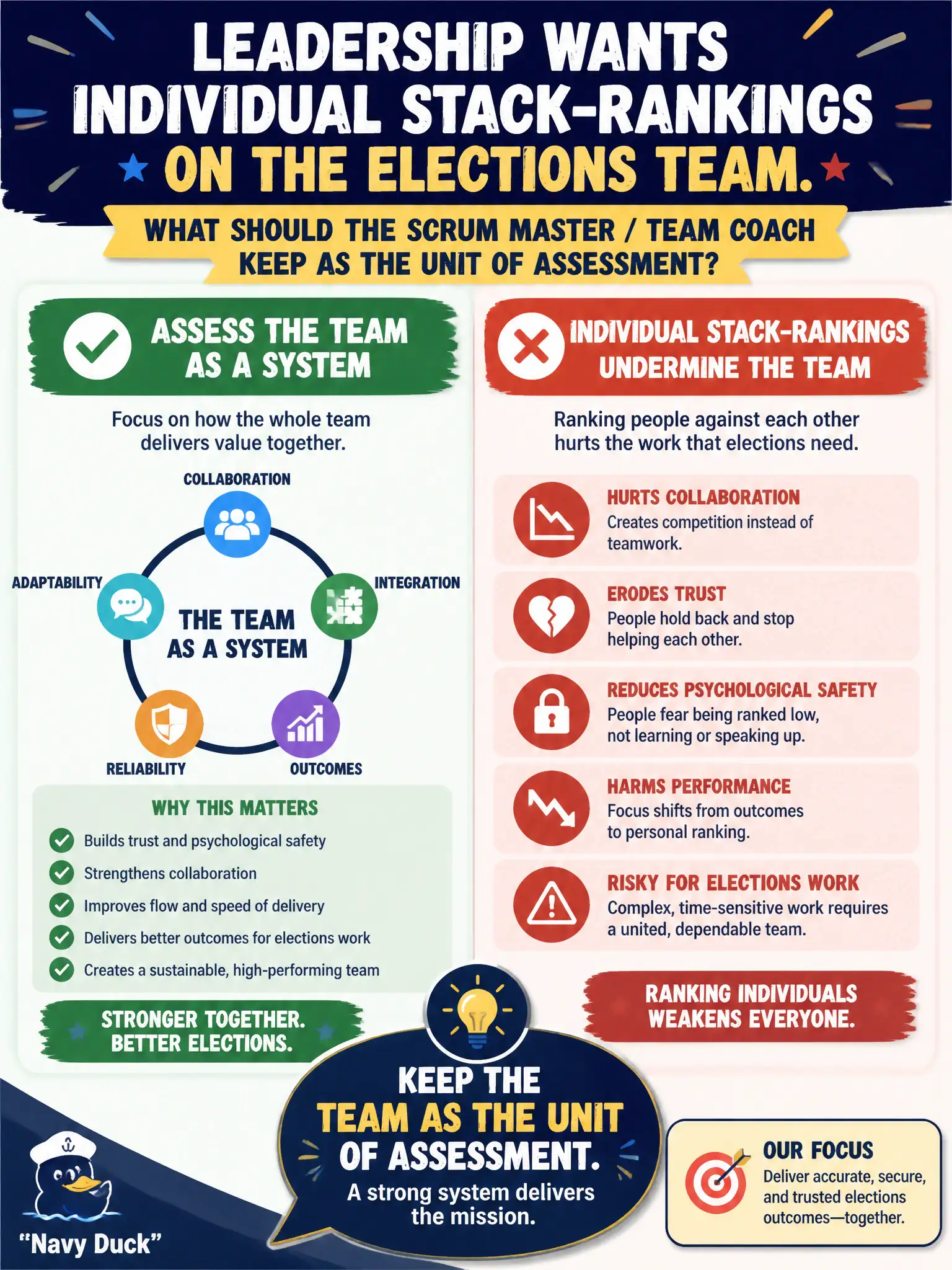
Leadership wants individual stack-rankings on the elections team. What should the Scrum Master / Team Coach keep as the unit of assessment?
Select an answer to reveal the explanation.
Short Explanation
Stack-ranking election workers is grading a relay team by who held the baton longest. The result is hoarding, not a certified count. Assess the team that has to pass work, not a leaderboard of names.
Full Explanation
Leadership requests for individual stack-rankings on an elections team should be met by keeping the team as the unit of assessment; individual stack-rankings undermine the collaboration elections work needs. Vote systems succeed through shared ownership of quality, security, and handoffs; ranking people against each other teaches hoarding, blame, and quiet refusal to help peers. Publishing a public stack-rank turns collaboration into a contest visible to the whole civic workplace. Tying each person's rank to stories they personally closed incentivizes thin slicing of credit rather than whole-increment delivery of election-ready software. Asking HR to stack-rank during PI Planning conflates planning with appraisal and poisons the candor planning requires. Exam caveat: SASM assesses high-performing teams as systems; individual stack-rank and personal story-closure contests are anti-patterns for collaborative civic work and should not be smuggled in as "Agile performance." Operational check: redirect assessment conversations to team outcomes, flow, quality, and health measures for the elections team, decline to publish individual stack-ranks as Agile performance, and partner with leadership on team-level goals that still satisfy legitimate HR needs outside planning events. Protect PI Planning from appraisal theater and revisit the agreement before the next elections PI.