
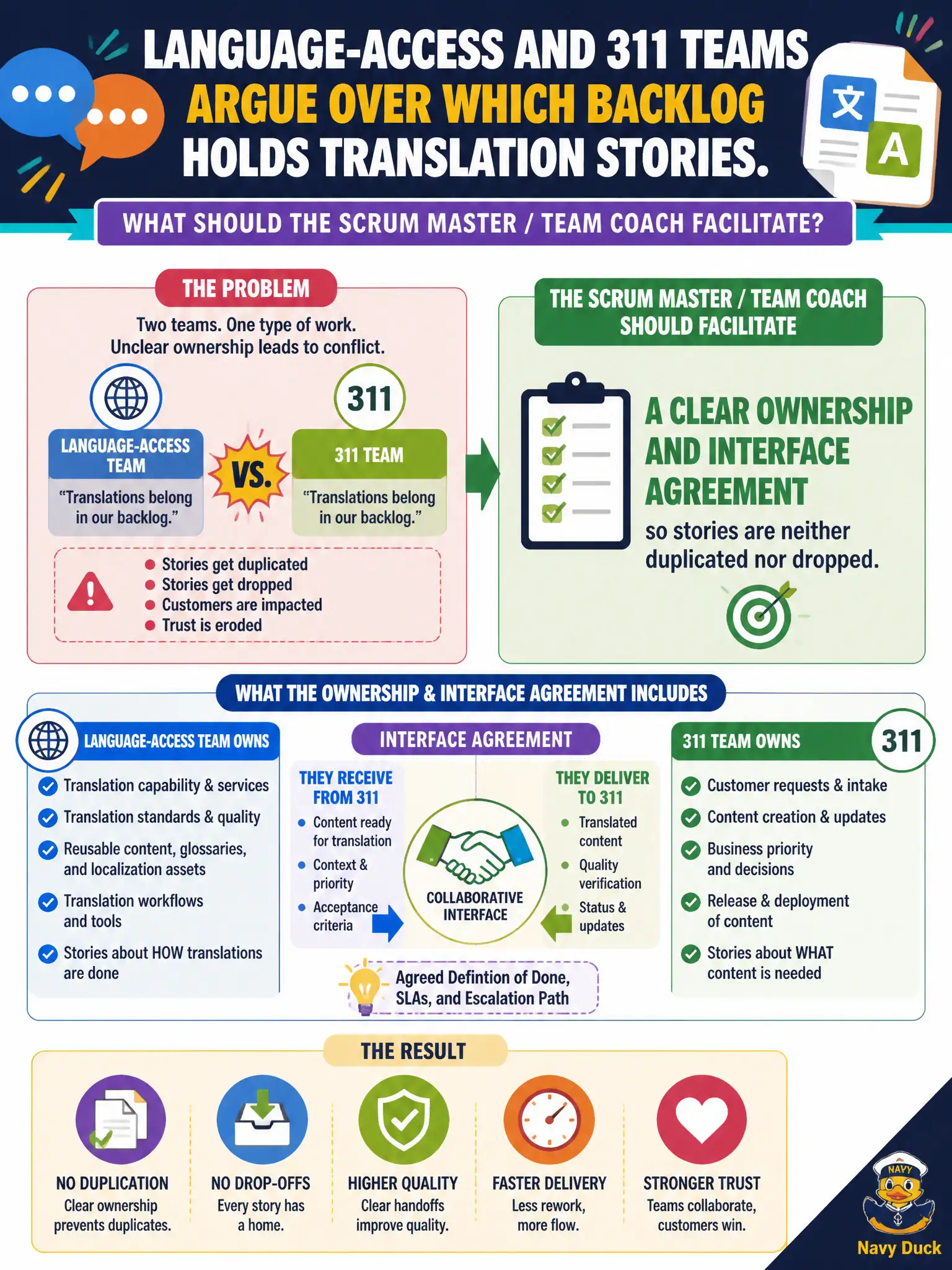
Language-access and 311 teams argue over which backlog holds translation stories. What should the Scrum Master / Team Coach facilitate?
Select an answer to reveal the explanation.
Short Explanation
Two backlogs claiming the same translation story is a lost-and-found with two windows and no clerk. Name who owns what, how the other team asks, and how residents still get the language. Turf wars drop work; dual copies hide it.
Full Explanation
When language-access and 311 teams argue over which backlog holds translation stories, the Scrum Master / Team Coach should facilitate a clear ownership and interface agreement so stories are neither duplicated nor dropped. Residents who need translated 311 guidance experience one service; unclear ownership creates gaps and twin work. Putting every translation story on both backlogs "so nothing is missed" doubles WIP and still fails to clarify who finishes the work. Awarding the entire translation backlog to the louder Product Owner as a turf prize resolves conflict through politics rather than service design. Moving translation work to a predictive change-control board outside both teams abandons Agile team ownership for a handoff model that slows civic language access. Exam caveat: SASM coaches clear cross-team ownership and interfaces for shared work; duplication on both backlogs, volume-based PO victories, and predictive boards as default are wrong concepts. Operational check: facilitate an ownership map for translation request types, define the interface (who writes, who reviews, how 311 requests language-access help), update both backlogs accordingly, and verify for two iterations that no translation story is silently duplicated or orphaned. Publish the agreement where both municipal teams and Product Owners can see it during refinement.