
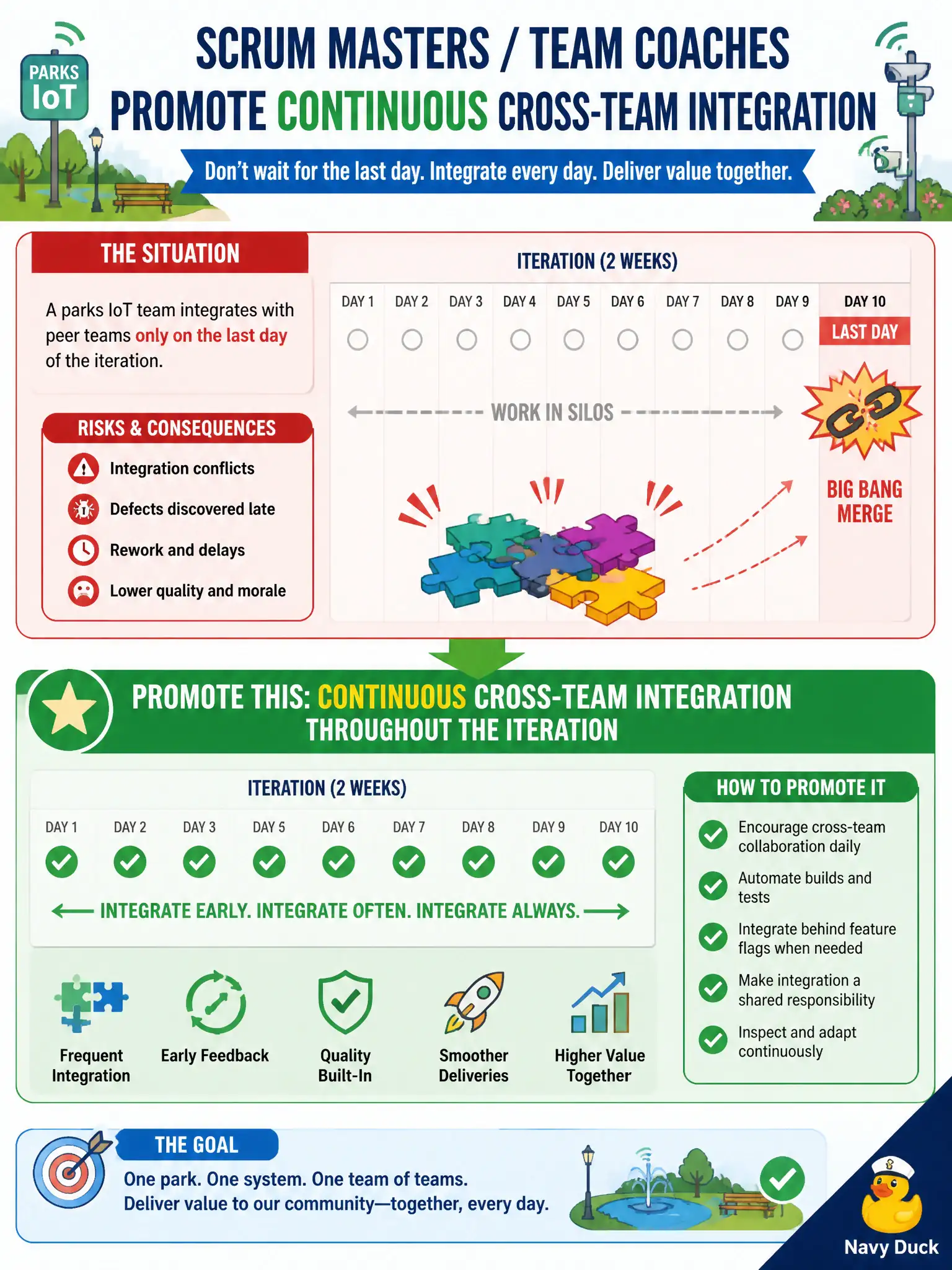
A parks IoT team integrates with peer teams only on the last day of the iteration. What should the Scrum Master / Team Coach promote?
Select an answer to reveal the explanation.
Short Explanation
Integrating on the last day is taping the fountain sensors together the morning of the ribbon cutting. Parks IoT and its neighbors should merge while there is still time to learn. Last-day glue is a demo stunt, not collaboration.
Full Explanation
A parks IoT team that integrates with peer teams only on the last day of the iteration should move to continuous cross-team integration throughout the iteration instead of a last-day merge. Late integration hides defects until demo pressure peaks and leaves no time to learn from sensor, gateway, or API mismatches that affect park operations. Keeping the last-day merge so each team can work in isolation until demo week optimizes for local comfort and against system learning. Integrating only at PI System Demo stretches the feedback loop across iterations and weakens iteration reviews. Branching IoT work until the next fiscal year to avoid merge conflict trades technical fear for long-lived divergence that will be harder and riskier to reconcile. Exam caveat: SASM and built-in quality practices favor frequent integration across teams; last-day merges, PI-only integration, and fiscal-year branching are anti-patterns. Operational check: establish at least a mid-iteration integration point (ideally daily or continuous) between parks IoT and dependent teams, track integration defects found before versus after the change, and confirm the System Demo no longer absorbs first-contact integration failures. Automate what can be automated so civic teams do not rely on hero merge days.