
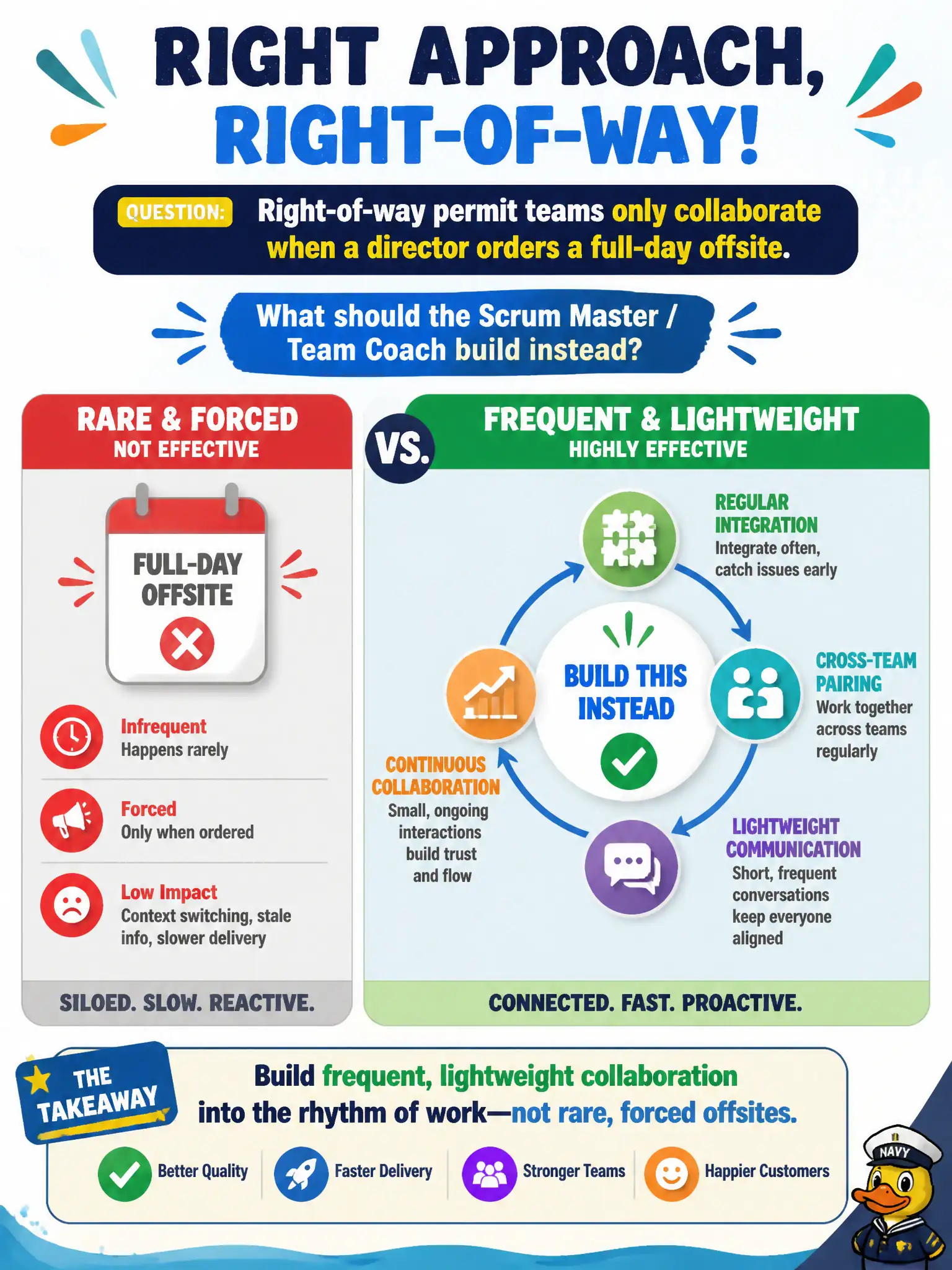
Right-of-way permit teams only collaborate when a director orders a full-day offsite. What should the Scrum Master / Team Coach build instead?
Select an answer to reveal the explanation.
Short Explanation
A once-a-year offsite is a family reunion that tries to replace weeknight dinners. Right-of-way work needs frequent, light touchpoints—integration and pairing—not a director-ordered retreat. Collaboration is a habit, not a catered day.
Full Explanation
Right-of-way permit teams that only collaborate when a director orders a full-day offsite need frequent, lightweight collaboration—regular integration and cross-team pairing—built by the Scrum Master / Team Coach instead of rare executive events. Permit flow depends on continuous handoffs among survey, engineering, and permitting perspectives; annual theater cannot replace iteration-level integration. Waiting for the next annual offsite keeps collaboration as an executive spectacle and leaves week-to-week permit friction unaddressed. Adding a mandatory two-day summit every PI while canceling iteration-level integration simply relocates the heavy event and still skips daily collaboration muscle. Routing every permit question through the director's calendar makes the executive the collaboration channel and creates a bottleneck that slows resident projects. Exam caveat: SASM prefers frequent lightweight cross-team collaboration over rare forced offsites; do not confuse valuable PI events with eliminating iteration integration, and do not elevate directors into the default collaboration bus. Operational check: establish a recurring lightweight integration touchpoint and at least one pairing or joint refinement habit between right-of-way teams, track permit cycle time and blocked handoffs for two iterations, and confirm collaboration continues without a director-ordered offsite. Capture the lightweight cadence in team working agreements so it survives personnel changes.