
The RTE asks every Scrum Master on the transit-fare ART to "just coordinate harder" so dependencies stop slipping. What should the Scrum Master / Team Coach prefer?
Select an answer to reveal the explanation.
Short Explanation
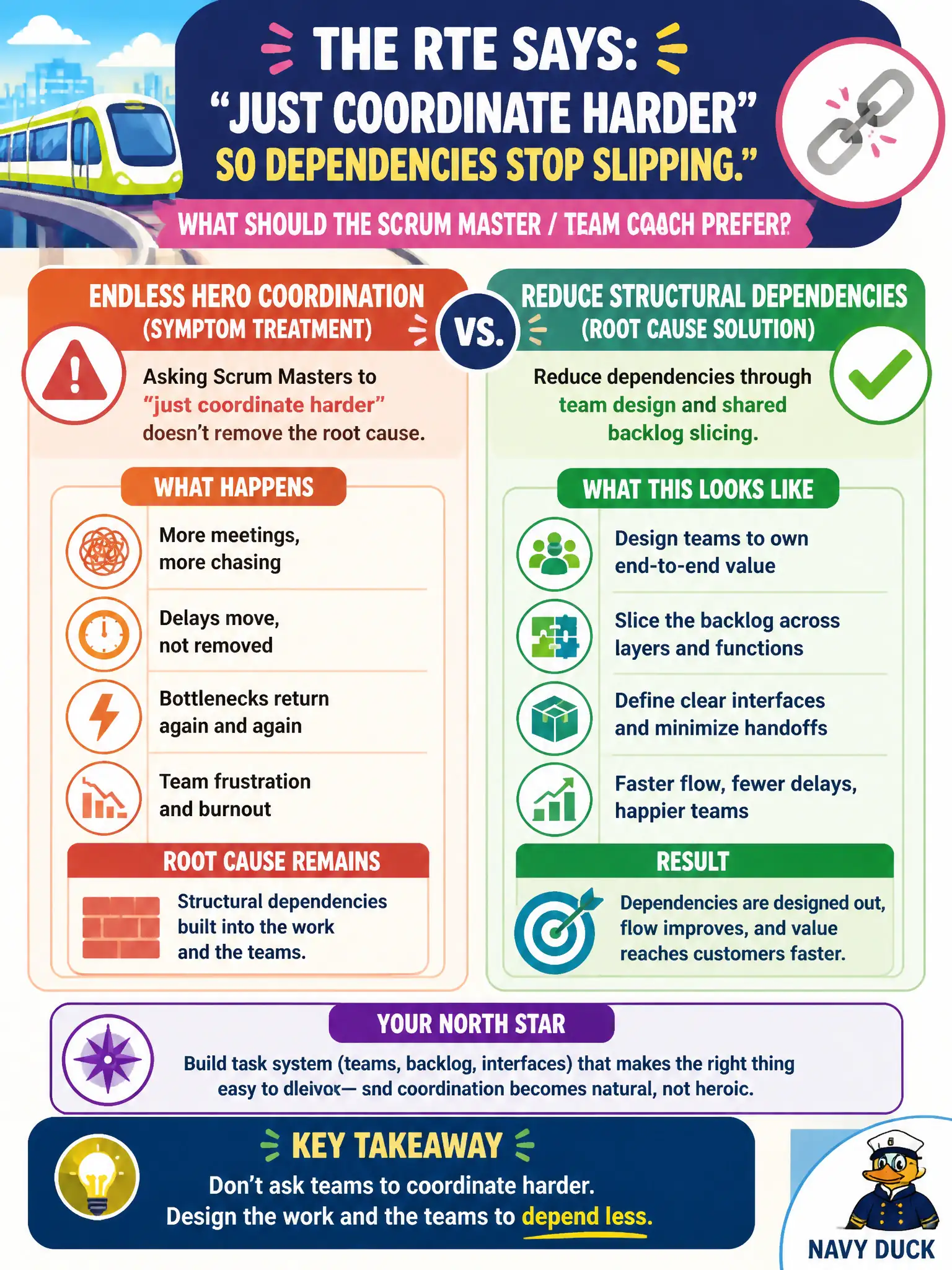
Telling coaches to "coordinate harder" is asking more traffic cops onto a jammed interchange. Transit-fare work gets faster when fewer lanes have to merge—better team design and slicing, not more radios. Hero coordination is a symptom, not a strategy.
Full Explanation
High-performing multi-team collaboration on a transit-fare ART improves when the dependency graph shrinks, not only when people coordinate more heroically. The Scrum Master / Team Coach should prefer team design and shared backlog slicing that let a team deliver a resident fare outcome with fewer handoffs. "Coordinate harder" without structural change adds meetings and personal heroics while the same fare stories still bounce between teams. A daily all-hands coordination call that verbally hands every story twice substitutes meeting load for design and crowds out real iteration work. Appointing the coach as permanent dependency secretary who tracks every handshake in a spreadsheet centralizes knowledge in one person and recreates the bottleneck the train already has. Freezing the fare product until the next fiscal year removes coordination pain by stopping resident value, which is delay disguised as flow management. Exam caveat: SASM coaches still participate in ART coordination, but prefer fewer structural dependencies over infinite coordination theater; this is not an invitation to cancel ART Sync or to invent fiscal freezes as dependency strategy. Operational check: map the top slipping fare dependencies, redesign a slice so one team can complete a thin resident outcome end-to-end, reduce one recurring handshake in the next PI Planning board, and confirm slip rate falls without adding another standing all-hands. Document the structural change so other civic coaches can reuse the slicing pattern.