
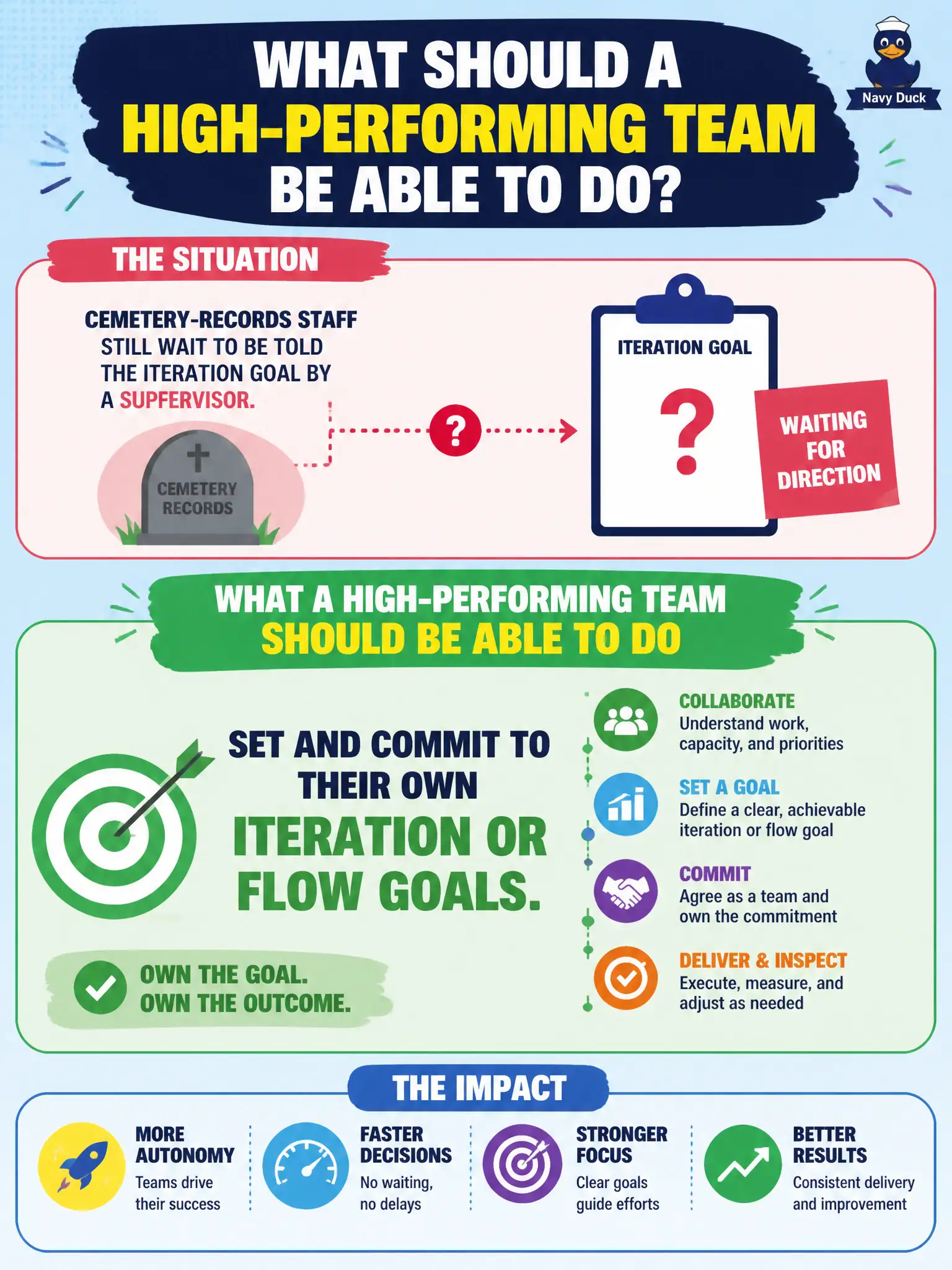
Cemetery-records staff still wait to be told the iteration goal by a supervisor. What should a high-performing team be able to do?
Select an answer to reveal the explanation.
Short Explanation
If cemetery-records staff wait for a supervisor to name the goal, they are a waiting room, not a team. High-performing teams write the destination on the whiteboard themselves and then walk toward it. Oldest ticket is not a goal.
Full Explanation
High-performing teams set and commit to their own iteration or flow goals. Cemetery-records staff who still wait for a supervisor to announce the iteration goal remain a directed group, not a performing team. The Scrum Master/Team Coach should coach the team to craft goals aligned to PI Objectives and Product Owner priorities so ownership and focus sit with the people doing civic records work.
Remaining a directed group that receives goals after planning starts fails by concept: late assigned goals undermine commitment. Skipping goals and pulling whatever ticket is oldest fails by concept by abandoning shared purpose. Asking program leadership to write the team’s iteration goal each cycle fails by concept because it externalizes ownership the team should hold.
Exam caveat: SAFe iterations/flow planning includes team-owned goals that create alignment and focus; supervisor-authored goals every cycle are a self-management anti-pattern. Goals still align upward—they are not invented in isolation from cemetery-records stakeholders.
Operational check: facilitate the team writing its next iteration/flow goal during planning, confirm supervisor supports rather than dictates, visualize the goal on the board, and review goal attainment at Iteration Review.