
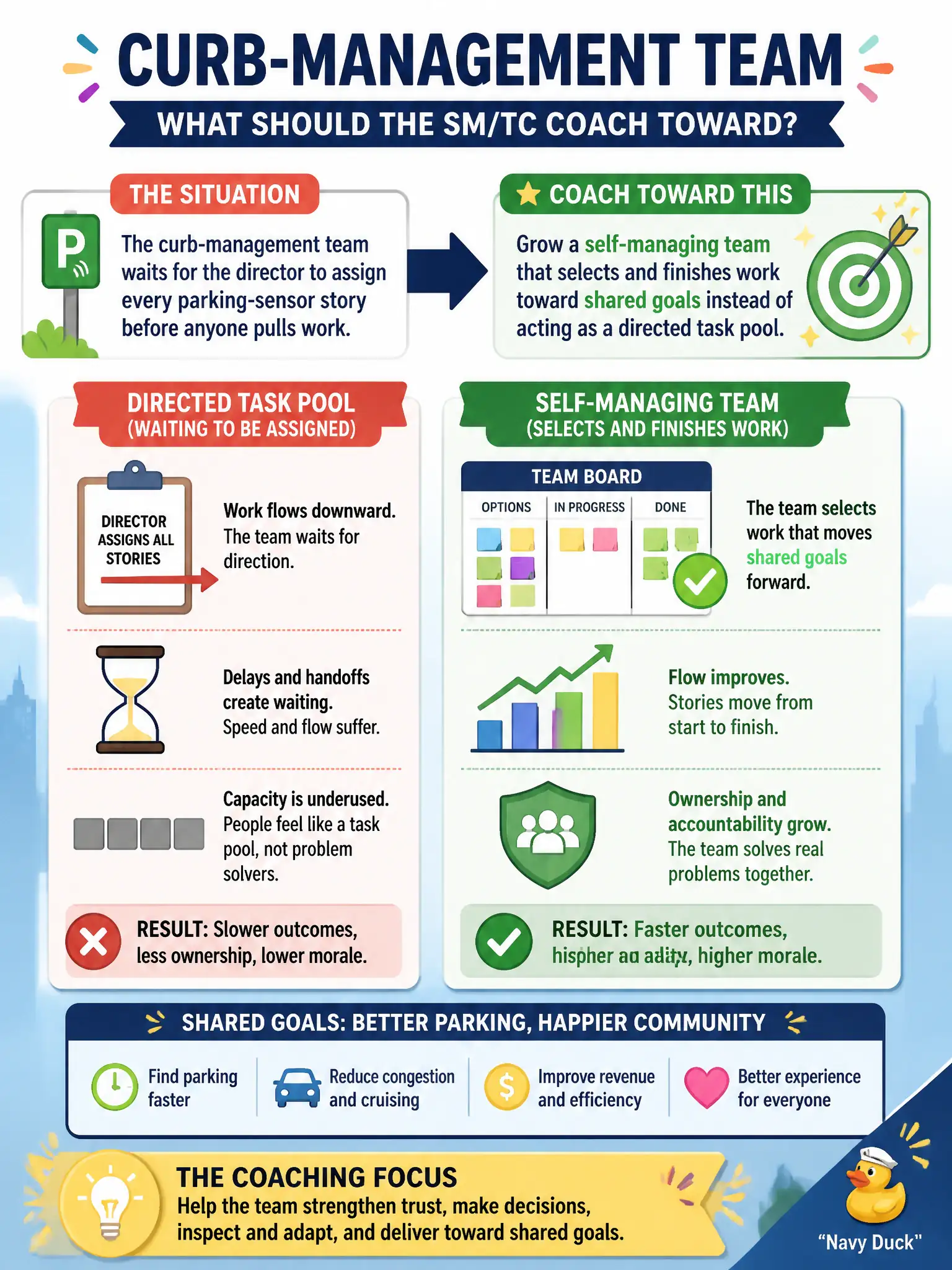
The curb-management team waits for the director to assign every parking-sensor story before anyone pulls work. What characteristic of a high-performing team should the SM/TC coach toward?
Select an answer to reveal the explanation.
Short Explanation
A team that waits for the director to deal parking-sensor cards is a checkout line, not a crew. High-performing teams pick up the next valuable slice themselves. Hand the deck to the team and let them manage the work.
Full Explanation
High-performing SAFe teams are self-managing: they select and finish work toward shared goals rather than acting as a directed task pool. When the curb-management team waits for the director to assign every parking-sensor story, autonomy and pull-based flow die. The Scrum Master/Team Coach should grow self-management so the team pulls sensor work aligned to objectives instead of waiting for org-chart dispatch on civic curb operations.
Keeping director assignment so accountability stays on the org chart fails by concept: hierarchical tasking preserves dependency and slows response to field conditions. Creating a dispatcher role that parcels stories each morning fails by concept by inserting another assignment bottleneck. Splitting into individual work queues owned by the director fails by concept because it fragments the team into a directed resource pool and destroys swarming.
Exam caveat: SAFe high-performing team characteristics emphasize self-management and shared goals; servant leadership enables that autonomy rather than substituting for it. Self-management still aligns to PI Objectives and Product Owner priorities—it is not random pull divorced from civic outcomes.
Operational check: stop director story assignment, facilitate team pull against clear goals for parking-sensor work, make WIP and goals visible, and verify the team finishes increments without daily assignment from the director.