
After mapping interests, the solar-permit team still has no next experiment. What should the Scrum Master / Team Coach do?
Select an answer to reveal the explanation.
Short Explanation
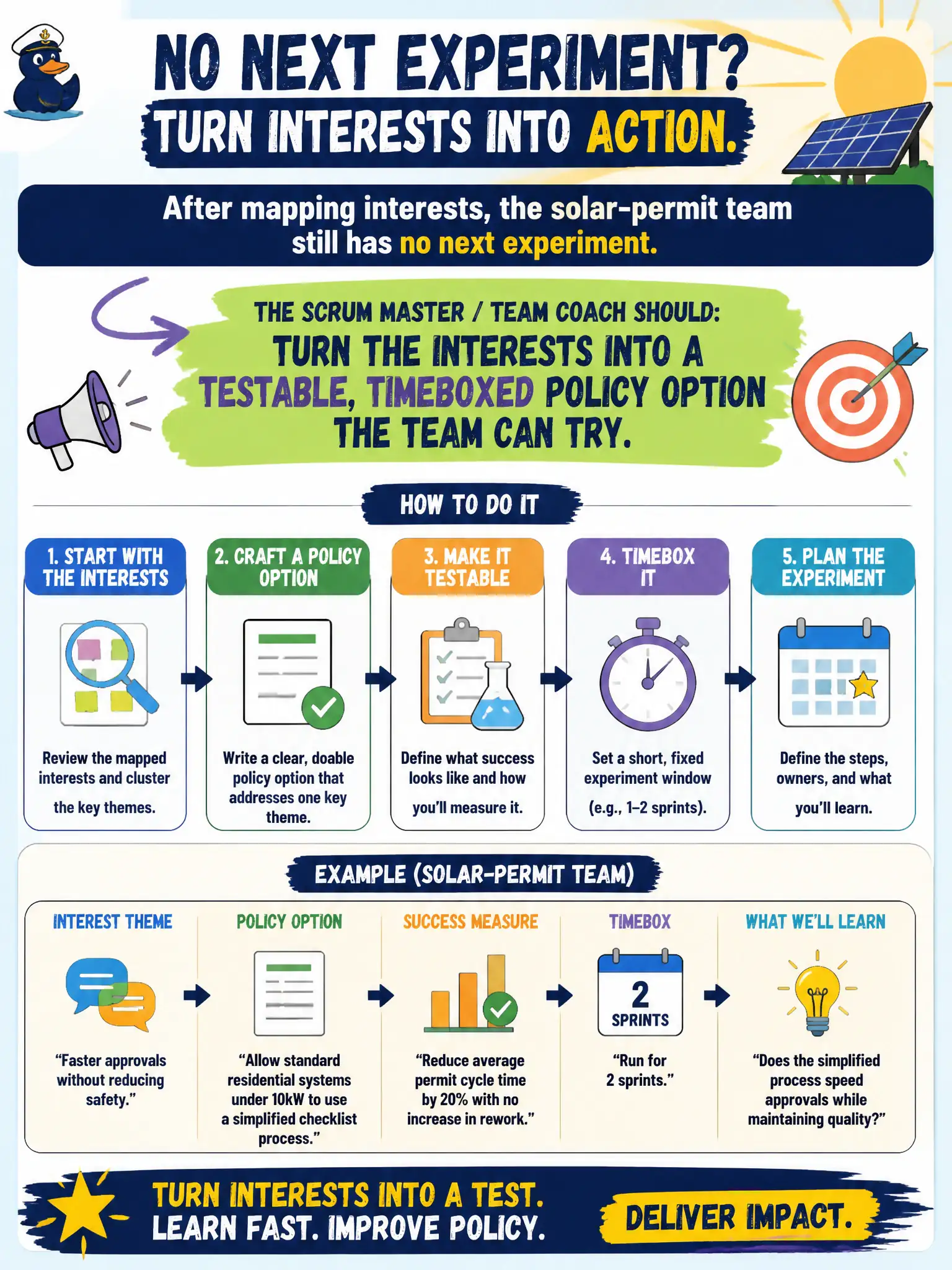
A beautiful map of needs that never leaves the wall is interior decorating. Solar-permit interests have to become a timeboxed try—a policy experiment with a review date. Posters do not issue permits.
Full Explanation
Interest-based problem-solving converts interests into options, including experiments. After mapping interests, when the solar-permit team still has no next experiment, the Scrum Master / Team Coach should turn the interests into a testable, timeboxed policy option the team can try. Mapping needs is incomplete until applicants and reviewers can inspect a concrete change—such as a completeness checklist trial or office-hour pilot—against solar-permit flow.
Framing the interest map as the deliverable and closing fails by concept: a map without options does not change permitting outcomes. Waiting for the next PI Planning so the RTE can invent the experiment fails by concept by delaying team ownership of a small test. Archiving interests as a poster and moving on to new stories fails by concept: it memorializes insight without operational learning.
Exam caveat: SASM expects interest work to lead to options and experiments, not artifacts alone; posters and deferred RTE invention are distractors. Large policy changes may need broader approval—the coach still pushes for a smallest testable step the solar-permit team can run soon.
Operational check: pick one interest cluster, design a timeboxed experiment with success metrics, secure any needed approvals, run it, inspect results with the team, and verify the interest map produces at least one live trial rather than ending as wall art.