
In SAS Viya, the SAS Event Stream Processing (ESP) engine is used to score a fraud detection model on streaming transaction data. Which model deployment format does ESP natively support for real-time scoring?
Select an answer to reveal the explanation.
Short Explanation
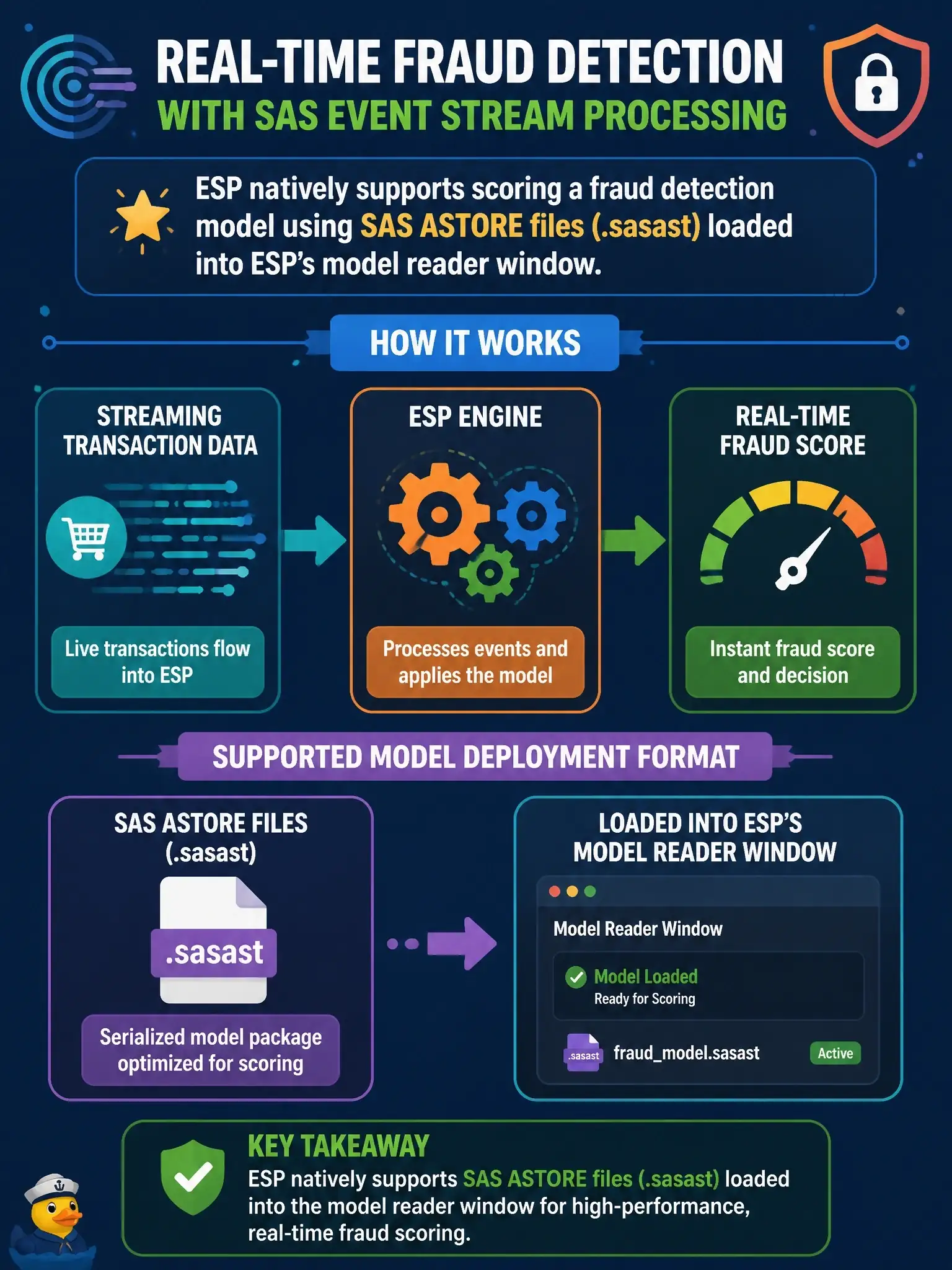
Here's the deal: ESP's native scoring path runs on the analytic store. You point a Model Reader window at a .sasast file, it hands the model to a Score window, and each transaction gets scored as it streams past. PMML files and Python pickles aren't formats that window loads natively.
Full Explanation
SAS Event Stream Processing scores streaming events with offline models that are trained elsewhere and loaded at run time. A Model Reader window receives a request that names the model type and the location of an analytic store (ASTORE) file, typically with a .sasast extension, and it publishes a model event to a Score window, which applies the model to each incoming transaction. The documented model types for this path are astore and recommender, with ONNX support added in newer releases, so an ASTORE produced by SAS Viya training is the native way to put a fraud model into a stream. The answer claiming both ASTORE and PMML is wrong because PMML is not a model type the Model Reader window accepts, and ESP does not document a built-in PMML scoring engine. The PMML-only answer fails for the same reason. The Python pickle answer is wrong because ESP does not load .pkl files as a native model format; Python logic runs through separate interfaces rather than as a Model Reader format. For the exam, remember the pairing of a Model Reader window and a Score window with an ASTORE reference. To verify a project, inspect its XML for a window-model-reader element with model-type set to astore and a reference to the .sasast file.