
A machine learning team applies partial dependence plots (PDPs) to interpret a random forest model's relationship between 'customer_tenure' and predicted churn probability. The PDP shows a non-monotone U-shaped curve. What does this indicate?
Select an answer to reveal the explanation.
Short Explanation
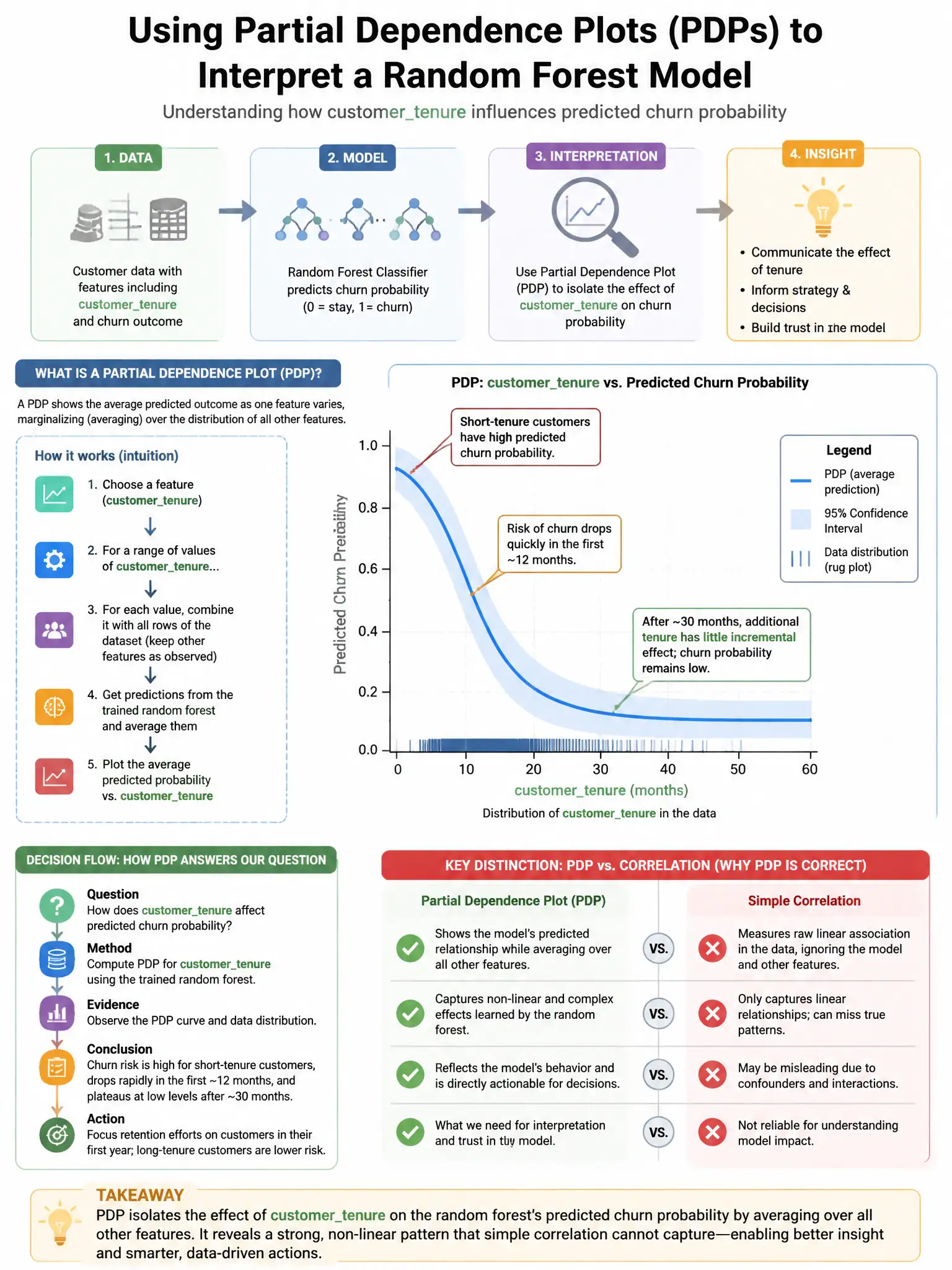
Here's the deal — the U-shaped partial dependence plot means you're seeing higher average predicted churn for both very short and very long tenure, with lower churn in the middle. That's a real non-monotone pattern, not a bug.
Full Explanation
The correct answer says customers with very short and very long tenure have higher average predicted churn than mid-tenure customers. A U-shaped partial dependence plot means the model's marginal effect of tenure on predicted churn is high at both extremes and lower in the middle, reflecting new customers still deciding and long-tenured customers becoming bored or churning. The claim that the model has a bug because random forests can only learn monotone feature effects is wrong; random forests can learn non-monotone effects. The claim that the plot is unreliable because random forests cannot model feature interactions is wrong; random forests can model interactions, and partial dependence plots marginalize over other variables while still showing average feature effects. The claim that the U-shape means tenure is not statistically significant is wrong; a non-monotone shape can reflect a genuine non-linear relationship.