
PROC DISCRIM is used to classify observations into predefined groups. Which assumption does Linear Discriminant Analysis (LDA) in PROC DISCRIM make that Quadratic Discriminant Analysis (QDA) does not?
Select an answer to reveal the explanation.
Short Explanation
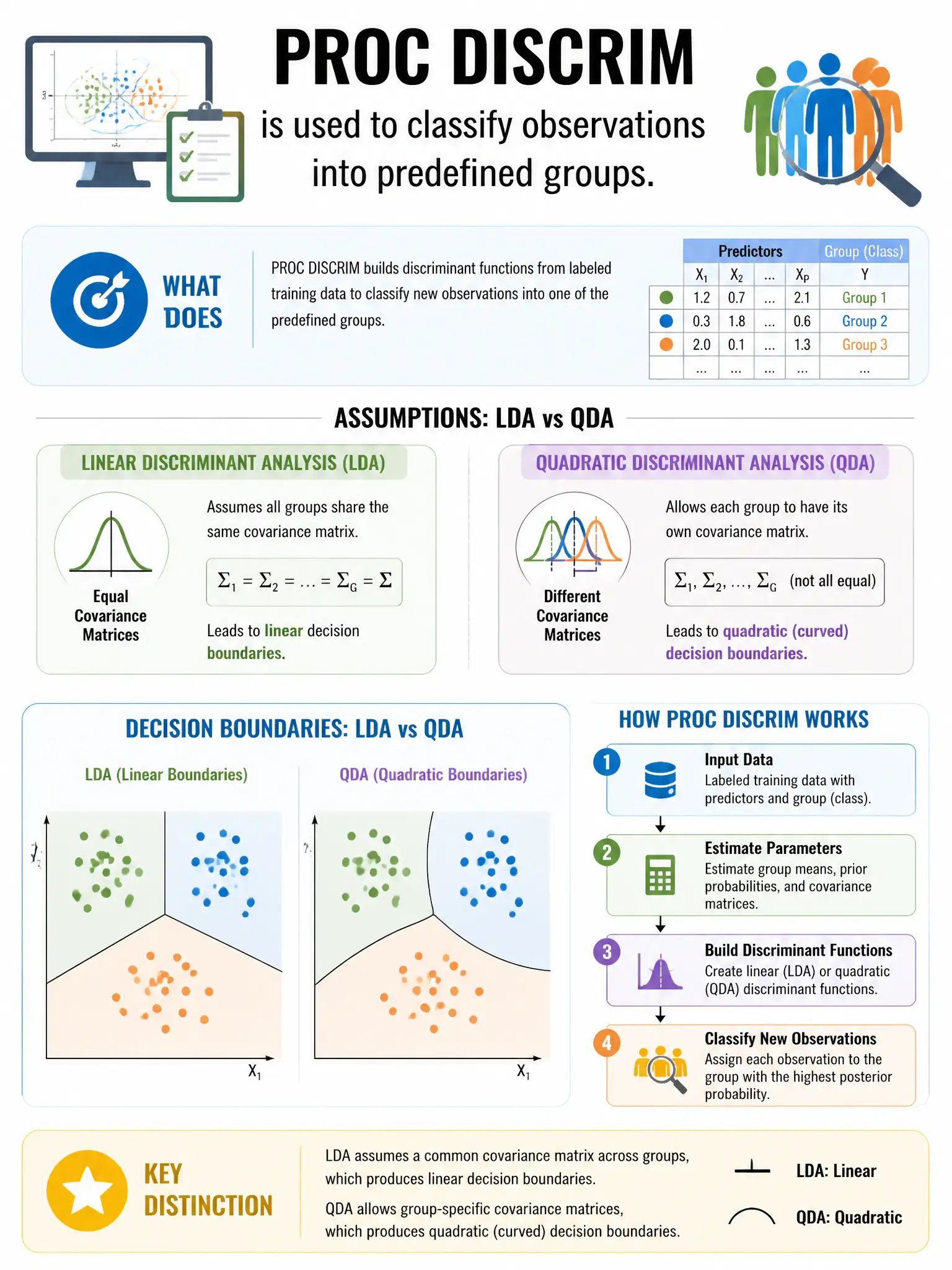
Here's the deal — LDA assumes all groups share the same within-group covariance matrix, so you get linear decision boundaries. QDA lets each group have its own covariance matrix, so you get quadratic boundaries.
Full Explanation
The correct assumption is that LDA assumes equal covariance matrices across all groups, also called homoscedasticity, while QDA allows each group to have its own covariance matrix. In PROC DISCRIM, LDA is the default pooled-covariance approach and produces linear decision boundaries, while QDA uses POOL=NO and produces quadratic decision boundaries. This makes LDA more parsimonious, but QDA more flexible. The option saying LDA assumes all group means are equal is wrong because LDA allows different group means; that difference is the basis for discrimination. The option saying LDA assumes multivariate normality while QDA allows non-normal distributions is wrong because both LDA and QDA assume multivariate normality. The option saying LDA requires more observations per group than QDA is wrong because QDA actually requires more observations to estimate separate covariance matrices for each group.