
A SAS analyst uses PROC SURVEYSELECT to create a stratified random sample. Why is stratified sampling preferred over simple random sampling when the population contains small but important subgroups?
Select an answer to reveal the explanation.
Short Explanation
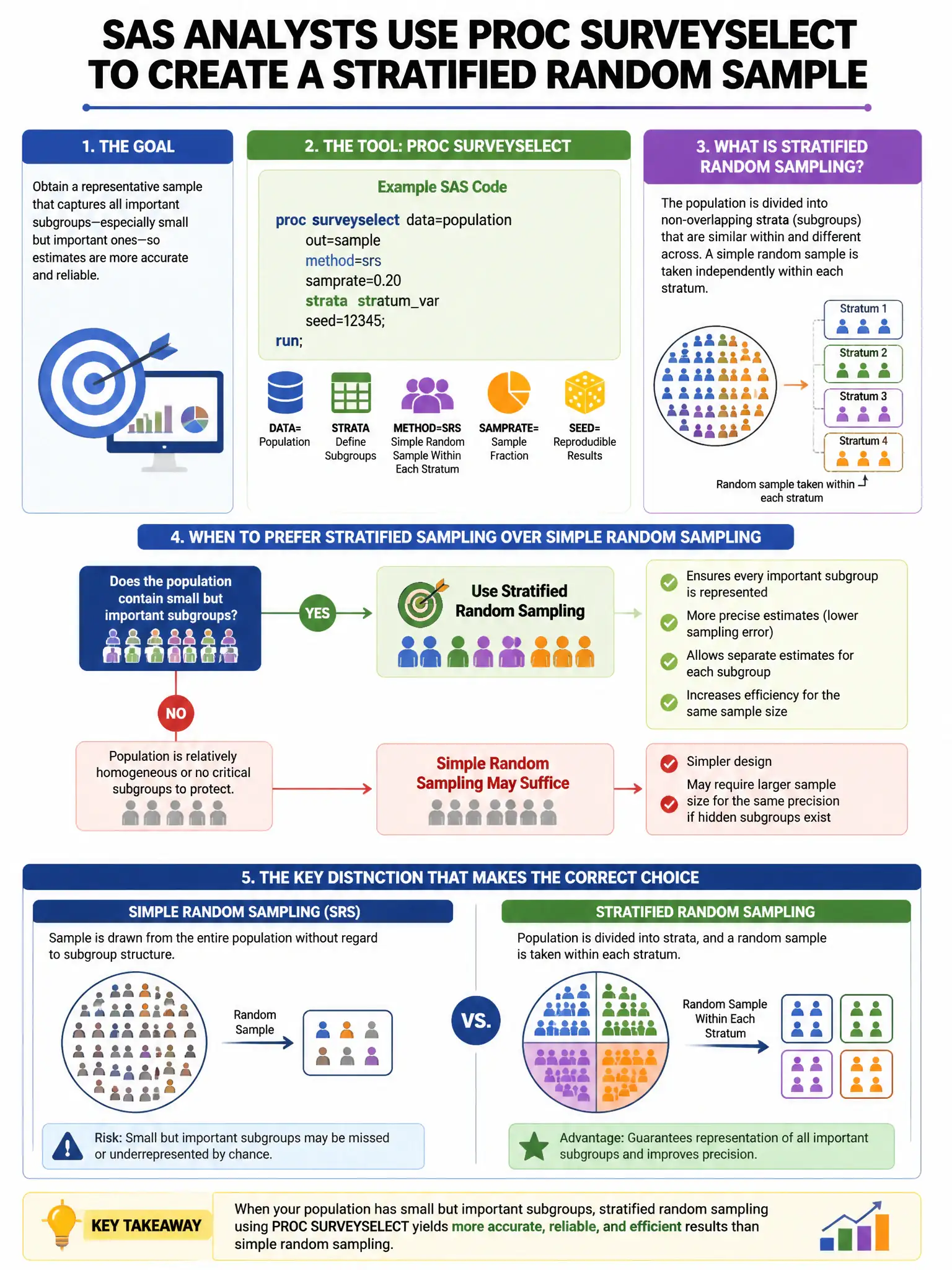
Here's the deal — stratified sampling is right because it samples within each stratum, so you guarantee representation for each group. Rare subgroups could have zero or very few observations under simple random sampling, making estimates for them unreliable.
Full Explanation
Stratified sampling is correct because it divides the population into strata and samples independently within each stratum, guaranteeing minimum representation for each group. Rare subgroups could have zero or very few observations under simple random sampling, making estimates for them unreliable. The claim that stratified sampling is faster to execute in SAS than simple random sampling is wrong; speed is not the advantage. The claim that stratified sampling removes the need for post-hoc weighting of survey estimates is wrong; stratified sampling may still require design-based weighting in analysis. The claim that stratified sampling ensures the sample mean exactly matches the population mean for all variables is wrong; stratification ensures stratum representation but does not guarantee exact population mean matching for all variables.