
A gradient boosting model is trained with SHRINKAGE=0.01 (low learning rate) and NTREES=500. A colleague trains the same model with SHRINKAGE=0.1 and NTREES=50. Assuming the same training dataset, what is the expected difference in model behavior?
Select an answer to reveal the explanation.
Short Explanation
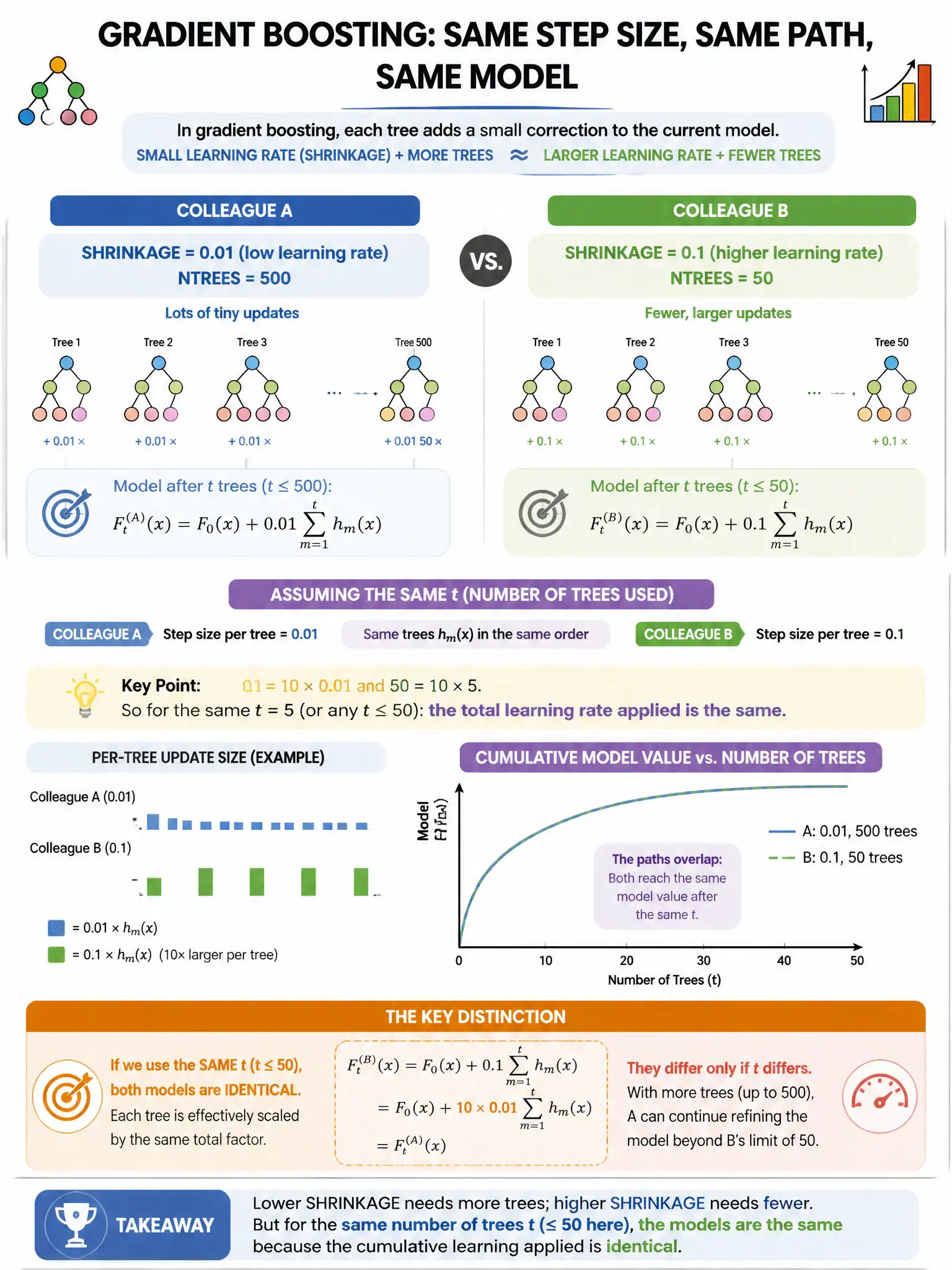
Here's the deal — you want the low-learning-rate model with 500 trees. Smaller shrinkage means each tree nudges the model slightly, so it needs more trees to catch up, but those gradual steps usually generalize better. The faster 0.1 model can overshoot the optimum.
Full Explanation
The correct behavior is that the low learning rate model with shrinkage 0.01 and 500 trees needs more trees to reach comparable training loss, but it tends to generalize better because each tree makes smaller, more regularized gradient steps. The high learning rate model with shrinkage 0.1 and 50 trees can converge faster, but it may overshoot the optimum or overfit if large steps are not controlled. The claim that the low learning rate model will have higher training error because each tree contributes minimally is wrong; with enough trees, small steps can still drive training error very low. The claim that both models will converge to identical predictions because the product of learning rate and tree count is the same is wrong; boosting updates interact non-linearly, so matching 0.01 times 500 to 0.1 times 50 does not make them equivalent. The claim that the high learning rate model will always outperform because fewer, more impactful trees reduce complexity is wrong; lower complexity does not guarantee better performance.