
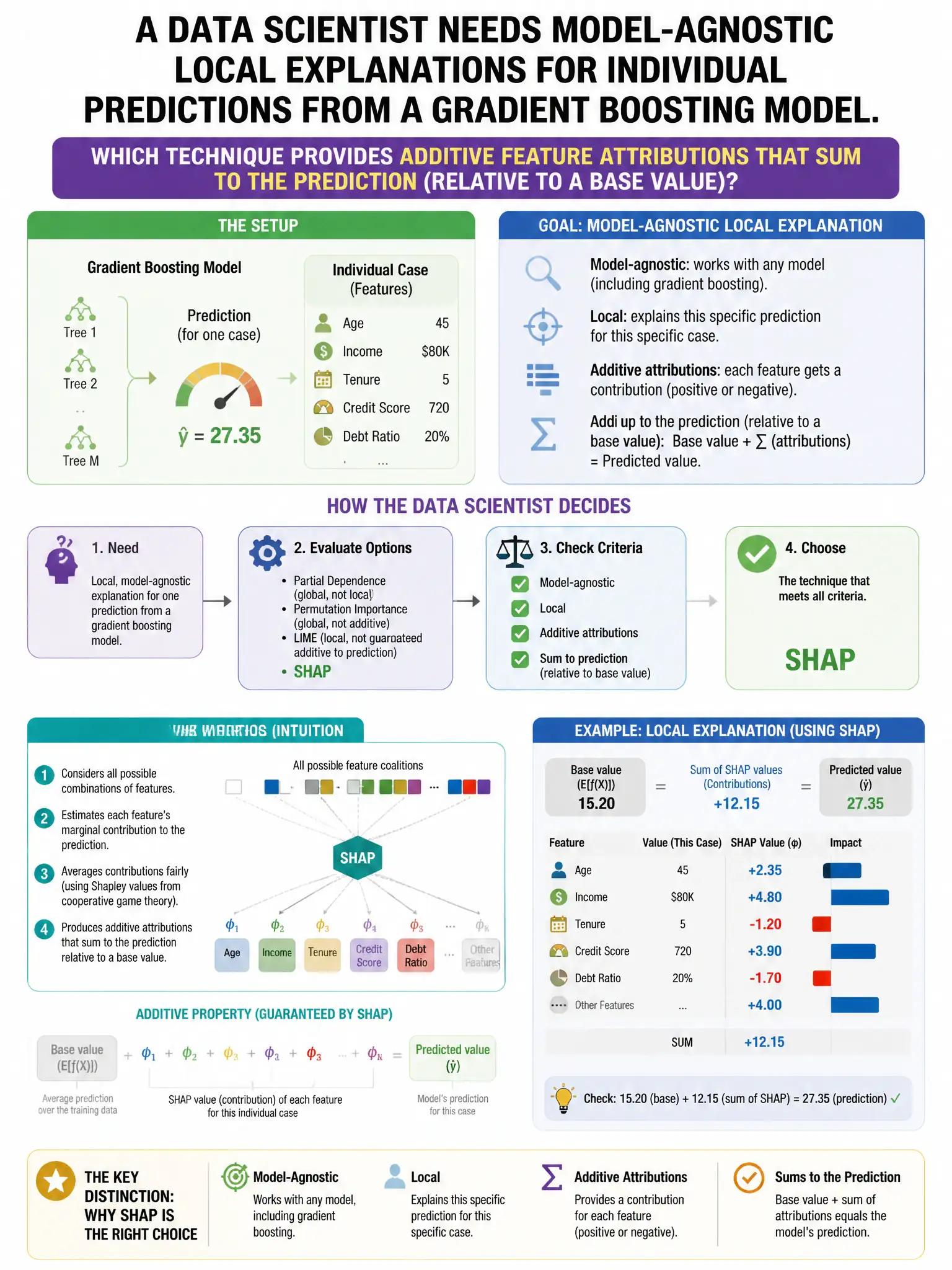
A data scientist needs model-agnostic local explanations for individual predictions from a gradient boosting model. Which technique provides additive feature attributions that sum to the difference between the model's output and the global expected output?
Select an answer to reveal the explanation.
Short Explanation
Here's the deal — you need SHAP values because they satisfy local accuracy, missingness, and consistency, and their feature contributions add up to the difference between the individual prediction and the global mean. PDPs, LIME, and split-gain importance don't provide that exact additive local explanation.
Full Explanation
SHAP values derived from cooperative game theory are correct because they satisfy three game-theory axioms (local accuracy, missingness, consistency) and guarantee that each feature's contribution sums to the difference between the individual prediction and the global mean prediction. Partial Dependence Plots showing average marginal feature effects across all training observations show global average effects, not individual explanations. LIME, which fits a local linear model around each prediction using perturbed samples, provides local linear approximations but does not sum to the exact prediction difference. Variable importance from the gradient boosting model based on split gain across all trees is a global metric, not a per-observation local explanation.