
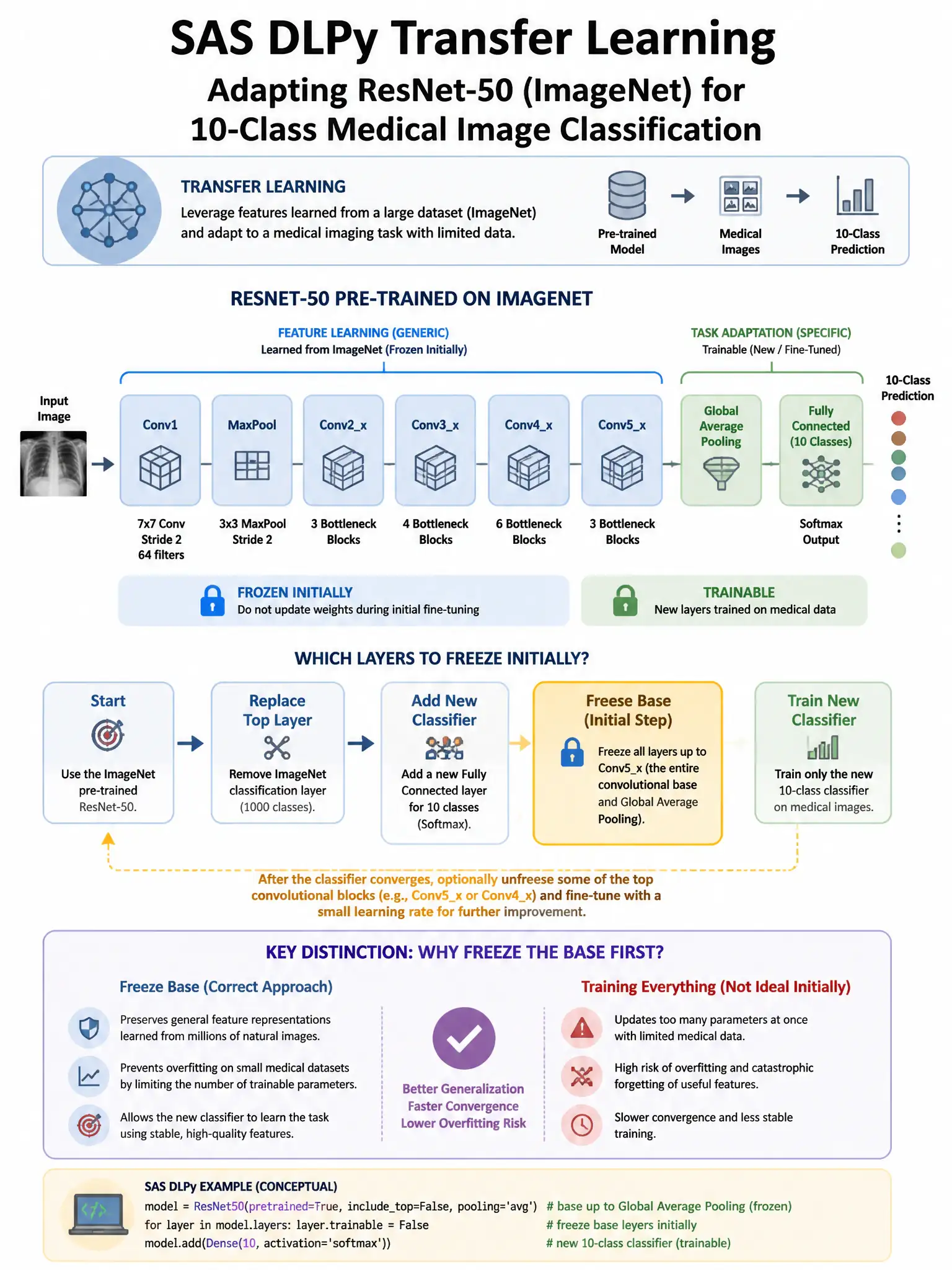
In SAS DLPy transfer learning, a ResNet-50 pre-trained on ImageNet is adapted for a 10-class medical image classification task. Which layers should initially be frozen during fine-tuning?
Select an answer to reveal the explanation.
Short Explanation
Here's the deal — you freeze the early convolutional layers because they capture general low-level features like edges and textures that transfer well. Then you train the later layers and the new output head so the model adapts to the 10-class medical image task without destroying useful pre-trained representations.
Full Explanation
The correct choice is to freeze the early convolutional layers that capture general low-level features like edges and textures, while training the later layers and the new output head. Early CNN layers learn general, transferable features useful across many image domains, so freezing them preserves those representations while allowing the task-specific parts to adapt to medical imaging. Freezing only the final classification output layer while allowing early convolutional layers to adapt is wrong because it defeats transfer learning by changing general feature extractors instead of the classifier. Freezing all layers including the new output layer, updating only bias terms, is wrong because it prevents meaningful learning. Freezing no layers and fully retraining from ImageNet weights is wrong because it discards the benefit of pre-trained features.