
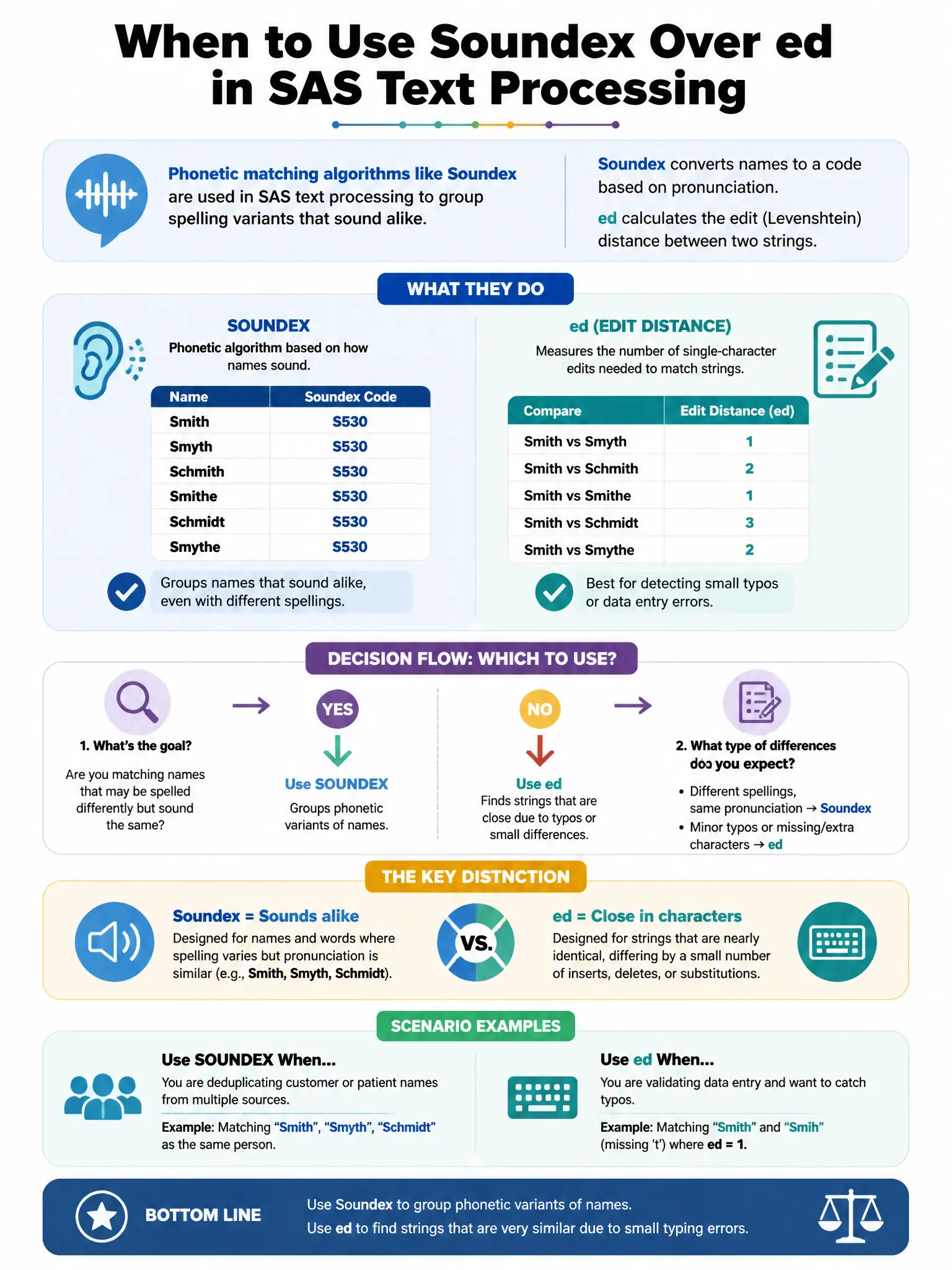
Phonetic matching algorithms like Soundex are used in SAS text processing to group spelling variants. Which scenario best illustrates when Soundex would be more appropriate than edit distance (Levenshtein)?
Select an answer to reveal the explanation.
Short Explanation
Here's the deal — Soundex is your go-to when you need to group surname variants like 'Jonson', 'Johnson', and 'Johnsen' because it encodes phonetic consonant patterns, not exact spelling. You use it when the same person's name is spelled differently across records but sounds the same.
Full Explanation
Soundex is more appropriate than edit distance when grouping variants that sound alike but may be spelled differently, especially surnames. It encodes phonetic consonant patterns, so 'Jonson', 'Johnson', and 'Johnsen' can be treated as matching surname variants across records (they share Soundex code J525). Grouping 'color' and 'colour' is better handled by edit distance or synonym expansion because the difference is one character and reflects spelling variants, not phonetic name matching. Detecting 'teh' as a typo for 'the' based on single-character transposition is an edit-distance scenario, because Levenshtein measures character operations such as transpositions. Normalizing 'U.S.A.', 'USA', and 'United States' requires synonym expansion, not phonetic matching.