
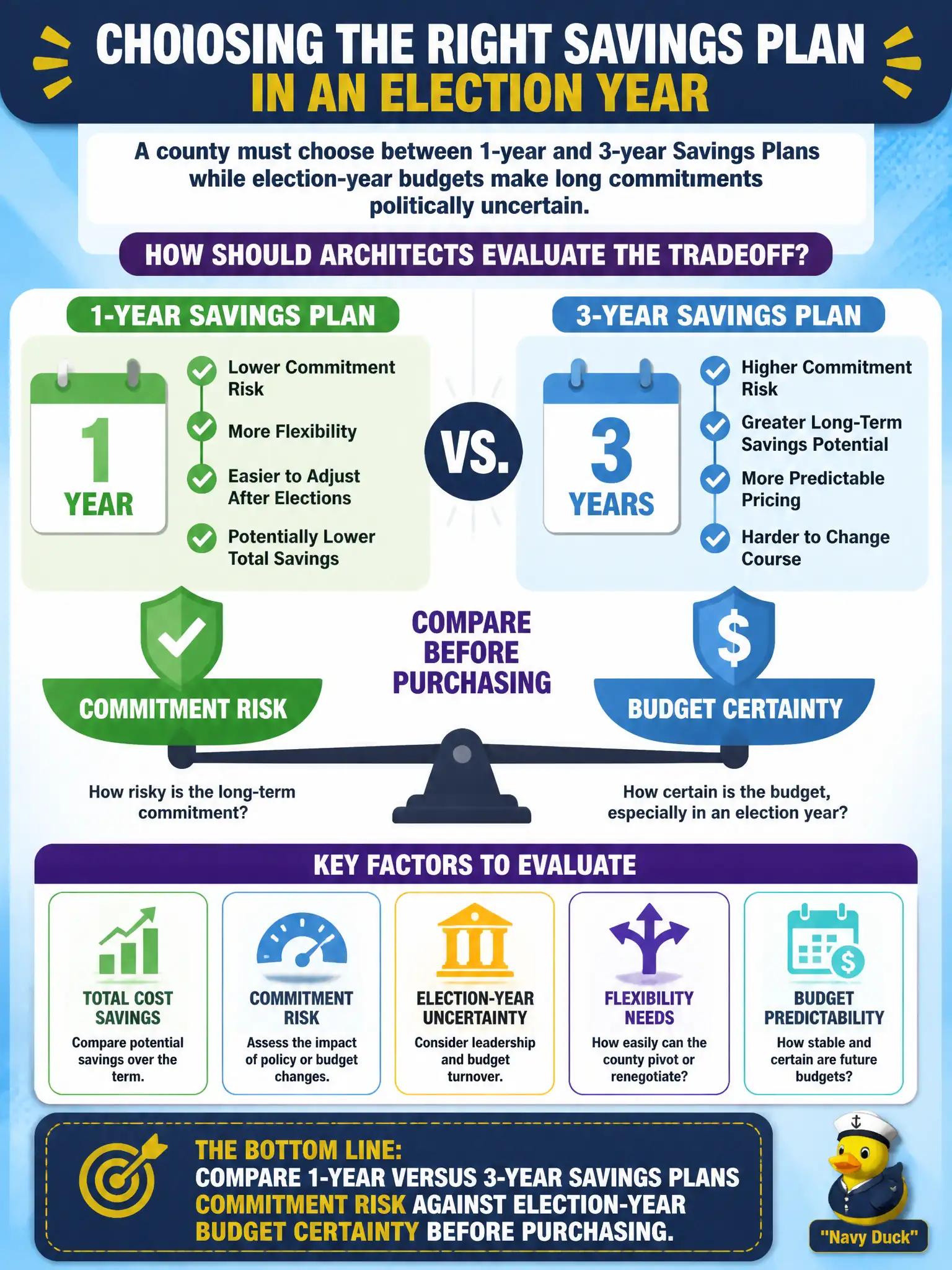
A county must choose between 1-year and 3-year Savings Plans while election-year budgets make long commitments politically uncertain. How should architects evaluate the tradeoff?
Select an answer to reveal the explanation.
Short Explanation
A three-year gym membership looks cheap until the budget committee changes after an election. Weigh the deeper 3-year Savings Plans discount against 1-year flexibility when funding certainty is shaky.
Full Explanation
A county choosing between 1-year and 3-year Savings Plans amid election-year budget uncertainty should explicitly compare commitment risk against funding certainty before purchasing. Longer terms usually deepen the discount but lock the municipality into a commitment that may outlast council priorities, program sunsets, or post-election budget cuts. Architects should model coverage from steady workloads, present the flexibility-versus-savings tradeoff to finance, and select the term that matches how certain the ratepayer IT budget will remain.
Always buying the longest commitment with no regard for budget risk maximizes discount optics while ignoring political and fiscal change—poor governance for public money. Avoiding all Savings Plans forever and paying pure On-Demand for steady workloads forgoes reliable savings on known baselines. Treating 1-year and 3-year terms as identical because discounts never differ is incorrect; term length and discount depth differ and must be evaluated.
Exam caveat: SAP-C02 cost questions reward matching commitment length to workload and budget stability, not reflexive maximum term or reflexive On-Demand. Operational check: quantify steady-state eligible usage, run Pricing Calculator or SP recommendations for 1-year versus 3-year, document election-year budget risk in the purchase memo, buy the term leadership accepts, and review coverage quarterly after the election cycle.