
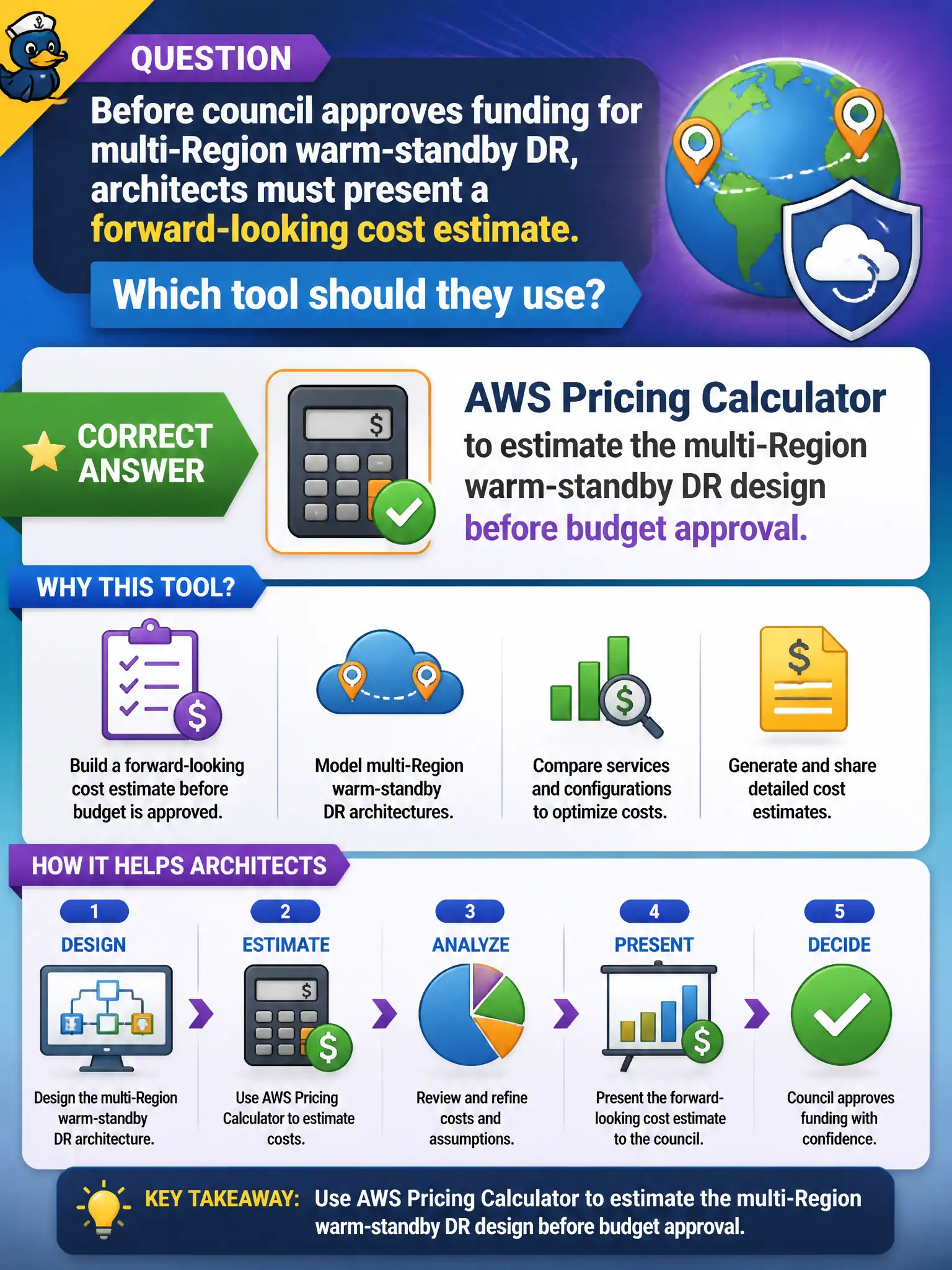
Before council approves funding for multi-Region warm-standby DR, architects must present a forward-looking cost estimate. Which tool should they use?
Select an answer to reveal the explanation.
Short Explanation
Council will not green-light a second firehouse without a construction estimate. Pricing Calculator lets you model the warm-standby DR bill before the budget vote.
Full Explanation
Before council approves funding for multi-Region warm-standby disaster recovery, architects must present a forward-looking cost estimate that reflects the proposed design—not last year's unrelated spend. AWS Pricing Calculator lets teams model compute, storage, databases, data transfer, and warm-standby assumptions for the secondary Region so elected officials and finance see a service-level estimate tied to the actual DR architecture. That estimate is the professional input to the budget vote for citizen-facing continuity investments.
Production CloudWatch alarms alone without any pricing model detect operational events; they do not price a future multi-Region design. Using only historical CUR from last year with no DR architecture modeled reports past run-rate and cannot capture new standby capacity, replication, or cross-Region transfer. Guessing a round number in the slide deck without service-level inputs fails procurement and audit expectations for public funding decisions.
Exam caveat: Pricing Calculator is for prospective architecture cost; CUR and Cost Explorer govern actuals after deployment—use both in sequence, not as substitutes. Operational check: enter warm-standby resources and transfer assumptions into Pricing Calculator, export the estimate for council materials, note confidence ranges for data transfer, and schedule a post-implementation CUR reconciliation once the DR stack exists.