
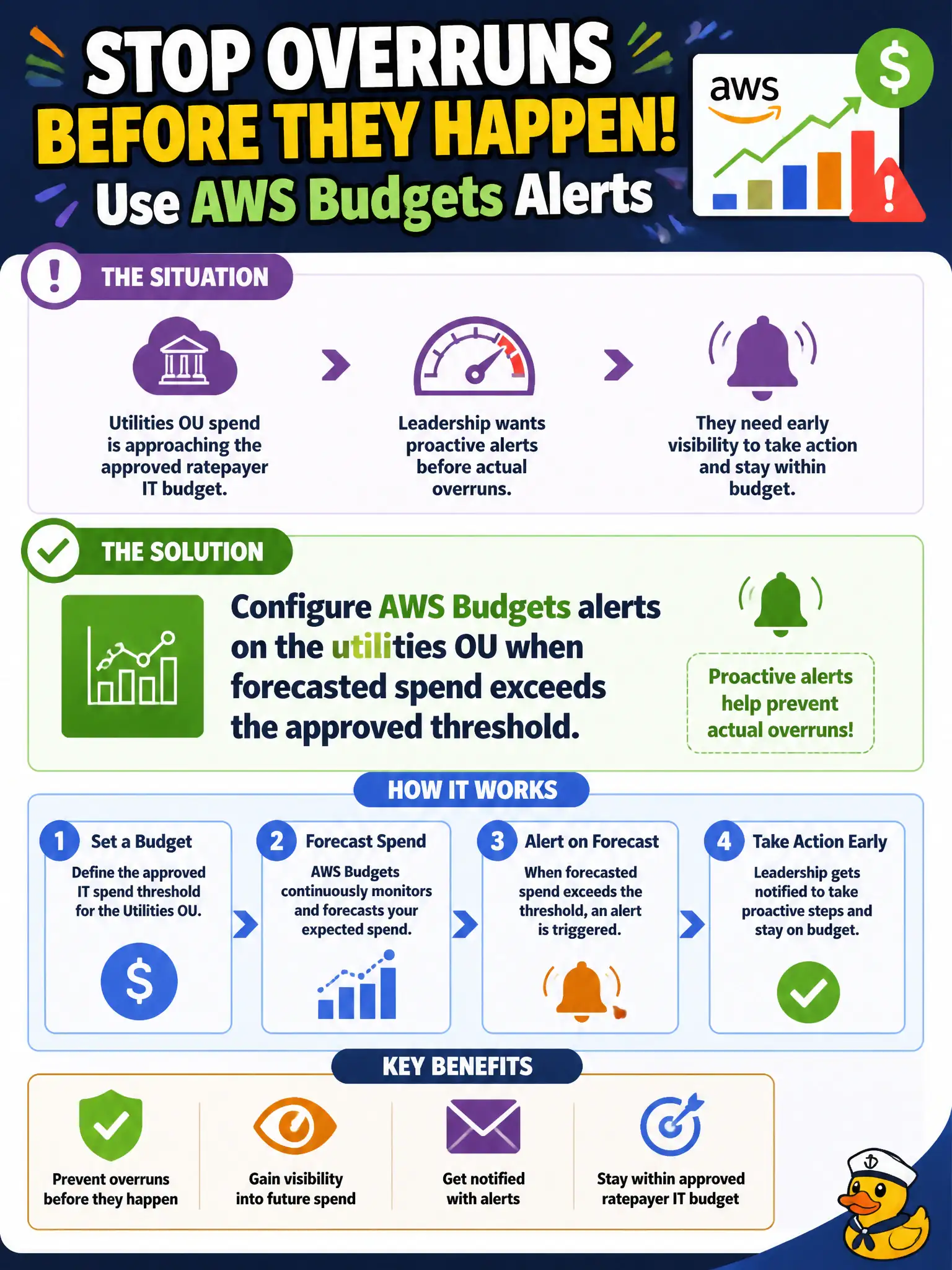
Utilities OU spend is approaching the approved ratepayer IT budget. Leadership wants proactive alerts before actual overruns. Which AWS capability should they use?
Select an answer to reveal the explanation.
Short Explanation
Ratepayers hate surprise overages the same way households hate a surprise water bill. AWS Budgets watches the utilities OU forecast and pings when spend is headed past the approved line.
Full Explanation
When utilities OU spend approaches the approved ratepayer IT budget, leadership needs proactive alerts before actual overruns—not a surprise after the month closes. Configure AWS Budgets with cost or usage budgets scoped to the utilities OU's linked accounts, and set alert thresholds on forecasted spend so finance and architecture can throttle experiments, rightsizing, or purchase coverage while there is still time to act. Forecast-aware budgets are the governed AWS capability that matches proactive municipal budget control.
Waiting for the final monthly invoice with no forecasts guarantees after-the-fact discovery when corrective options are limited. Turning off consolidated billing so OU spend cannot be measured removes the aggregation path that makes OU-level budgets practical. Using only handwritten sticky notes on the NOC wall as the budget system lacks durable thresholds, auditability, and automated notification to stakeholders.
Exam caveat: AWS Budgets can alert on actual or forecasted amounts and filter by account or other cost dimensions—choose forecast alerts when the requirement is "before overruns." Operational check: create a utilities-scoped budget at the approved threshold, enable SNS or email forecast alerts at 80% and 100%, simulate or wait for a forecast breach in a non-prod OU first, and confirm on-call and finance both receive the notification.