
City finance requires every AWS resource to map to a department and fund code so chargeback invoices are accurate. Which cost-visibility strategy should architects implement?
Select an answer to reveal the explanation.
Short Explanation
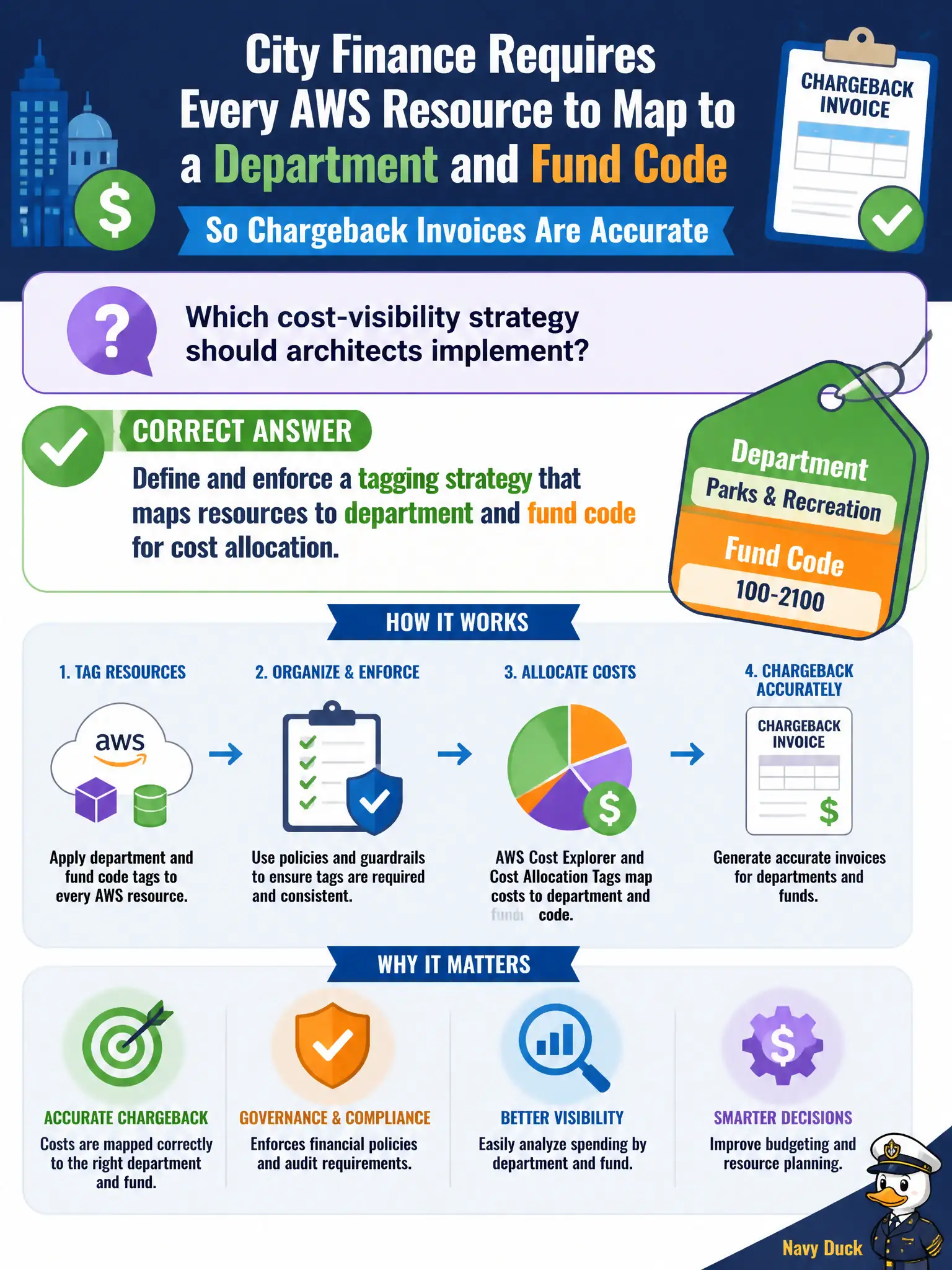
Chargeback is like labeling every tool in the city warehouse with shop and budget line. Department and fund-code tags — enforced — are how finance maps the AWS bill to real owners.
Full Explanation
City finance cannot issue accurate chargeback invoices unless every billable AWS resource carries stable dimensions that map to department and fund code. Architects should define a mandatory tagging strategy for those keys, activate them as cost allocation tags, and enforce the scheme with Service Control Policies, Config rules, or tag policies so Cost Explorer, CUR, and showback dashboards attribute spend to the real civic owners. Untagged or inconsistently tagged resources become opaque lines that finance cannot assign fairly across parks, courts, utilities, and other funds.
Forbidding tags so Cost Explorer stays empty of dimensions deliberately destroys allocation visibility and contradicts the finance office's requirement. Using only random instance Name tags without activating cost-allocation dimensions creates cosmetic labels that never become reportable cost axes. Allocating all spend to a single miscellaneous code regardless of owner collapses departmental accountability and makes ratepayer chargeback meaningless.
Exam caveat: a tagging policy without activation of cost allocation tags, or without enforcement that blocks untagged creates, will not produce reliable chargeback. Operational check: activate department and fund-code tags in Billing, sample Cost Explorer grouped by those tags for a known parks workload, confirm untagged spend trends toward zero after enforcement, and reconcile one invoice cycle against the departmental ledger before go-live.